
Temporary Kitchen Setup During Remodel: A Practical How-To Guide

Updated: 2 days ago
A practical temporary kitchen setup during remodel doesn’t need to recreate the kitchen under construction. Start with the meals your household actually makes, the space you can safely use, and how the work may affect access. A microwave, a clear prep surface, and a plan for dishes may matter more than a full set of appliances.
Losing your usual cooking, cleaning, and food-storage routines can be disruptive, especially if you’re unsure what to move before demolition begins. This guide explains how to choose a workable location, protect the area from construction activity, and keep everyday meals and cleanup manageable.
You’ll also find ways to compare setup options, choose useful supplies, and discuss work areas and access with your remodeling contractor. DK Production Restoration provides residential kitchen remodeling, so an early conversation about your project can help clarify the work area and your planning needs.
Key Takeaways
Build your temporary kitchen setup during remodel around your household’s meal and cleanup habits, then choose a location that fits the work plan.
Compare a compact meal-prep station with a larger secondary-space arrangement by weighing available room, useful equipment, and everyday trade-offs.
Keep food preparation, storage, serving, and cleanup organized where possible, and place the setup away from active construction.
Ask your contractor about work boundaries, access, schedule updates, and household decisions so you can plan the setup and move back in stages.
DK Production provides residential kitchen remodeling for homeowners planning a remodel.
Table of Contents
How to plan a temporary kitchen setup before your remodel begins
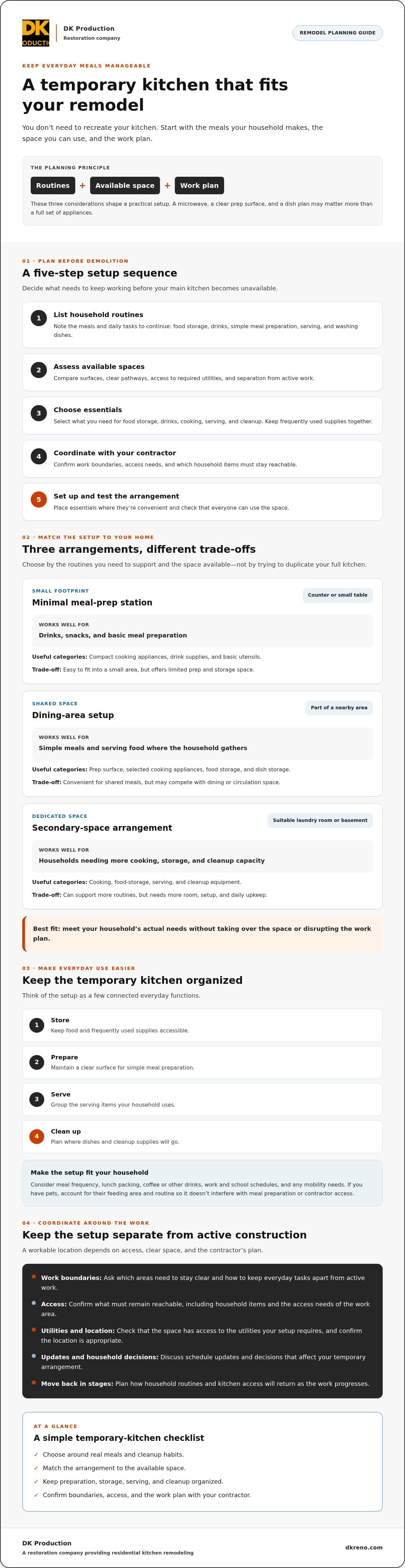
Once remodeling starts, familiar places to cook, store food, and wash dishes may be out of reach. Base your temporary kitchen setup during remodel on household routines, available space, and the contractor’s work plan, rather than trying to recreate your full kitchen somewhere else.
Use this sequence before the main kitchen becomes unavailable:
List routines. Note the meals and daily tasks your household needs to continue.
Assess available space. Compare possible locations for usable surfaces, clear pathways, and access to any utilities your plan requires.
Choose essentials. Decide what you need for food storage, drinks, cooking, serving, and cleanup.
Coordinate with the contractor. Confirm work boundaries, access needs, and which household items must remain reachable.
Set up and test the arrangement. Place essentials where they’re convenient and check that everyone can use the space.
Quotable takeaway: Before your kitchen is unavailable, decide what your household needs, where it can function, and how that plan fits around the work area.
List the routines your temporary kitchen needs to support
Start with what happens at home, not with a shopping list. How often do you prepare meals, and which routines are hardest to change? Consider food storage, making coffee or other drinks, preparing simple meals, serving food, and washing dishes as separate needs. A household that packs lunches may prioritize accessible food storage, while someone with limited mobility may need a clear path and supplies within easy reach. Account for work, school, and other daily schedules, too. If you have pets, include their feeding area and routine so it doesn’t interfere with meal preparation or contractor access.
Choose a location and coordinate the work area
Compare possible spaces by checking whether they offer a suitable surface, access to the utilities your plan requires, and enough separation from active work to keep everyday tasks apart. Think through kitchen functions such as preparation and storage with this Kitchen design and functions overview as background. Ask the contractor which areas need to stay clear and what must remain accessible during the remodel. For project planning information, see residential kitchen remodeling from DK Production.
Temporary kitchen setup options: match the arrangement to your home
The right temporary kitchen setup during remodel depends on what you cook, how much space you can spare, and which areas remain accessible during construction. A compact station may cover drinks and simple meals, while a dedicated room can support more involved routines. Compare the trade-offs before moving equipment or supplies.
When a compact meal-prep station may be enough
If your household mainly needs drinks, snacks, and straightforward meals, a small station may be sufficient. Group frequently used supplies together, keep the work surface clear, and store only the items you reach for regularly nearby. Before choosing this approach, confirm that the location and equipment suit your home and the remodeling plan.
When a more complete temporary kitchen makes sense
Frequent cooking or greater food-storage needs may call for a dedicated secondary space. That can make daily tasks easier to organize, but it takes more room and attention to keep the area orderly. Ask your contractor how to maintain clear access around the active work zone, and confirm which locations and utilities are appropriate for your setup.
The best temporary kitchen is the one that meets your household’s actual needs without taking over the space or disrupting the work plan. If you’re planning kitchen remodeling, explore DK Production’s kitchen remodeling services as you consider the project and its temporary arrangements.
How to make a temporary kitchen safe and easier to use
A well-organized temporary kitchen setup during remodel can simplify everyday tasks, but it should remain separate from active construction. Confirm work-area boundaries with your contractor, including which routes and household spaces should stay clear. If you have questions about electrical or plumbing work, ask a qualified professional instead of improvising. Follow each appliance manufacturer’s instructions for use and placement.
Organize essentials for cooking, storage, and cleanup
Set up small zones where space allows: a clear surface for food preparation, a place for frequently used food and supplies, a serving area, and a spot for washing or collecting dishes. Keep the inventory focused so you’re not searching through packed boxes every day:
Daily-use dishes, cups, utensils, and food-preparation tools
Pantry items and drink supplies your household reaches for often
Cleanup supplies and a designated place for used dishes
Store occasional-use cookware and specialty items elsewhere to reduce clutter. Before packing, label kitchen boxes by priority and intended use, such as “first-week meals” or “serving dishes.” That makes it easier to find essentials without unpacking everything at once. Keep temporary kitchen essentials grouped and accessible to make daily cooking easier in a smaller space.
Reduce disruption while work is underway
Access can change as the work progresses, so check with your contractor about boundaries, routes, and any changes that may affect your setup. Keep the temporary kitchen, household traffic, and pets clear of the active work area, and revisit the arrangement if access needs shift. For days when cooking there is inconvenient, decide in advance on simple backup meals that fit your household’s routine.
Clear communication helps align household needs with the project plan. For more guidance on choosing and communicating with a remodeling contractor, see Home Remodel Contractors Near Me: How to Choose a Partner in the Puget Sound. To discuss a kitchen remodel and work-area planning, visit DK Production’s kitchen remodeling page.
Coordinate your temporary kitchen with the remodel and plan the move back
A temporary kitchen works best when its location and use fit the project plan. Before work begins, agree with your contractor on which areas will be unavailable, how you’ll access the rest of the home, and how you’ll receive updates if the work plan changes. These details help you adjust your setup without assuming a completion date or a guaranteed project duration.
Questions to discuss with your kitchen remodeling contractor
Use an early planning conversation to clarify how construction and household routines will coexist. Ask questions such as:
Which rooms, routes, or household items may be unavailable during different parts of the work?
Where should family members stay clear, and what access should remain open?
How will you share timing updates or changes that affect the temporary kitchen?
Who should we contact if the current setup no longer fits the work plan?
Agreeing on how updates will be communicated gives you a practical way to respond if access changes. For help evaluating what to discuss before choosing a remodeling partner, read Home Remodel Contractors Near Me: How to Choose a Partner in the Puget Sound.
Plan a smooth return to your remodeled kitchen
Treat moving back as a sequence, not a single date on the calendar. Keep packed kitchen items organized by priority so everyday dishes and utensils are easy to locate. As the project progresses, ask your contractor when the space is ready for household access and follow project-specific guidance before resuming normal use. Bring essentials back first, then unpack less-used items as you settle into the room.
A clear plan can make both the temporary arrangement and the transition home more manageable. DK Production provides residential kitchen remodeling. Review its residential kitchen remodeling services when considering your project’s planning needs.
Make your remodel easier with a plan that fits your home
A workable temporary kitchen setup during remodel doesn’t have to mirror your usual kitchen. Start with the routines your household needs to maintain, choose an arrangement that fits the available space, and keep everyday essentials organized and away from active construction. Clear communication with your contractor about access, work boundaries, and schedule updates can help you adjust as the project progresses.
Plan the move back with the same care. Keep daily-use items easy to find, and follow your contractor’s guidance before returning to normal use of the remodeled space. Small decisions made early can make the transition more manageable from start to finish.
DK Production is based in Arlington, Washington, and provides residential kitchen remodeling for homeowners in Arlington and nearby communities. If you’re planning a kitchen remodel, explore residential kitchen remodeling with DK Production and discuss your project needs. With a thoughtful plan and the right conversations, you can move through the remodel with greater confidence and look forward to using your refreshed kitchen.
Frequently Asked Questions
How do you set up a temporary kitchen during a remodel?
Plan your temporary kitchen around the meals and household routines you need to maintain, then choose a location away from the active work area. List separate needs for food storage, simple cooking, drinks, and cleanup so you can select supplies and equipment that fit your space. Before setting up, ask your remodeling contractor which areas must stay clear and what access your household can expect during the work.
What should I include in a temporary kitchen?
Start with daily-use dishes, utensils, food-storage containers, pantry staples, and cleanup supplies. Add cooking equipment only after considering what you plan to prepare and whether the chosen location suits its use. A household that mostly needs snacks and simple meals may need fewer items than one planning to cook regularly. Keep less-used kitchen belongings packed and follow the manufacturer’s instructions for any equipment you use.
Where should I put a temporary kitchen during a remodel?
Choose an available spot with enough room for your planned tasks and a convenient route for household members. A dining area or another suitable secondary space may work, depending on your home’s layout. Don’t assume the location has the utilities or conditions your equipment requires. Discuss your preferred spot with the contractor, confirm which areas and pathways need to remain clear, and keep the setup separate from active work.
Can you cook during a kitchen remodel?
Often, you can prepare some meals with a temporary arrangement, but what’s practical depends on your available space, equipment, and access. A temporary kitchen setup during remodel might support simple meals without replacing every function of your usual kitchen. Follow appliance manufacturers’ instructions, and ask the contractor about project-specific access and safety considerations. It also helps to plan backup meals for days when cooking in the temporary space isn’t convenient.
How do you keep food and dishes organized without a kitchen?
Keep only frequently used food and kitchen items in the temporary area, and store the rest in labeled boxes elsewhere. If space allows, separate food-preparation supplies from serving items and cleanup products so each is easy to find. Choose food-storage methods that suit the location and the equipment available. Follow the product instructions for any storage equipment, and avoid overcrowding the area with belongings you rarely use.
What should I ask my contractor before setting up a temporary kitchen?
Ask which rooms and pathways may be affected, what must stay clear, and how you’ll receive updates if the work plan changes. Discuss your proposed location and any access or equipment questions before relying on it. DK Production provides residential kitchen remodeling for homeowners in Arlington, Washington, and nearby communities including Mukilteo, Marysville, Lake Stevens, Snohomish, Lynnwood, Mill Creek, Mountlake Terrace, Brier, Edmonds, Woodway, Stanwood, Monroe, Granite Falls, Sultan, Gold Bar, Darrington, Index, and Bothell.


Comments