
Water Mitigation: The Essential Guide to Protecting and Restoring Your Home

Updated: Jun 17
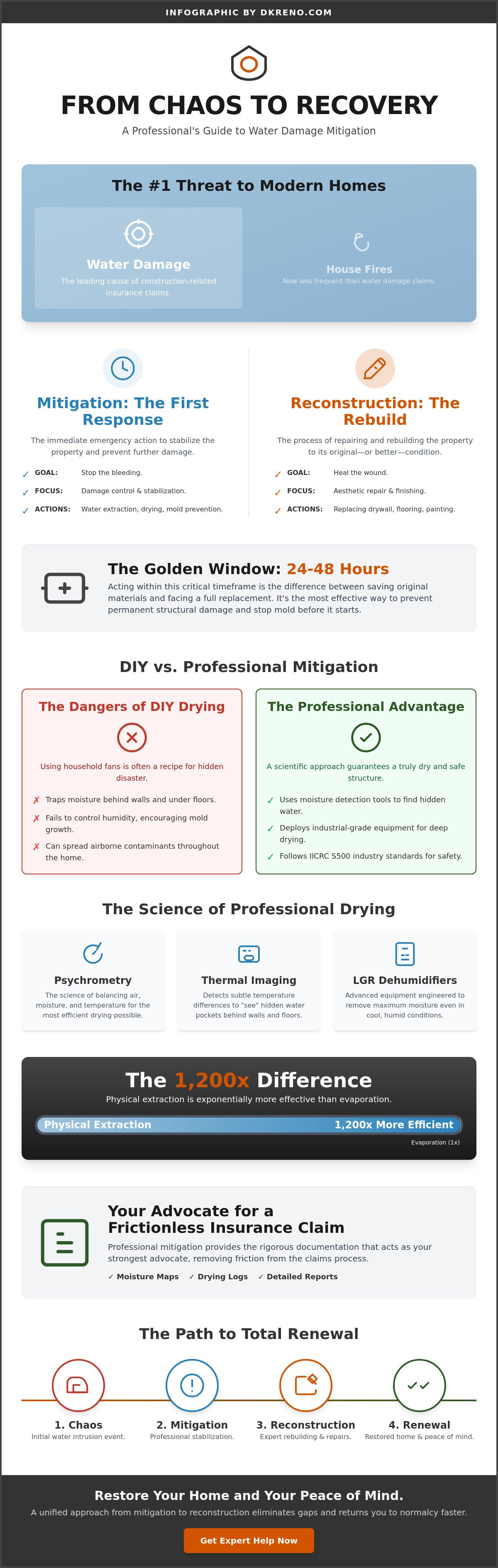
Did you know that water damage is now the leading cause of construction-related insurance claims, even surpassing the frequency of house fires? When you are standing in a flooded room, it's natural to feel overwhelmed by the fear of hidden mold or the stress of managing a complex insurance claim. You need a stabilizing force during this crisis, someone who can turn the initial chaos into a logical path toward recovery while protecting your most valuable asset.
Professional water mitigation is the essential first step that does more than just dry your floors; it's a specialized stabilization process that protects your home's structural integrity and enables a superior reconstruction. Discover how professional water mitigation stabilizes your property and sets the stage for a seamless home reconstruction that leaves your space safer and more beautiful than before. This guide walks you through the methodical drying process, the importance of rigorous documentation for your insurance provider, and how a comprehensive approach removes the friction from your total home restoration.
Key Takeaways
Learn the critical difference between stopping immediate damage and the eventual restoration of your property to ensure every step of recovery is handled with precision.
Understand the science of psychrometry and how professional water mitigation prevents long-term structural issues by managing humidity and moisture levels effectively.
Discover why a unified approach between the drying and rebuilding phases eliminates communication gaps and helps you return to normalcy faster.
Gain insights into the essential documentation needed for a frictionless insurance claim, including how professional moisture maps and drying logs act as your strongest advocate.
Explore how a methodical transition from chaos to order results in a high-quality finished state that often exceeds the home's original condition.
Table of Contents
What is Water Mitigation? Understanding the First Step to Recovery
When a pipe burst or a storm compromises your home, the first few hours are critical for your property's future. This is where water mitigation plays its most vital role. Many homeowners confuse mitigation with restoration, but they serve two distinct purposes in the recovery journey. Mitigation is the immediate emergency response designed to stop the spread of damage and prevent further loss. While restoration focuses on the eventual rebuilding and aesthetic repair of your property, mitigation is about stabilization. It's the difference between saving your original hardwood floors and being forced to replace them entirely. To understand the full scope of these risks, it's helpful to look at what is water damage and how it affects different materials over time.
Industry experts often refer to the first 24 to 48 hours as the "Golden Window." During this brief period, the primary goal is to stabilize the environment before permanent structural degradation or microbial growth begins. If you act within this timeframe, you significantly increase the chances of preserving your home's original materials. A professional team acts as a stabilizing force during this crisis, assuming the administrative and technical burdens so you can focus on your family's safety. They move from chaos to order by implementing a methodical plan that secures the structure and provides you with a clear path forward.
The Goals of a Professional Mitigation Plan
A disciplined mitigation strategy follows a logical path to ensure your home is secure. The process is not just about removing standing water; it involves a comprehensive approach to property health. Key objectives include:
Stopping the intrusion: We identify and halt the source of the water immediately to prevent further accumulation.
Structural protection: We prioritize the integrity of subflooring, wall studs, and framing to avoid long-term safety hazards.
Mold prevention: By controlling humidity and moisture levels, we stop the secondary disaster of mold and mildew before it can take root.
Why DIY Drying Often Fails
It's tempting to set up a few box fans and hope for the best, but surface-level drying is often a recipe for hidden disaster. Moisture frequently remains trapped behind baseboards, under laminate flooring, and inside wall cavities where the naked eye cannot see it. Household fans lack the static pressure needed to reach these hidden areas and can actually spread airborne contaminants throughout your home. Professional water mitigation teams use industrial-grade moisture detection tools and high-capacity air movers to ensure every hidden pocket is truly dry, protecting your home from the long-term threat of hidden decay.
The Science of Drying: Why Professional Extraction Matters
Effective water mitigation relies on more than just high-powered fans; it's rooted in the complex science of psychrometry. This field of study examines the relationship between air, moisture, and temperature to determine the most efficient path to dryness. In the unique climate of the Pacific Northwest, where humidity levels in Shoreline and Seattle often remain high, natural evaporation is rarely enough to protect a home from long-term damage. Professional teams follow the IICRC S500 Standard to manage these environmental variables, ensuring that every action taken is backed by rigorous industry research.
We don't rely on guesswork to determine if your home is safe. Our technicians utilize thermal imaging cameras to detect subtle temperature variances that reveal hidden water pockets behind finished surfaces. This technology allows us to see through walls and under floors, identifying moisture that would otherwise remain trapped and lead to structural decay. To achieve deep drying in our damp region, we deploy Low Grain Refrigerant (LGR) dehumidifiers. These advanced machines are specifically engineered to remove moisture even in the cool, humid conditions typical of our local environment, providing a level of performance that standard retail units simply cannot match.
Water Extraction vs. Evaporation
Physical extraction is 1,200 times more efficient than evaporation alone, making it the most critical step in the stabilization process. Subsurface extraction is vital for carpets and pads because it pulls water directly from the deepest fibers to prevent delamination and permanent odors. By using weighted extractors, we can often save high-value flooring materials that would otherwise require costly replacement. This disciplined approach focuses on salvage over demolition, helping you maintain the original character of your home while reducing the overall scope of the project.
Managing Airflow and Humidity
Once standing water is removed, the focus shifts to the air itself. Strategically placing air movers creates a "drying vortex" that continuously pulls moisture from wet materials and moves it into the path of our dehumidifiers. Our technicians monitor grains per pound (GPP) daily, which is a precise measurement of the water vapor in the air. This data tells us exactly when the environment has returned to its dry standard, rather than just feeling dry to the touch. This methodical approach ensures we stay on-site until the job is done, providing you with the peace of mind that your home is safe for the next phase of restoration and reconstruction.
Mitigation vs. Reconstruction: The Path to Total Renewal
Recovery from property damage occurs in two distinct, yet deeply interconnected phases. The first phase is water mitigation, which involves the "demo and dry" process where technicians stabilize the environment and prevent further loss. Once the home is certified dry, the project transitions into reconstruction, the "rebuild" phase where your home is returned to its finished state. Many homeowners find themselves overwhelmed when they have to manage different contractors for each stage, leading to miscommunication and extended timelines. By utilizing a single firm that manages both mitigation and reconstruction, you ensure a frictionless transition that maintains the structural integrity of your home from the first day of the crisis to the final coat of paint.
A comprehensive approach is particularly valuable when navigating the financial complexities of a loss. While insurance policies typically cover the cost of returning a home to its pre-loss condition, some homeowners may also qualify for FEMA disaster assistance depending on the cause and scale of the event. Having a single project manager who understands both the technical drying requirements and the administrative needs of a claim provides you with a powerful advocate throughout the entire duration of the project. For a deeper look at how these phases work together in our local area, you can explore our water damage arlington recovery guide.
The Advantage of a Seamless Transition
The transition between drying and rebuilding is where many projects lose momentum. When the same team handles both, the detailed moisture logs and thermal images from the water mitigation phase inform the reconstruction budget and material selection. This eliminates "gap time," the period where a home sits empty and exposed while a new contractor is vetted and scheduled. We verify that every stud and subfloor is structurally sound and completely dry before any finishes are applied, ensuring that your new walls are never built over hidden moisture or compromised materials.
Turning a Loss into a Luxury Upgrade
While water damage is undeniably stressful, the reconstruction phase offers a unique opportunity for home improvement. Since walls are already open and flooring is often removed, it's the ideal time to consider a kitchen or bathroom remodel that adds long-term value to your property. Many of our clients choose this moment to implement waterproof shower remodels or updated cabinetry layouts. This strategic approach transforms a traumatic event into a form of total renewal, leaving you with a home that isn't just restored, but significantly improved.
Navigating Insurance Claims: Your Advocate in the Restoration Process
The administrative burden of a property loss often feels just as heavy as the physical damage itself. Many homeowners experience deep anxiety over potential claim denials or the fear that their payout won't cover high-quality repairs. This is why your water mitigation partner must act as a protective specialist and a dedicated advocate. We speak the technical language of insurance adjusters, using data and industry standards to justify every step of the stabilization process. By assuming the burden of these negotiations, we provide a stabilizing force that allows you to focus on your family's well-being while we secure the resources needed for a total renewal.
For readers in other regions seeking this level of specialized support, Dryrite Restoration provides an excellent example of how professional advocacy and technical precision can streamline the recovery process.
To ensure a frictionless experience, we recommend following this 5-step process when filing your claim:
Safety and Notification: Ensure everyone is safe and contact your insurance provider immediately to initiate the claim.
Professional Assessment: Have an expert identify the water category and source to prevent administrative delays later.
Evidence Collection: Take detailed photos and videos of the damage before any materials are moved or discarded.
Mitigation Deployment: Start the drying process immediately to meet your policy's requirement to "mitigate further loss."
Scope Alignment: Ensure your contractor and adjuster agree on a comprehensive scope of work before reconstruction begins.
The Importance of Detailed Documentation
In the world of insurance, if a detail isn't documented, it didn't happen. We utilize professional moisture maps and daily drying logs to provide undeniable proof of the environment's state throughout the project. These records capture the "before" and "during" stages of water mitigation, showing exactly how industrial equipment moved the property from a saturated state to a dry standard. For more guidance on finding a team that excels at this level of detail, see our guide on insurance restoration companies.
Working with Claims Adjusters
A claims adjuster's role is to verify the "Scope of Work," which is the detailed list of every task required to restore your home. We provide professional estimates that use the same software as major carriers, which reduces friction and speeds up the approval process. This transparency ensures you have sufficient funds to choose high-quality materials for your eventual reconstruction. Most insurance carriers prefer working with an IICRC-certified partner because it guarantees that the work follows a standardized, scientifically-backed protocol that minimizes the risk of future liability. If you are currently facing a property crisis, contact our expert team to act as your advocate and guide you through a successful recovery.
Restoring Peace of Mind: The DK Production Path to Total Renewal
At DK Production, we understand that a flood in your home is more than a technical problem; it is a profound disruption to your sense of security. We serve as a stabilizing force for homeowners in Arlington, Everett, and the greater Seattle area, providing the expert intervention needed to turn a property crisis into a controlled recovery. Our commitment goes beyond simply returning your home to its pre-loss condition. We aim to elevate your living space through meticulous water mitigation and high-value reconstruction, ensuring the finished result is safer and more durable than it was before the damage occurred. By assuming the management of the entire project, we allow you to focus on your family while we handle the complexities of restoration.
The transition from emergency stabilization to high-value remodeling is where our team truly differentiates itself. We don't just dry out a room and leave you with bare studs; we envision the final restored state from the moment we arrive on-site. This comprehensive perspective ensures that every action taken during the initial drying phase supports a seamless rebuild. Whether we are saving original materials or preparing a space for a full kitchen or bathroom remodel, our focus remains on quality, safety, and your total satisfaction with the finished home.
A Compassionate Approach to Home Services
We assume the full burden of the crisis on your behalf, acting as both project managers and protective specialists throughout the entire project duration. Transparent communication is the foundation of our process, and we provide regular updates so you never feel lost in the complexity of your own restoration. By managing every detail from the initial water mitigation to the final administrative negotiations, we remove the friction typically associated with large-scale repairs. This methodical approach allows you to regain peace of mind while we maintain rigorous standards of performance on your home.
Start Your Journey Back to Normalcy
Seeing your home in a state of disrepair is difficult, but it can also be the catalyst for the high-quality finished state you have always wanted. Whether you need immediate emergency help or are looking for home remodeling in Seattle, our team is ready to guide you through a stress-free renewal. Don't let the stress of property damage overwhelm your future plans. Take the first step toward a dry, safe, and beautiful home today. Contact DK Production for Expert Water Mitigation and let us transform your property loss into a form of total renewal.
Secure Your Home’s Future Through Expert Restoration
Navigating a property loss is one of the most challenging experiences a homeowner can face, but you don't have to manage the burden alone. We've explored how water mitigation serves as the critical foundation for your home's recovery, protecting structural integrity and preventing secondary damage like mold. By prioritizing scientific drying methods and rigorous documentation, you ensure your property is truly safe before the first new board is nailed into place. Choosing a partner who manages the full duration of the project, from the initial emergency to the final luxury finish, removes the friction and uncertainty from your restoration journey.
As 24/7 emergency response specialists, we provide the expert insurance claim advocacy and technical precision required for a high-quality result. You deserve a partner who acts as a protective specialist for your property and assumes the administrative weight of your claim. Restore your home with the experts at DK Production and experience the peace of mind that comes from a seamless, full-service transition from mitigation to reconstruction. Your home is your sanctuary, and we're committed to making it stronger and more beautiful than ever before.
Frequently Asked Questions
How long does the water mitigation process typically take?
The water mitigation process typically takes between three and five days to complete. This timeline depends on the extent of the saturation and the types of materials affected, as porous surfaces like hardwood or thick subflooring require more time to release moisture. Our technicians monitor the progress daily to ensure the environment reaches its dry standard, providing you with a predictable path toward the reconstruction phase.
Is water mitigation covered by standard homeowners insurance?
Standard homeowners insurance policies generally cover water mitigation when the damage is caused by a sudden and accidental event, such as a burst pipe or appliance failure. Most policies actually require you to take immediate action to mitigate further loss. We act as your advocate by providing the detailed moisture logs and documentation your adjuster needs to process your claim without unnecessary friction or delays.
What is the difference between water mitigation and water damage restoration?
Water mitigation is the immediate emergency phase focused on stopping the spread of damage and stabilizing your property through extraction and drying. In contrast, restoration involves the permanent repairs and reconstruction needed to return your home to its finished state. While mitigation prevents a crisis from worsening, restoration focuses on the high-quality craftsmanship that brings your home back to its pre-loss condition or better.
Can I stay in my home during the water mitigation and drying process?
You can typically stay in your home during the drying process, though the constant noise from industrial air movers and dehumidifiers can be disruptive. If the water is category 3, such as sewage, or if the power must be shut off for safety, we may recommend temporary relocation. We prioritize your comfort and safety, explaining the operational needs of the equipment so you can make an informed decision for your family.
How do I know if my home is completely dry after a flood?
We verify that your home is completely dry using professional moisture meters and thermal imaging cameras that detect moisture hidden deep within wall cavities. You shouldn't rely on a simple touch test, as surfaces can feel dry while the underlying structure remains saturated. Our team provides a certificate of dryness once the readings match the dry standard of unaffected materials in your home, ensuring total peace of mind.
What happens if I delay water mitigation after a leak?
Delaying water mitigation for even 24 to 48 hours often leads to secondary damage like mold growth and permanent structural warping. Moisture continues to migrate through porous materials, increasing the cost and complexity of the eventual reconstruction. Additionally, insurance carriers may deny a claim if they determine the homeowner failed to take reasonable steps to prevent the damage from worsening immediately after the discovery.
Does water mitigation include mold removal?
Water mitigation focuses primarily on preventing mold by rapidly removing moisture, but it also includes sanitizing affected areas with antimicrobial treatments. If mold has already begun to grow due to a delay in discovery, the process transitions into specialized remediation. Our methodical approach ensures that we stabilize the environment first, creating a safe and dry foundation that prevents future microbial issues from compromising your home’s air quality.
Why should I hire a local Arlington contractor instead of a national franchise?
Hiring a local Arlington contractor ensures you receive a personalized partnership from specialists who understand the unique humidity challenges of the Pacific Northwest. Unlike national franchises that often use a one-size-fits-all approach, we provide a stabilizing presence with deep roots in the community. Our local expertise allows for faster response times and a higher level of accountability throughout the full duration of your home’s restoration and reconstruction.


Comments