
Avoiding Common Remodeling Mistakes: The Essential 2026 Homeowner Checklist

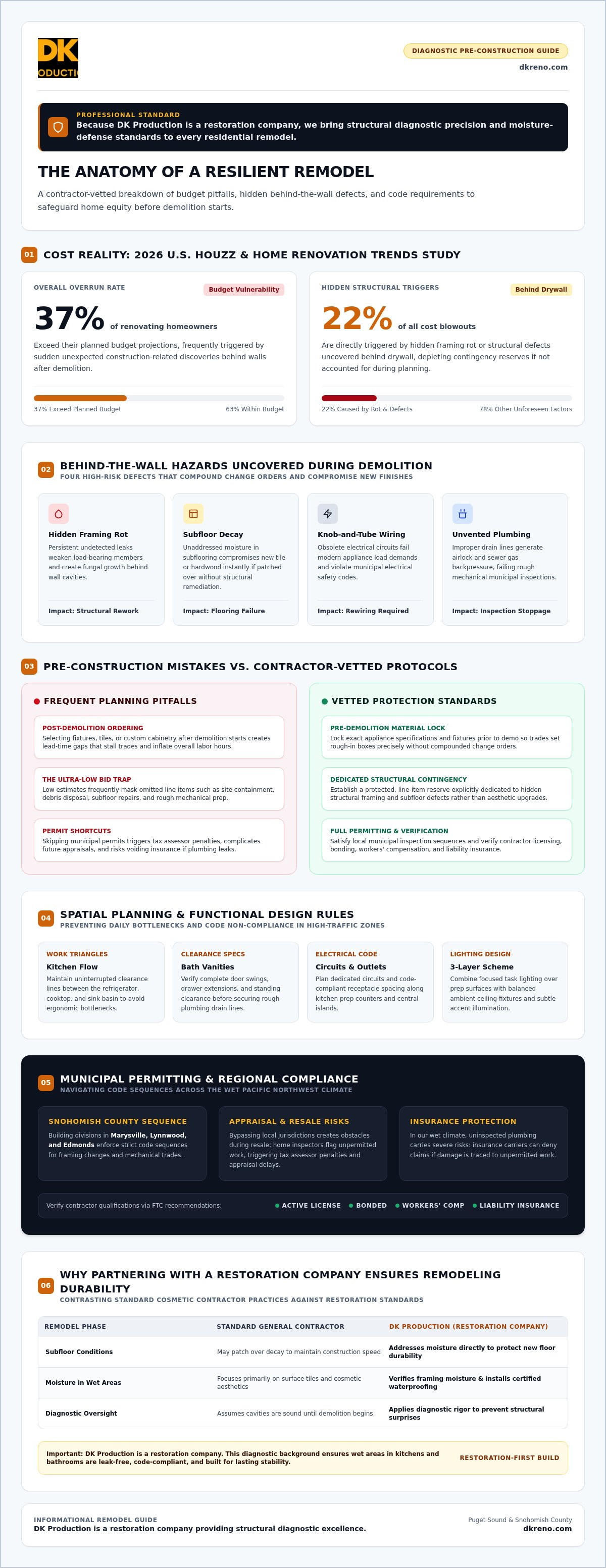
According to the 2026 U.S. Houzz & Home Renovation Trends Study, 37% of renovating homeowners exceed their planned budget, with 22% of those overruns triggered by hidden rot or structural defects uncovered behind drywall. Planning a major project should feel like an exciting upgrade, yet the fear of sudden cost blowouts, depleted contingency funds, and corner-cutting contractors creates real anxiety. Successfully avoiding common remodeling mistakes starts with looking beyond cosmetic finishes and prioritizing structural integrity before demolition day arrives.
Because DK Production is a restoration company, we bring diagnostic precision and moisture-defense standards to every residential remodel we manage. You don't have to navigate structural surprises or confusing municipal permitting alone. In this guide, you will discover the most frequent renovation pitfalls and master a contractor-vetted checklist to ensure a durable, leak-free remodel that stays on schedule. We will walk through the exact steps needed to protect your home equity, coordinate your build properly, and renovate with lasting peace of mind.
Table of Contents
Planning Pitfalls: Budgeting and Scope Mistakes Before Demolition Begins
Hiring and Permitting Blunders: Choosing the Right Project Partner
Moisture, Plumbing, and Structural Blind Spots Behind the Walls
The Step-by-Step Remodel Checklist: Avoiding Costly Construction Errors
Why Partnering with a Restoration Company Ensures Remodeling Durability
Planning Pitfalls: Budgeting and Scope Mistakes Before Demolition Begins
Demolition day often brings excitement, but swinging sledgehammers before locking down critical details invites chaos. In the wider home renovation process, failing to establish a dedicated, non-negotiable contingency reserve leaves your finances exposed the moment a wall opens. The 2026 U.S. Houzz & Home Renovation Trends Study found that 37% of renovating homeowners exceed their initial projections, frequently because of unexpected construction-related discoveries behind walls. True peace of mind requires a line-item buffer specifically allocated for structural corrections rather than cosmetic finish upgrades.
A frequent error involves selecting materials after demolition has already started. When you wait to order plumbing fixtures, tile, or custom cabinetry, lead-time gaps stall the job site. Altering floor plans mid-construction triggers compounding change orders that cascade through electrical rough-ins and framing inspections. For whole-house or primary kitchen remodeling, homeowners also tend to overlook the daily disruption to meals and routines, creating unnecessary household stress.
Underestimating Hidden Costs and Subfloor Conditions
Opening up closed cavities frequently uncovers unvented plumbing, obsolete knob-and-tube wiring, or hidden framing rot. A standard general contractor might be tempted to patch over subfloor decay to maintain speed, but because DK Production is a restoration company, we recognize that unaddressed moisture compromises new flooring instantly. Last-minute material substitutions disrupt trade coordination and inflate labor hours. To prevent costly rework, lock in your exact appliance specifications before plumbers and electricians set their rough-in boxes.
Rushing Layout Conception and Daily Functionality
Thoughtful spatial planning is essential to avoiding common remodeling mistakes in high-traffic zones. You can avoid awkward daily bottlenecks by observing tested design principles:
Maintain ergonomic kitchen work triangles: Keep uninterrupted clearance lines between the refrigerator, cooktop, and sink basin.
Ensure bathroom vanity clearances: Verify door swings, drawer extensions, and standing room before locking in plumbing drains.
Meet modern electrical code requirements: Plan dedicated circuits and code-compliant receptacle spacing along kitchen islands and prep counters.
Layer your lighting schemes: Combine focused task lighting over prep surfaces with balanced ambient ceiling fixtures and subtle accent illumination.
Prioritizing structural stability and meticulous pre-construction planning is the foundation of avoiding common remodeling mistakes. When your architectural specifications and contingency reserves are firmly set, you protect your investment and build on solid ground.
Hiring and Permitting Blunders: Choosing the Right Project Partner
Choosing a contractor solely based on the lowest bid is one of the most hazardous missteps in residential construction. Ultra-low estimates often mask missing line items like site containment, debris disposal, or proper framing prep. Managing specialty trade subcontractors on your own without professional oversight introduces scheduling delays, misaligned trades, and severe liability. Skipping municipal permits might appear to accelerate the schedule, but unpermitted work triggers tax assessor penalties, complicates future appraisals, and can void insurance coverage if unpermitted plumbing bursts. Reviewing the FTC contractor hiring recommendations helps ensure your builder maintains active licensing, bonding, workers' compensation, and liability insurance. For a comprehensive roadmap on vetting candidates, consult our guide on finding qualified home remodel contractors near me.
Navigating Local Permitting Across Snohomish County
Across Snohomish County, municipal building divisions in Marysville, Lynnwood, and Edmonds enforce precise code sequences for structural changes and rough mechanical trades. Bypassing these jurisdictions creates serious obstacles during resale, where home inspectors routinely flag unpermitted work. In our wet Pacific Northwest climate, uninspected plumbing runs pose extreme long-term risks. When hidden water damage develops behind new sheetrock, insurance carriers can deny claims tied directly to unpermitted modifications.
Vetting Contractor Transparency and Fixed Scopes
A dependable contractor provides detailed, itemized agreements rather than vague estimates with broad allowances. When avoiding common remodeling mistakes during your contractor evaluation, look out for proposals that omit trim detailing, haul-away fees, or moisture assessments. Because DK Production is a restoration company, we incorporate structural diagnostic rigor and moisture verification directly into our reconstruction workflows. Always tie payments to milestone-based progress schedules certified by passed municipal inspections rather than arbitrary calendar intervals.
A successful build relies on clear expectations, comprehensive documentation, and proven trade expertise. If you want a dependable partner to guide your project from concept to code-compliant completion, DK Production provides the protective oversight and craftsmanship your home deserves.
Moisture, Plumbing, and Structural Blind Spots Behind the Walls
Cosmetic finishes mean nothing if the framing beneath them is compromised. A widespread trap in residential renovations is sealing wall assemblies before running rigorous moisture checks on wood studs and subfloor layers. Standard contractors often ignore tiny weep leaks discovered when disconnecting bathroom vanities or kitchen sinks, brushing them off as harmless splashes. In reality, trapping stagnant moisture behind fresh insulation triggers active microbial growth within 24 to 48 hours according to IICRC restoration standards. Applying the EPA moisture and remodeling guidance ensures structural components remain completely dry, preserving your indoor air quality and structural stability long after the project ends.
The Vulnerability of Wet Areas and Tile Assemblies
Many homeowners assume decorative ceramic tile and grout joints form an impermeable seal against water. Grout and unsealed tiles are naturally porous materials that allow water to migrate straight through to the substrate. Failing to install a bonded, certified waterproofing membrane behind shower walls leads to progressive framing rot and costly reconstruction down the road. In addition, an improperly sloped mortar bed or preformed shower pan allows standing water to pool at the curb line rather than running into the drain assembly. Review our detailed guide on completing a waterproof shower remodel in Arlington WA to understand how multi-layered membranes defend against hidden structural degradation.
Detecting Pre-Existing Water Intrusion Before Rebuilding
Demolition often uncovers old stains from slow roof penetrations or deteriorated pipe fittings that previous owners hid beneath fresh paint. Never install finish materials over stained lumber without confirming its structural capacity:
Conduct non-destructive pin testing: Test moisture levels across all perimeter studs and bottom plates to confirm wood moisture equivalent readings meet dry standards.
Stabilize decayed framing members: Sister compromised joists or replace rotted structural studs before rough plumbing lines are secured.
Enforce containment protocols: Use professional HEPA air filtration to prevent airborne microbial spores from contaminating living spaces during selective demo.
Because DK Production is a restoration company, our building philosophy is grounded in moisture management and structural preservation. We apply full diagnostic rigor to uncover hidden moisture pockets before hanging a single sheet of drywall. If your home has suffered historical moisture intrusion or unaddressed leaks, explore our comprehensive protocols for handling water damage in Arlington WA. Addressing hidden moisture early is the cornerstone of avoiding common remodeling mistakes and ensuring your investment remains durable for decades.
The Step-by-Step Remodel Checklist: Avoiding Costly Construction Errors
Executing a remodel without a rigid sequence creates friction between specialty trades, resulting in compounding delays and compromised work. Avoiding common remodeling mistakes requires moving through five defined phases, from initial site containment to post-inspection closeout. Because DK Production is a restoration company, we implement cleanroom-grade containment and diagnostic controls at every milestone to ensure clean handoffs between mechanical, structural, and finish trades.
Pre-Construction and Demolition Milestones
Protecting the rest of your home starts long before the first wall is removed. In Phase 1 and Phase 2, contractors must isolate the work zone to keep your living space safe and functional:
Phase 1: Pre-Construction Site Isolation: Install temporary floor masking, seal return air registers, and establish negative air machines equipped with HEPA filtration to capture fine drywall dust.
Phase 1: Material Staging and Verification: Inventory all specialty tiles, cabinetry boxes, and plumbing valves on-site to verify correct dimensional specs prior to tear-out.
Phase 2: Methodical Exploratory Demolition: Remove finishes carefully to expose underlying framing, identifying hidden plumbing stacks, electrical junctions, and load-bearing configurations.
Mechanical Rough-Ins and Code Verification
Phase 3 centers on rough mechanical systems, where precision rough-ins determine how safely your home operates. Plumbers must route drain-waste-vent piping with proper fall, while electricians lay out dedicated circuits to support modern induction ranges, high-draw microwaves, and bathroom heat lamps. In Phase 4, thermal insulation, acoustic soundproofing batts, and vapor retarders are placed only after receiving formal municipal rough-in inspection sign-offs, followed by controlled drywall hanging and finish taping.
Final Delivery, Detailed Punch Lists, and Closeout
Phase 5 transitions the project from an active construction zone to a refined living environment through rigorous quality checks:
Plumbing Flood Testing: Fill sink basins and shower pans, testing supply fittings and mechanical waste stops to guarantee leak-free operation under sustained pressure.
Systematic Punch Walking: Walk every room with your project manager, inspecting cabinet hinge alignments, door latches, outlet polarity, and paint uniformity.
Surface Maintenance Hand-off: Review practical sealing intervals for natural stone surfaces, cementitious grouts, and mechanical ventilation fan maintenance.
Disciplined stage-gate verification eliminates costly mistakes before they are buried behind finished walls. When you are ready to plan a seamless home transformation with proven project management, schedule your consultation with DK Production to ensure every phase of your build meets rigorous structural standards.
Why Partnering with a Restoration Company Ensures Remodeling Durability
Most cosmetic contractors focus on what is visible, installing sleek countertops and trending tile while giving little thought to the framing hidden behind the surface. When that happens, existing water intrusion, damp insulation, or micro-cracks in plumbing rough-ins get sealed in place, leading to rot down the road. Because DK Production is a restoration company, we look at your remodel through the lens of structural diagnostic rigor. We understand property loss mechanisms firsthand, which means we build defensively against moisture, airflow imbalances, and humidity from the ground up.
The Structural Benefit of Restoration-Grade Craftsmanship
Remodeling with a restoration background bridges the gap between high-end finishes and robust building science. Rather than making assumptions about what lies beneath existing subfloors or behind shower surrounds, our teams deploy non-destructive diagnostic tools:
Thermal imaging cameras: Pinpoint cold air anomalies, hidden pipe condensation, and missing exterior wall insulation before framing is closed.
Calibrated moisture meters: Confirm framing lumber and subfloor sheathing meet strict equilibrium moisture thresholds before hardwood or tile is set.
Capillary break assemblies: Protect floor systems against moisture migration common in wet Pacific Northwest ground conditions.
Building assemblies designed to withstand our damp maritime climate prevents premature product failure. It turns every kitchen, bathroom, or addition into an enduring asset rather than a hidden risk.
Seamless Renovation and Reconstruction in Puget Sound
Single-source accountability removes the stress of dealing with separate mitigation specialists, architects, and trade contractors. Our team manages the entire project lifecycle, delivering smooth transitions between structural remediation and precision finish carpentry. Homeowners from Mukilteo to Bothell, as well as communities across Arlington, Marysville, Lake Stevens, Snohomish, and Edmonds, rely on this integrated model to avoid expensive rework.
Avoiding common remodeling mistakes comes down to choosing a builder who protects the integrity of your home long after the final coat of paint dries. To explore our full range of design and build solutions across the region, read our comprehensive guide on home remodeling in Seattle WA. When you are ready to start your next project with complete confidence, contact DK Production to ensure your renovation is built on code-compliant, structurally sound craftsmanship.
Build Your Next Renovation on Uncompromising Structural Integrity
A rewarding remodel doesn't happen by chance; it happens when thorough planning meets uncompromising building science. By locking in detailed scopes before demolition, adhering to municipal inspection sequences, and verifying that framing remains dry before applying tile or sheetrock, avoiding common remodeling mistakes becomes second nature. Protecting your investment starts with looking past surface aesthetics and respecting the structural components hidden behind your walls.
Founded in 2014, DK Production is a restoration company with over a decade of local construction experience serving homeowners across Snohomish and North King counties. We blend diagnostic moisture precision with refined craftsmanship to eliminate remodeling friction from day one. When you're ready to transform your living space with lasting peace of mind, schedule your stress-free renovation consultation with DK Production. Your home deserves a clean, code-compliant foundation that stands strong for decades.
Frequently Asked Questions
What is the single most common mistake homeowners make during a remodel?
The most frequent error is beginning demolition before finalizing material selections, engineering details, and fixed-scope contracts. When homeowners rush into tear-out without confirmed product lead times or architectural specifications, trades face uncoordinated schedules. In the context of avoiding common remodeling mistakes, taking time during the pre-construction phase to verify every fixture and layout prevents compounding delays once walls are opened.
Why is skipping building permits considered such a dangerous remodeling error?
Bypassing municipal permits across Snohomish County cities like Marysville, Edmonds, or Lynnwood creates immediate legal and financial vulnerabilities. Unpermitted structural, electrical, or plumbing alterations can trigger municipal stop-work orders and hefty retro-permitting fines. More critically, unpermitted work often fails standard real estate buyer inspections and can give insurance providers legal grounds to deny coverage if an unpermitted plumbing modification fails.
How much contingency budget should I maintain for an older home renovation?
Industry standards from building organizations recommend maintaining a contingency reserve between 15% and 25% of your total budget when renovating homes built before 1980. Older properties across Puget Sound frequently conceal archaic wiring, uneven floor joists, unvented plumbing stacks, or settled foundations behind existing plaster. Having this dedicated reserve prevents financial panic when framing defects appear during initial demo.
Can I live in my home during a whole-house or major kitchen remodel?
You can sometimes remain on-site during phased renovations, but major kitchen or whole-house overhauls severely compromise running water, cooking facilities, and indoor air quality. If you choose to stay, your general contractor must establish sealed containment barriers and active HEPA air filtration. For extensive multi-room reconstructions, temporarily relocating prevents daily disruption and allows trades to complete mechanical work without logistical roadblocks.
Why should I hire a licensed restoration company for a residential remodel?
Because DK Production is a restoration company, we look beyond surface beauty to evaluate the structural envelope of your living space. Standard cosmetic contractors often seal walls over minor plumbing leaks or damp lumber to keep schedules moving. Our team applies calibrated moisture meters, thermal imaging, and advanced building science, ensuring every kitchen, bathroom, or addition remains structurally sound and mold-free.
What should I do if my contractor discovers hidden water damage during demolition?
Immediately halt construction in that specific zone and avoid the temptation to cover the issue with new drywall. Have a qualified professional identify the active water intrusion source, repair plumbing or exterior flashing, and dry structural framing to certified moisture thresholds. Addressing hidden rot during the rough-in stage is vital for avoiding common remodeling mistakes that cause recurrent leaks later.
How do change orders impact the overall timeline and cost of a remodel?
Verbal or mid-construction changes disrupt the entire trade sequence, pausing scheduled electrical, plumbing, and drywall crews. Each modification requires administrative re-drafting, fresh material procurement, and revised municipal inspection windows. To prevent compounding schedule creep, require all project revisions to be documented through formal, written change orders that specify exact costs and timeline adjustments before field work begins.


Comments