
The Water Damage Insurance Claim Process: A Complete Guide to Home Recovery in 2026

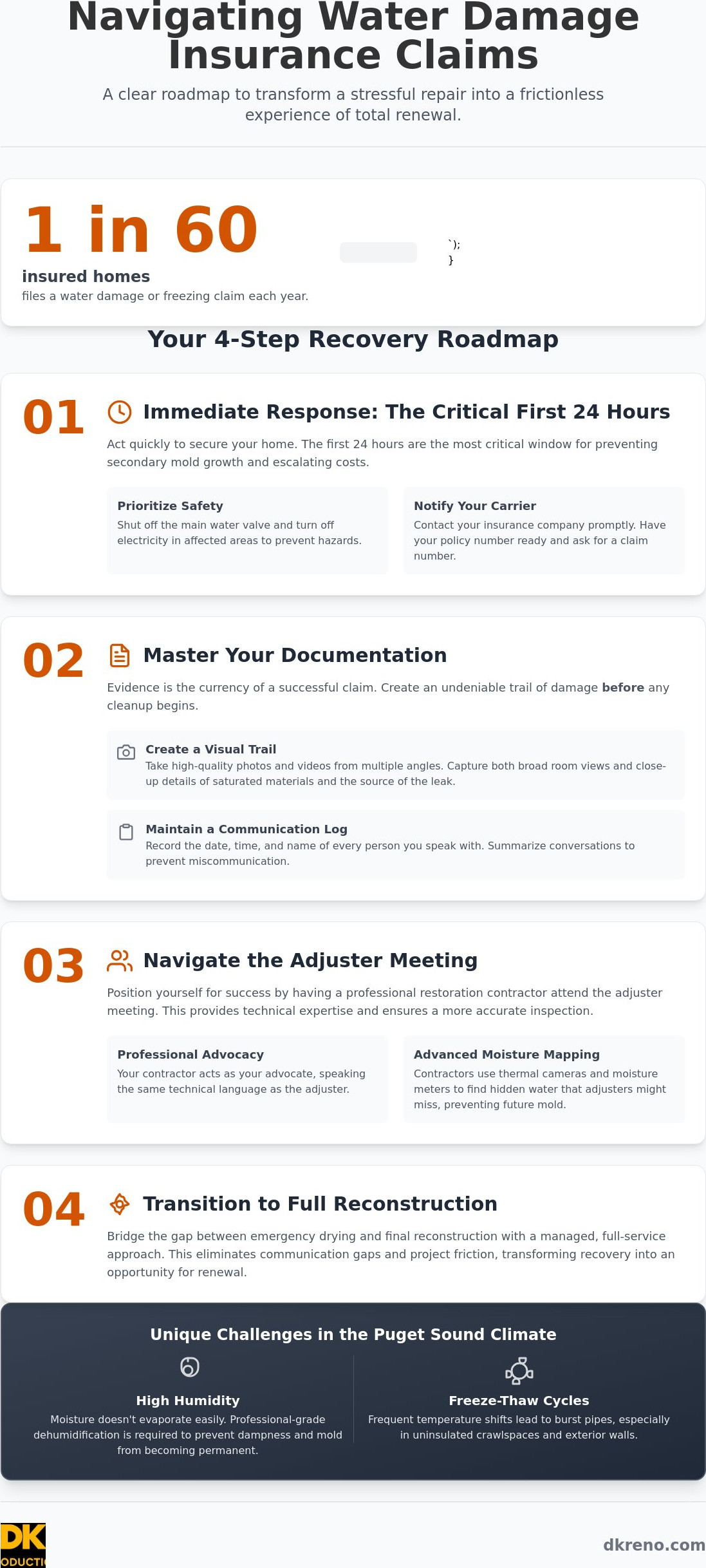
Did you know that 1 in 60 insured homes files a claim for water damage or freezing every single year? It is the second most common type of home insurance claim; however, discovering a burst pipe or a failing appliance still feels like an isolating and overwhelming crisis. You are likely facing the immediate stress of a damaged home while worrying about the complexities of the water damage insurance claim process. It's natural to feel anxious about potential claim denials or the hidden threat of mold, especially when you're caught between the conflicting priorities of insurance adjusters and restoration contractors.
You deserve a reliable mentor who acts as a stabilizing force during this transition from chaos to order. This guide provides the clear, step-by-step roadmap you need to navigate insurance negotiations and ensure your home is restored to a high-quality finished state. We will explore how to document damage effectively, manage the specific 2026 insurance landscape, and advocate for a fair settlement. By the end of this article, you'll understand how to move through the recovery phase with confidence, transforming a stressful repair into a frictionless experience of total renewal.
Table of Contents
Immediate Response: Securing Your Property and Starting the Claim
When water enters your home, the initial shock can be paralyzing. Your first priority is safety. If you can safely reach the main water valve, shut it off immediately to stop the flow. You should also turn off the electricity in affected areas to prevent electrical hazards. These quick actions provide a foundation for a successful water damage insurance claim process by demonstrating that you took reasonable steps to limit the loss. A foundational Understanding Water Damage involves recognizing that moisture doesn't just sit on the surface; it migrates into subflooring and wall cavities almost instantly.
The first 24 hours are the most critical window in property recovery. During this time, standing water begins to compromise structural materials and creates an ideal environment for secondary mold growth. If mitigation doesn't begin within this timeframe, the complexity and cost of the claim can escalate. Many homeowners wonder whether they should call their insurance company or a restoration specialist first. While you must notify your carrier, contacting an expert like DK Production first can be a strategic advantage. We act as a stabilizing force, providing immediate mitigation that prevents further damage while documenting the scene before anything is moved or discarded.
Stopping the Damage in the Puget Sound Climate
Our local climate presents unique challenges. In Western Washington, the frequent freeze-thaw cycles often lead to burst pipes in uninsulated crawlspaces or exterior walls. High humidity levels in cities like Seattle and Everett mean that moisture doesn't evaporate easily on its own. Effective recovery requires professional-grade dehumidification and strategic ventilation to pull moisture from the air and prevent that familiar damp smell from becoming permanent. We focus on these technical details so you can focus on returning to normalcy.
Notifying Your Insurance Carrier
Most policies include a "duty to mitigate" clause. This means you're contractually obligated to take steps to prevent more damage from occurring. When you call your claims representative, have your policy number, the date of loss, and a brief description of the cause ready. Ask for your claim number and the name of your assigned adjuster immediately. This information is the key to managing your project's administrative side with ease. Having this data organized early in the water damage insurance claim process removes the friction typically associated with third-party negotiations.
Essential Documentation for a Successful Water Damage Claim
Evidence is the primary currency of a successful claim. To ensure you receive a fair settlement, you must create an undeniable visual trail of the damage before any cleanup begins. Start by taking high-quality photos and videos from multiple angles, capturing both the broad scope of the room and close-up details of saturated materials. It's particularly vital to document the source of the leak, such as a failed water heater or a burst supply line, as this evidence directly impacts what homeowners insurance covers under your specific policy. Without clear proof of the cause, carriers may question if the event was truly sudden and accidental.
Beyond visual evidence, maintaining a meticulous communication log is essential for a frictionless experience. Record the date, time, and name of every person you speak with, including claims representatives and adjusters. Summarize the key points of each conversation and save all emails in a dedicated folder. This level of organization acts as a protective shield, preventing details from being lost or misrepresented during the water damage insurance claim process. If you feel overwhelmed by the administrative burden, partnering with a specialist who understands insurance restoration can provide the professional advocacy you need to move forward with confidence.
Professional Moisture Mapping
While your smartphone photos are a great start, they can't see what lies beneath the surface. We use advanced technology like thermal imaging cameras and moisture meters to create a professional moisture map of your property. This documentation identifies "hidden" water trapped behind drywall or under hardwood floors that would otherwise lead to mold growth. Adjusters often give more weight to these technical reports because they provide objective data about the extent of the loss. This data forms the basis of a comprehensive 'Scope of Work' that ensures no repair is overlooked.
Inventorying Loss and Damaged Possessions
Creating a detailed inventory of personal property is a demanding but necessary step. List every item affected, from furniture and clothing to high-value electronics, noting the age and original purchase price when possible. Don't discard any items until the adjuster has inspected them. You'll likely need to complete a 'proof of loss' form to formalize these claims. In 2026 policies, it's vital to understand the difference between valuation types: Actual Cash Value (ACV) is the depreciated value of an item at the time of loss, while Replacement Cost Value (RCV) provides the funds to buy a new equivalent at today's prices.
Navigating the Insurance Adjuster Meeting and Settlement
The arrival of the insurance adjuster marks a pivotal phase in the water damage insurance claim process. This physical inspection is where the adjuster evaluates the damage to determine the scope of the payout. It's often a high-pressure situation for homeowners who are still living in the aftermath of the crisis. You don't have to face this meeting alone. Having a professional restoration contractor present acts as a stabilizing force, ensuring that every saturated wall cavity and compromised structural element is correctly identified before the adjuster leaves your property.
Discrepancies between an adjuster's initial estimate and a contractor's bid are common. These gaps often occur because adjusters might miss hidden moisture or underestimate the cost of local labor and materials in 2026. When your restoration partner is on-site, they can point out specific technical details that an adjuster might overlook during a brief walkthrough. This collaborative approach removes the friction from the negotiation phase and sets a clear trajectory for a high-quality finished state.
The Contractor as Your Advocate
A specialist doesn't just watch the inspection; they actively collaborate with the adjuster to ensure accuracy. Professional restoration companies use industry-standard software like Xactimate, which is the same platform adjusters use to calculate costs. This shared language helps bridge the gap between the initial estimate and the actual cost of premium materials. By advocating for your home's original standards, your contractor helps prevent the use of generic shortcuts that could lower your property's value. If differences arise, your contractor provides the technical justification needed to reach a fair agreement.
Reviewing Your Loss Settlement
Once the inspection is complete, you'll receive an estimate and an initial payment. It's vital to understand the insurance claims payment process, as you likely won't receive the full amount upfront. Usually, the first check covers the Actual Cash Value, with the "recoverable depreciation" released only after the work is finished. If you have a mortgage, the check might be made out to both you and your lender, requiring an extra administrative step to release the funds. Don't worry if the initial settlement seems low. It's common to "supplement" the claim later if hidden damage is discovered during the reconstruction phase, ensuring your home's recovery is fully funded.
The Transition from Mitigation to Full Reconstruction
The drying equipment has finally been removed, and the constant hum of industrial fans has stopped. While this marks the end of the emergency phase, many homeowners find themselves standing in a gutted room, wondering what comes next in the water damage insurance claim process. There is a fundamental difference between "drying out" a property and "putting it back together." Mitigation focuses on stabilization and safety; reconstruction focuses on renewal and returning your home to a high-quality finished state. A seamless hand-off between these two phases is essential to prevent project delays and communication gaps that often leave families living in a construction zone longer than necessary.
This transition is also the perfect moment to evaluate your home's future. Since materials like flooring, cabinetry, and drywall have already been removed, you have a unique opportunity to consider upgrades that go beyond simple repair. Many homeowners in Arlington and Kirkland choose to leverage their insurance settlement to jumpstart a kitchen or bathroom remodel, transforming a property loss into a long-term investment. By working with a partner who manages the full duration of the project, you ensure that every administrative detail is handled while your vision for a restored home remains the priority. If you're ready to move from mitigation to a finished result, contact our reconstruction team to discuss your project's next steps.
Structural Reconstruction Standards
Rebuilding after a loss isn't just about aesthetics. It's about ensuring that your subfloors, framing, and drywall meet the rigorous 2026 Washington State building codes. It is absolutely critical to complete professional water mitigation before any rebuilding starts. If reconstruction begins over damp studs or trapped moisture, you risk structural rot and recurring mold issues. We prioritize a disciplined approach to moisture testing, ensuring the structural integrity of your home is fully restored before the first piece of new trim is installed.
Local Permitting and Compliance
Navigating the permit requirements for Seattle, Shoreline, and surrounding areas can be a significant source of friction for homeowners. Each municipality has specific rules regarding electrical updates and energy efficiency standards that must be met during a rebuild. Experienced insurance restoration companies assume the burden of this paperwork on your behalf, coordinating with local building departments to ensure every repair is compliant and inspected. This methodical approach ensures your water damage insurance claim process concludes with a home that is not only beautiful but fully permitted and safe for your family.
Choosing a Partner for Property Recovery and Total Renewal
At DK Production, we assume the full burden of the crisis so you don't have to. We act as your project manager and advocate, ensuring that the insurance settlement reflects the true cost of returning your home to its pre-loss condition or better. Our methodical approach moves you from the chaos of standing water to the quiet confidence of a completed project. The journey concludes with a comprehensive final walk-through, where we ensure every detail meets our rigorous performance standards and your home feels like a sanctuary once again.
The DK Production Full-Service Advantage
Our expertise allows for a seamless transition from emergency mitigation to sophisticated home remodeling Seattle WA. We specialize in turning a property disaster into an opportunity for high-end upgrades. For example, if a bathroom leak occurred, we can move from initial drying to a luxury waterproof shower remodel Arlington WA. This frictionless experience ensures that you are not just settling for a basic repair, but rather advocating for the premium finishes and modern standards your property deserves.
Restoring More Than Just Walls
The true value of a managed restoration project is the emotional relief it provides. Knowing that a protective specialist is handling the permits, the adjuster meetings, and the construction allows you to focus on your family's return to normalcy. We take pride in our ability to transform a stressful water damage insurance claim process into a rewarding kitchen or bath upgrade that increases your home's value. If you are ready to move past the damage and toward a state of total renewal, contact DK Production for an expert consultation and let us assume the burden of your recovery.
Reclaiming Your Home and Peace of Mind
Navigating the path from a property crisis to a fully restored home requires a methodical approach and a committed advocate by your side. We have explored how meticulous documentation and professional moisture mapping provide the essential evidence needed for a fair settlement. You now understand that having an expert present during the adjuster meeting is a game-changer for accuracy; this ensures no structural detail is overlooked. By managing the full duration of the water damage insurance claim process, you can transform a period of chaos into a frictionless experience of total renewal.
Since 2014, DK Production has served homeowners in Arlington, Seattle, and across the Puget Sound as a stabilizing force in times of crisis. We specialize in both emergency mitigation and high-end reconstruction, providing A-to-Z project management that removes the heavy burden of insurance negotiations from your shoulders. Our team is dedicated to returning your property to a high-quality finished state that often exceeds its pre-loss condition. Your home is your sanctuary, and we are here to protect its future.
Let DK Production Handle Your Recovery—Contact Us Today
With the right partner, you can move forward with quiet confidence and look forward to the day your home is beautiful, safe, and fully restored.
Frequently Asked Questions
Does homeowners insurance cover all types of water damage?
No, standard homeowners policies specifically cover damage that is sudden and accidental, such as a burst pipe or a failing water heater. They typically exclude gradual damage resulting from long term leaks or poor maintenance. Additionally, standard policies do not cover rising groundwater or floods; these events require separate flood insurance through the National Flood Insurance Program or private carriers.
Should I call a plumber or my insurance company first?
You should call a plumber or a restoration specialist immediately to stop the water source and begin emergency mitigation. Your policy includes a duty to mitigate, which means you are contractually obligated to prevent further loss to the property. Once the situation is stabilized, you can contact your agent to formally begin the water damage insurance claim process with a clear understanding of the initial damage.
Can I choose my own contractor for insurance restoration work?
Yes, you have the legal right to select any licensed contractor you trust to perform repairs on your home. While insurance companies often suggest preferred vendors, these contractors may have pre-negotiated rates that prioritize the carrier's costs. Choosing an independent specialist like DK Production ensures you have an advocate who is committed to high quality reconstruction and your total satisfaction.
How long does the average water damage claim process take in 2026?
The duration of a claim varies based on the extent of the damage, but the initial drying phase typically lasts three to seven days. The reconstruction phase can take several weeks or months, especially when navigating current permit timelines in cities like Seattle or Arlington. We focus on providing a frictionless experience by managing the schedule tightly and coordinating all administrative requirements to minimize delays.
What happens if my contractor finds more damage after the claim is settled?
Your contractor will file a supplemental claim to address any hidden issues discovered during the reconstruction phase. It is common for the water damage insurance claim process to include these adjustments when rot or mold is found behind walls. We provide the necessary photographic evidence and technical documentation to ensure the insurance company covers these essential repairs, protecting your home's structural integrity.
Will my insurance rates go up if I file a water damage claim?
Filing a claim can lead to premium increases, though this depends on your specific carrier and claims history. With national average homeowners insurance premiums projected to reach $3,057 in 2026, many homeowners are concerned about rising costs. However, failing to address water damage properly can lead to much more expensive structural failures or health issues that could jeopardize your future insurability and property value.
What is the difference between water mitigation and water reconstruction?
Water mitigation is the emergency response phase focused on stopping the water, extracting moisture, and drying out the structure to prevent mold. Reconstruction is the subsequent rebuilding phase where we replace damaged drywall, flooring, and cabinetry to return your home to a finished state. We manage both phases seamlessly to ensure a consistent standard of quality throughout the entire duration of your project.
How do I know if I have hidden mold after a water leak?
Professional moisture mapping is the only definitive way to identify trapped water that leads to hidden mold growth. Specialists use thermal imaging cameras and moisture meters to see behind surfaces that appear dry to the naked eye. If you notice persistent musty odors or if your home wasn't professionally dried within the first 24 to 48 hours, an expert inspection is necessary to ensure your safety.


Comments