
Signs of Hidden Water Damage in Walls: The Homeowner’s Guide to Early Detection

Did you know that water damage is the second most common reason for home insurance claims, accounting for nearly 30% of all filings? You might feel a lingering sense of unease when you notice a faint musty scent or a tiny, discolored patch on your drywall. It's natural to worry about hidden mold growth or the stress of navigating complex insurance claims while fearing for your home's structural integrity. Identifying the signs of hidden water damage in walls is the first step in moving from a state of uncertainty to a position of control.
This guide empowers you to spot the subtle, invisible warnings of moisture intrusion before it compromises your home's structure or your family's health. We'll provide a clear roadmap for professional mitigation and repair, ensuring you have the knowledge to restore your property to its high-quality, pre-loss condition. By understanding these indicators, you can replace the friction of a property crisis with the peace of mind that comes from a disciplined, expert restoration process. Our goal is to act as your protective specialist, guiding you through the transition from the initial discovery of damage to the final state of a fully renewed home.
Table of Contents
Understanding the Stealthy Nature of Hidden Water Damage in Walls
Hidden water damage occurs when moisture becomes trapped behind your drywall, insulation, or vapor barriers, creating a silent environment for decay. While a flooded floor is obvious, moisture inside a wall cavity is a "slow-motion" disaster that often goes unnoticed until the damage is extensive. In the Puget Sound region, our high humidity and persistent rainfall mean that even a small roof leak or a pinhole pipe failure can quickly saturate structural elements. Recognizing the signs of hidden water damage in walls is essential because once water enters these dark spaces, it has no way to evaporate naturally.
Time is your most critical factor in these situations. According to industry standards, mold can begin to colonize damp wall cavities within just 24 to 48 hours of the initial intrusion. Our professional goal is always to restore your home to its "pre-loss condition," which means returning the environment to the exact state of safety and structural integrity it possessed before the incident occurred. Achieving this requires a methodical approach that addresses what is happening behind the surface, rather than just what is visible to the eye.
Why Walls Hide Damage So Effectively
The very materials designed to keep your home comfortable often contribute to the concealment of moisture. Fiberglass and cellulose insulation act like sponges, absorbing water and holding it against wooden framing members for weeks. Vapor barriers, which are intended to keep moisture out, can inadvertently trap water against wooden studs if a leak originates from the inside. This creates a deceptive situation where your drywall may feel dry to the touch, while the interior cavity remains completely saturated and prone to rot.
The Health and Structural Risks of Delay
Ignoring the subtle indicators of moisture can lead to significant long-term consequences for both your property and your family. Industry data suggests that moisture is linked to approximately 50% of all indoor air quality issues, often manifesting as respiratory discomfort or allergies. Prolonged exposure to structural dampness eventually weakens the load-bearing capacity of wall studs, potentially compromising the safety of your home's framework. As mold grows behind the drywall, it releases Volatile Organic Compounds, or VOCs, which are the gaseous chemicals produced as fungi digest organic building materials. These invisible threats underscore why early detection and professional intervention are the only ways to ensure a safe, high-quality restoration.
7 Critical Signs of Hidden Water Damage in Your Walls
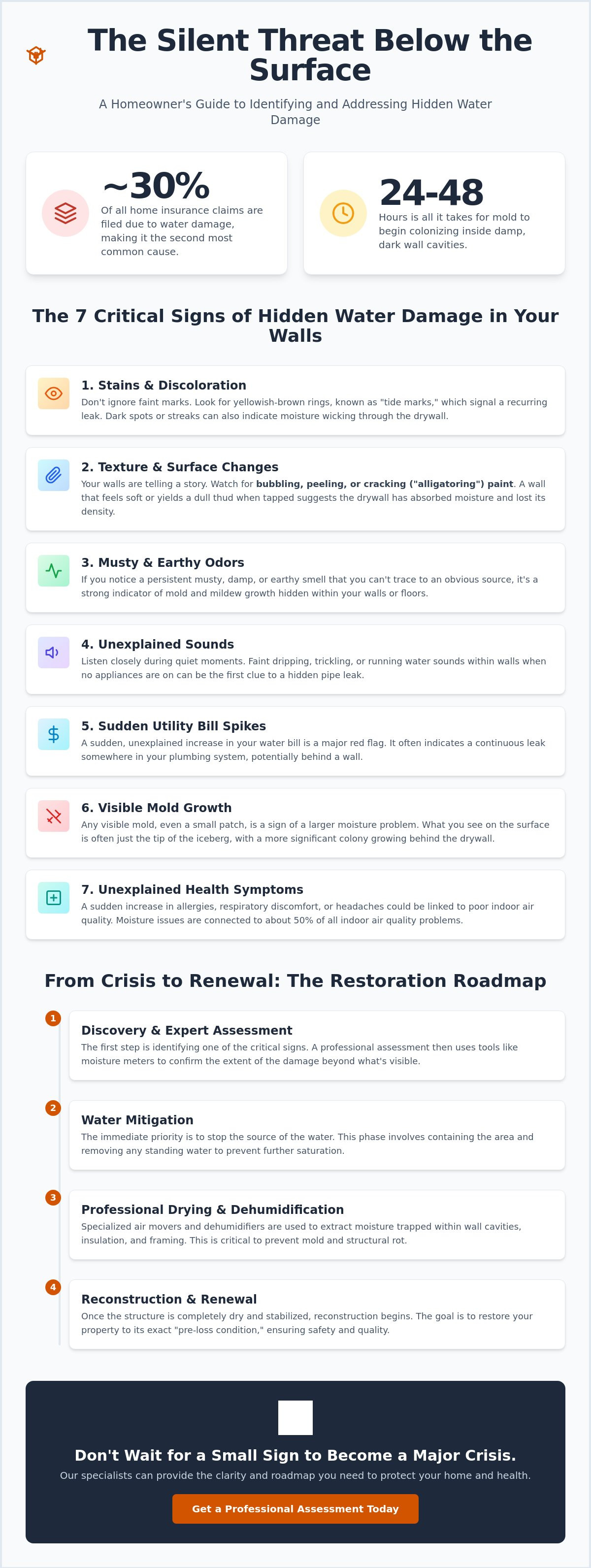
Identifying the signs of hidden water damage in walls requires a disciplined eye and a methodical approach to your home's environment. While some indicators are obvious, others are subtle warnings that your property is currently in a state of crisis. We categorize these warnings into the "Big 7": stains, texture changes, odors, sounds, utility spikes, mold growth, and physical health symptoms. Each of these signals acts as a diagnostic tool that helps you determine when it's time to pivot from observation to professional intervention.
The "tapping test" is one of the most effective DIY strategies for assessing your home's interior. When you tap on a healthy wall, you should hear a clear, hollow sound; however, a dull, soft thud indicates that the drywall has absorbed moisture and lost its structural density. Similarly, keep a close watch on your flooring transitions. Baseboard warping or a slight "cupping" near the wall is often the first silent alarm for a slab leak or a pipe burst occurring behind the scenes. If these signs leave you feeling overwhelmed, seeking a professional assessment for water damage restoration can provide the clarity and roadmap you need to move forward.
Visual and Tactile Indicators
Your walls tell a story through their surface finish, and learning to read that story is vital for early detection. Bubbling paint is a high-priority sign, as it typically indicates that liquid water is physically trapped between the drywall and the paint film. This differs from peeling paint, which is more commonly a result of age or poor surface preparation. You should also look for "tide marks," which are yellowish-brown rings that indicate a recurring leak that has saturated and dried multiple times. Additionally, watch for "alligatoring," a pattern of fine cracks that suggests the underlying materials are repeatedly swelling and shrinking due to fluctuating moisture levels.
Auditory and Olfactory Warnings
Sometimes your ears and nose will detect a problem before your eyes do. A persistent hissing sound often points to a high-pressure pinhole leak in a copper line, while a rhythmic dripping usually signals a roof intrusion or failed flashing. These auditory clues are often accompanied by a distinct, musty odor. These scents are strongest when the HVAC system is running, as air circulation pulls microbial VOCs from the damp wall cavities into your living spaces. Finally, check your water bills regularly. A sudden spike in usage without a change in habits is a mathematical indicator that water is escaping your plumbing system. As you work to control moisture in your home, these sensory clues act as your primary defense against long-term structural loss and health risks.
Beyond the Surface: How to Verify Hidden Leaks
Once you suspect a problem, the next step is moving from observation to verification. While the human eye can detect surface stains, it cannot see through porcelain tile or heavy kitchen cabinetry. This is where a methodical inspection becomes your most valuable asset. Verifying the signs of hidden water damage in walls involves a combination of tactile checks and professional-grade technology to pinpoint the exact source of intrusion without causing unnecessary destruction to your home. Our approach focuses on non-invasive testing to protect your property from premature demolition while providing the clear answers you need to restore your peace of mind.
The Moisture Meter vs. Thermal Imaging
Moisture meters are essential for quantifying the exact percentage of water within a building material, allowing us to distinguish between normal humidity and structural saturation. Pinless meters use electromagnetic signals to scan deep into the wall, while pin-type meters provide precise readings by penetrating the surface. In contrast, thermal imaging cameras detect "cold spots" that indicate active evaporation, visually mapping the hidden moisture plume behind your drywall. Professional interpretation is vital here, as cold air drafts or metal studs can create false positives that look like water damage to an untrained eye. Using these tools correctly provides the relief that comes from knowing exactly where the problem lies, allowing for a targeted and efficient restoration plan.
Checking High-Risk Areas
Certain areas of your home are naturally predisposed to moisture issues due to their proximity to plumbing or external elements. Begin by pulling away the kickplates on your dishwasher and refrigerator to look for slow-leak evidence, such as warped subflooring or dark spots on the back wall. Inspect window sills and door frames for "soft wood," which indicates advanced rot from failed exterior flashing or poor drainage. Don't forget to check the attic; water often enters through a roof leak and travels down the interior of the wall cavity, manifesting as damage on the first floor. By following these signs of water damage in walls, you can catch a problem in its infancy before it compromises your home's structural load-bearing capacity. This thorough, methodical search acts as a stabilizing force, turning a chaotic situation into a controlled project that moves your home closer to total renewal.
From Crisis to Renewal: The Path from Mitigation to Reconstruction
Once you've identified the signs of hidden water damage in walls, the journey toward recovery begins with a clear, two-part strategy. Many homeowners assume that once the standing water is gone, the problem is solved, but professional water mitigation is only the first half of the journey. This initial "stabilization" phase focuses on preventing further loss through high-capacity extraction and industrial-grade dehumidification. It's a critical period where we assume the burden of the crisis to ensure your home's structural integrity is preserved. For those dealing with property issues in our local service area, you can find a deep dive into recovery in our guide on water damage in Arlington, WA.
The transition from drying to rebuilding requires a contractor who understands both the technical requirements of restoration and the creative possibilities of remodeling. This dual expertise allows for a frictionless experience where your home isn't just patched, but truly renewed. We prioritize a methodical flow that moves your property from a state of chaos back to a high-quality finished state, ensuring every structural element is as safe and safety-conscious as it was before the incident occurred.
Navigating the Insurance Reconstruction Process
Rebuilding after a leak involves more than just physical labor; it requires a protective specialist who acts as an advocate for the property owner. Professional documentation, including detailed moisture maps and photo evidence, is essential to ensure your insurance claim accurately reflects the scope of the work needed. Since the average insurance claim payout for water damage was $13,954 in late 2025, having a disciplined partner to manage these details is vital for a successful outcome. Working with experienced insurance restoration companies reduces administrative friction and allows you to focus on returning to your normal routine while we handle the complex negotiations.
The Opportunity for Upgrade
While the primary goal is returning your home to its pre-loss state, this period of reconstruction offers a unique opportunity for a form of total renewal. If a wall must be opened to address signs of hidden water damage in walls, it's often the perfect time to execute a waterproof shower remodel or a modern bathroom update. We help you balance the necessity of "restoring to original" with the aspirational goal of "improving for the future." This "down time" can be leveraged for high-quality kitchen or bathroom remodeling that adds long-term value to your property. If you're ready to move from discovery to a fully restored home, our team is prepared to manage your reconstruction and remodeling project from start to finish.
Why Professional Restoration is Essential in the Puget Sound
Living in the Puget Sound region means contending with a unique set of environmental challenges that make DIY drying nearly impossible for most homeowners. While you may have successfully identified the initial signs of hidden water damage in walls, the high ambient humidity in cities like Seattle and Arlington prevents building materials from reaching a "dry standard" through simple ventilation. In our wet climate, moisture trapped in wall cavities doesn't just evaporate; it lingers for weeks, creating a persistent breeding ground for microbial growth. Professional restoration is essential here because we utilize specialized LGR (Low Grain Refrigerant) dehumidifiers designed to pull water vapor from the air even in the dampest conditions, ensuring your home is truly stabilized.
We act as a stabilizing force during what is often a high-stress property crisis. Attempting to manage a leak without professional-grade extraction often leads to "secondary damage," where elevated humidity levels cause hardwood floors to cup or mold to form on furniture far from the original leak site. By assuming the burden of the crisis on your behalf, we provide the relief and peace of mind that comes from a disciplined, expert intervention. Our team is deeply committed to your satisfaction, moving methodically from the chaos of discovery to the orderly completion of a high-quality finished state.
Local Expertise: Arlington to Seattle
Everett, Shoreline, and Seattle each have specific drainage patterns and soil compositions that influence how groundwater interacts with residential foundations. Local building codes in the Puget Sound also dictate rigorous standards for moisture barriers and structural integrity during the reconstruction phase. Having a local partner who can be on-site quickly for emergency mitigation is the difference between a minor repair and a total structural failure. We understand these local nuances and the specific moisture challenges of the Pacific Northwest, acting as your protective specialist to ensure your home meets all safety requirements while returning to its pre-loss condition.
The DK Production Promise: Quality and Ease
We believe that a property crisis shouldn't just be managed; it should be transformed into an opportunity for total renewal. Our commitment to a frictionless experience means we assume the full weight of administrative coordination and technical execution. From the moment we verify the signs of hidden water damage in walls to the final walkthrough of a high-end remodel, we maintain a logical, results-oriented flow. We don't just patch drywall. We advocate for your property's long-term value and your family's health through rigorous standards of performance. If you are ready to move from the stress of discovery to the relief of a completed project, we invite you to Request a professional water damage assessment and begin the journey back to normalcy.
Turning Discovery into a Path for Property Renewal
Recognizing the signs of hidden water damage in walls is the critical pivot from a property crisis to a controlled home renewal. By understanding the sensory warnings and utilizing professional-grade verification, you protect your family's health and your home's structural integrity from the unique moisture challenges of the Puget Sound. Early intervention ensures that a "slow-motion" disaster is stopped before it requires extensive structural replacement.
Since 2014, our team has acted as a stabilizing force for homeowners, providing expert water mitigation and high-value residential remodeling. We specialize in navigating complex insurance restoration claims, assuming the administrative burden so you can focus on returning to your normal routine. Our methodical approach ensures every project moves from chaos to a high-quality finished state with total accountability. Your home deserves more than a simple repair; it deserves a form of total renewal led by experienced specialists.
Restore Your Home to Perfection—Contact DK Production Today. We are ready to help you navigate this transition with confidence and ease.
Frequently Asked Questions
Is hidden water damage covered by standard homeowners insurance?
Standard homeowners insurance usually covers hidden water damage if the cause is sudden and accidental, such as a burst pipe or a failing appliance. However, policies often exclude damage resulting from long-term seepage or a lack of routine maintenance. We recommend reviewing your specific policy and working with a professional who can provide the detailed documentation required to support your claim and ensure a frictionless recovery.
How long does it take for mold to grow behind a wet wall?
Mold can begin to colonize dark, damp wall cavities in as little as 24 to 48 hours after moisture intrusion. This rapid growth makes immediate professional intervention essential to protect your home's structural integrity and your family's health. Because mold feeds on organic materials like drywall and wooden studs, delaying the drying process often leads to more extensive restoration requirements.
Can I just use a dehumidifier to fix a leak in my wall?
A residential dehumidifier cannot fix a leak or dry out saturated materials trapped inside a wall cavity. While it may reduce ambient humidity, it won't reach the moisture held by insulation or the wooden framing members. Using a small unit as a primary solution often provides a false sense of security while the signs of hidden water damage in walls continue to worsen behind the surface.
What are the health symptoms of living with hidden water damage?
Living with hidden moisture often leads to respiratory discomfort, persistent allergies, and the worsening of asthma symptoms. These issues are frequently caused by the release of microbial Volatile Organic Compounds (VOCs) and mold spores into your indoor air. If you notice unexplained health changes alongside a musty odor, it's a strong indicator that moisture is currently compromising your home's environment.
How much does it cost to repair water damage in a wall?
The cost of repairing water damage varies significantly based on the source of the water, the extent of the structural saturation, and the types of materials involved. While minor clean-water incidents are less complex, contaminated "black water" events or long-term leaks require more intensive sanitation and reconstruction. A professional on-site evaluation is the only way to get an accurate roadmap and budget for your specific restoration needs.
What is the difference between water mitigation and water reconstruction?
Water mitigation is the immediate stabilization phase that involves water extraction, professional drying, and sanitation to prevent further loss. Water reconstruction is the subsequent phase where we rebuild and remodel the damaged areas to return your home to a high-quality finished state. We manage both phases to provide a seamless transition from the initial crisis to the final, renewed result.
How do I know if a stain is old or currently leaking?
You can identify an active leak by checking the texture and temperature of the stain; active moisture often feels damp, soft, or cool to the touch. In contrast, an old stain that has completely dried will usually feel brittle and hard. However, because surfaces can dry while the interior remains saturated, using a professional moisture meter is the most reliable way to confirm if a leak is truly resolved.
Why is my wall soft to the touch but not wet?
A wall that feels soft but dry to the touch has likely suffered structural damage to its gypsum core from a previous moisture event. Even if the water has evaporated, the internal integrity of the drywall is permanently compromised, which is one of the common signs of hidden water damage in walls. This softness suggests that the materials have lost their load-bearing capacity and may require professional reconstruction to ensure safety.


Comments