
Financing a Home Remodel in Washington: The 2026 Homeowner’s Guide

Updated: 1 day ago
Could the very equity you’ve built in your home be the safest way to hedge against inflation in 2026? While high interest rates might make you hesitate, the cost of delaying a necessary reconstruction or kitchen remodel often outweighs the price of a well-structured loan. We understand that financing a home remodel in Washington feels like a high-stakes puzzle right now. You want to breathe new life into your space, but the fear of over-leveraging or choosing the wrong financial product can keep you stuck in a home that no longer fits your lifestyle.
We're here to act as your professional advocate, providing the clarity you need to move forward with confidence. This guide simplifies the path to your dream addition or bath by offering a direct comparison of HELOCs and construction loans tailored to the current market. You’ll learn about the updated 2026 Washington loan limits and discover a methodical plan to align your capital with your contractor’s timeline. From initial planning to the final walkthrough, we’ll help you transform financial complexity into a streamlined roadmap for your home’s renewal.
Table of Contents
The 2026 Washington Remodel Landscape: Costs and Equity
The Puget Sound corridor continues to show remarkable resilience, yet homeowners face a unique set of financial variables when planning a reconstruction or whole house remodeling project. Your home is likely your most significant asset. Protecting that value requires a strategic approach to debt. We understand that the shifting market can feel daunting, but identifying your current equity position is the first step toward a stable, successful project. Our goal is to act as a stabilizing force, helping you transform financial uncertainty into a clear roadmap for your home’s renewal.
Understanding Your Home Equity in the Puget Sound
Home equity represents the difference between the current market value of your property and the remaining balance on your mortgage. In Snohomish and King County, recent property tax assessments reflect a sustained demand for housing. This often translates to higher borrowing power for you. Lenders typically evaluate your Loan-to-Value (LTV) ratio, often requiring you to maintain at least 15% to 20% equity after your loan is funded. This buffer protects you from market fluctuations while providing the capital needed for substantial home improvement financing. It’s a protective measure that ensures you aren't over-leveraged during your renovation.
2026 Washington Loan Limits and Conforming Loans
For 2026, the Federal Housing Finance Agency has adjusted conforming loan limits to reflect the high-value nature of the Washington market. In high-cost areas like King and Snohomish counties, these limits sit significantly higher than the national floor. They often allow homeowners to access over $1.15 million without entering jumbo loan territory. Understanding these limits is essential when financing a home remodel in Washington, as it dictates whether you qualify for standard or jumbo products. Conforming loans generally offer more favorable terms and lower interest rates, making them an ideal choice for large-scale bathroom remodeling or kitchen projects.
There is a distinct difference between wish list remodeling and value-add reconstruction. While a new aesthetic is wonderful, focusing on structural integrity and high-ROI updates ensures your investment pays off. We recommend prioritizing projects that address both form and function. These are the improvements lenders value most during the appraisal process. For homeowners looking to maximize value through functional exterior upgrades, you might visit Affordable Garage Door Repair & Sales LLC to find cost-effective solutions that enhance curb appeal and security.
When you're budgeting for labor and materials in Everett or Kirkland, a 15% contingency fund is no longer optional. Local supply chain dynamics and the high demand for skilled trades mean that unexpected costs can arise. Planning for these variables from the start prevents the stress of a mid-project funding gap. Financing a home remodel in Washington is a methodical process. Starting with a clear view of your equity ensures your project stays on track from the first estimate to the final coat of paint.
Choosing the right debt structure is a critical step in your home’s total renewal. It’s not just about the interest rate; it’s about aligning the capital with your project’s specific rhythm. Financing a home remodel in Washington requires a nuanced understanding of how different products interact with your existing mortgage and long-term goals. We see our role as a supportive partner in this process, helping you identify the most stable path to fund your vision while maintaining your financial peace of mind.
HELOC vs. Home Equity Loan: Which is Better?
A Home Equity Line of Credit (HELOC) acts like a revolving credit line secured by your property. It’s particularly effective for phased projects, such as a series of bathroom remodeling updates spread across several months. You only pay interest on the funds you actually draw. In contrast, a Home Equity Loan provides a lump sum with a fixed rate, offering stability for those who prefer predictable monthly payments. Many homeowners utilize a HELOC as a protective financial cushion for restoration projects where the full scope might evolve as work progresses.
A Cash-Out Refinance involves replacing your current mortgage with a larger one and taking the difference in cash. In 2026, this option is most viable if your current rate is relatively close to market averages. If you currently hold a legacy low rate, a second mortgage or FHA Title I Property Improvement Loans might be more cost-effective than resetting your entire primary debt. This strategy allows you to access capital without sacrificing the favorable terms of your original mortgage.
Renovation-Specific Mortgages: FHA 203(k)
Government-backed options like the FHA 203(k) or Fannie Mae Homestyle are designed for major reconstructions. The "Limited" path covers smaller repairs up to $35,000, while the "Standard" path is for structural work and requires a HUD-certified consultant. These loans are unique because they factor in the "after-improved" value of the home. This allows you to borrow based on what your house will be worth after we complete your addition or whole house remodeling project, rather than its current state.
For smaller kitchen or bath updates, an unsecured personal loan offers a fast, no-collateral alternative. While interest rates are typically higher, the lack of closing costs and quick funding can be a relief when you need to move forward quickly. When you're evaluating the best path for financing a home remodel in Washington, consider the duration of your construction. Obtaining a professional estimate for your reconstruction helps you secure the exact amount of capital needed to finish your project without friction or unexpected shortfalls.
Matching Your Loan to Your Project Scope
Your choice of funding should mirror the physical scope of your project. A minor kitchen refreshment requires a different financial strategy than a multi-story addition or a whole-house reconstruction. We aim to help you align these pieces so the process feels orderly rather than chaotic. When you are financing a home remodel in Washington, matching the loan to the project scope is the most effective way to protect your investment. Understanding your home equity loan options is the foundation for this alignment. When you match the debt type to the project duration, you avoid the stress of high-interest short-term debt on a project that takes months to complete.
Financing Restoration and Reconstruction
Unexpected property damage brings immediate stress. While insurance typically covers the cost to return your home to its pre-loss condition, many homeowners see this as an opportunity for total renewal. Bridging the gap between an insurance payout and a high-end upgrade requires careful coordination. Managing the flow of funds between your bank, insurance adjuster, and contractor is a specialized task. We act as your advocate here, ensuring that your home remodeling in Seattle project remains financially transparent. Choosing one of the right insurance restoration companies is vital because they understand how to document these costs for your lender. This partnership ensures that your reconstruction moves forward without the friction of administrative delays.
Major Additions and Whole-House Renovations
Structural changes like residential additions introduce complexity that standard loans often can't handle. For these large-scale transformations, construction-to-permanent loans are often the most stable choice. Lenders in areas like Arlington and Everett rely heavily on "as-completed" appraisals. This means they value your home based on its future state, which unlocks the capital needed for significant footprint expansions. It's essential to include costs for engineering and permits within your initial loan request. Financing a home remodel in Washington that involves structural work requires a disciplined budget. We provide the professional estimates needed to ensure your loan covers every detail, from the first permit fee to the final finishing touch. This methodical approach removes the friction of mid-project budget adjustments and allows you to focus on the excitement of your home's transformation. Our experience in managing complex timelines acts as a stabilizing force throughout the duration of your project.
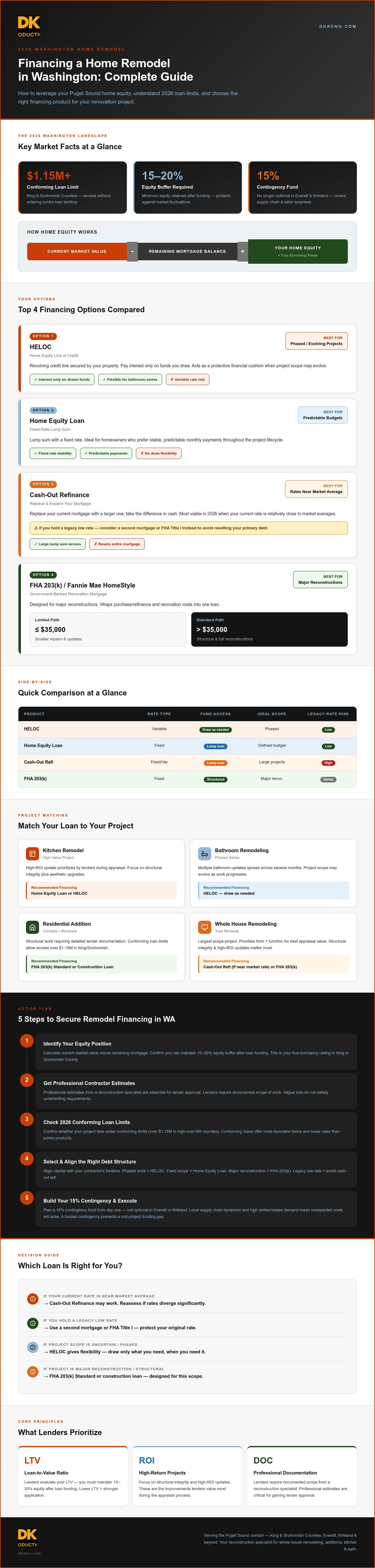
5 Steps to Secure Remodel Financing in WA
Securing the capital for a major home transformation is a methodical journey that requires both financial discipline and professional partnership. We understand that the application process can feel overwhelming, especially when you're managing the stress of a reconstruction or whole house remodeling project. By following a structured approach, you can move from initial planning to funded approval with confidence. Our role is to act as your advocate, ensuring your financial preparation matches the high standards lenders expect in the Puget Sound market.
Assess Your Financial Health: Start by reviewing your credit score and Debt-to-Income (DTI) ratio. Lenders prioritize applicants with a DTI below 43%, as this suggests you can comfortably manage your new loan alongside existing obligations.
Define the Scope: Clearly outline whether you're pursuing a kitchen remodel, a bathroom update, or a structural addition.
Select Your Product: Choose between a HELOC, cash-out refinance, or renovation-specific loan based on your current equity and project timeline.
Partner with a Specialist: Choose a contractor who understands the administrative rigor of construction financing.
Complete the Appraisal: Prepare for a professional valuation that considers the "as-completed" value of your home.
The Importance of a Detailed Contractor Bid
A vague ballpark estimate is one of the most common reasons lenders reject a renovation loan. Financial institutions require a line-item budget and a comprehensive materials list to verify that the loan amount aligns with the actual work. Financing a home remodel in Washington requires this level of precision to protect both you and the bank. This standard for professional documentation is mirrored by top-tier contractors like A United Construction, who provide detailed project breakdowns for luxury remodels in the D.C. area. We assist our clients by creating bank-ready documentation that clearly defines every phase of the project. This transparency removes friction during the underwriting process and establishes a reliable foundation for your home’s renewal.
The appraisal is a pivotal moment in your financing journey. In competitive areas like Shoreline or Everett, local comps (comparable sales) heavily influence your loan-to-value ratio. If an appraisal comes in lower than expected, you may need to adjust your scope or provide additional cash to close the gap. Once approved, your lender will likely implement a draw schedule. This means funds are released in stages as we hit specific construction milestones. This logical flow ensures that the work stays on schedule and that the capital is used efficiently. To begin this process with a reliable partner, you can request a professional reconstruction estimate to provide to your lender.
The DK Production Advantage: Your Partner in Reconstruction
Choosing the right partner for your project is just as important as choosing the right loan. At DK Production, we act as a stabilizing force throughout the entire duration of your project. Financing a home remodel in Washington is a complex administrative task, but our team provides the rigorous documentation lenders demand. We specialize in high-value reconstruction and remodeling, which means we understand the technical language required to bridge the gap between your vision and the bank's requirements. Our goal is to remove the friction that often stalls large-scale repairs and renovations, allowing you to focus on the excitement of your home's transformation.
From Crisis to Renewal: Our Restoration Expertise
When your property suffers damage from water or fire, the path back to normalcy can feel overwhelming. We assume the burden of administrative coordination on your behalf. Our experience with insurance claims allows us to advocate for you, ensuring that the scope of work reflects the true cost of total renewal. As a one-stop restoration and remodeling shop, we manage every detail from water mitigation to the final kitchen or bathroom remodeling touches. This integrated approach is a key factor when you're looking for home remodel contractors near me who can handle both the crisis and the subsequent upgrade. We act as project managers and protective specialists, ensuring that your reconstruction isn't just a repair; it’s a form of renewal that restores your home's value and your peace of mind.
Ready to Start Your Transformation?
If you're ready to move forward with your Arlington or Seattle home, the first step is a professional consultation. We recommend bringing the following to our first meeting to streamline the process:
Your current mortgage statements or equity estimates.
Initial design ideas or "must-have" lists for your addition or remodel.
Any insurance claim documents if the project involves restoration.
A general project timeline that aligns with your family's needs.
This information allows us to create a precise line-item budget that you can take to your lender. Financing a home remodel in Washington is much simpler when you have a disciplined advocate by your side. We’re committed to your satisfaction and the eventual return to a high-quality finished state. Contact us today to schedule your consultation and receive the professional estimate your project deserves.
Secure Your Home’s Future with a Clear Financial Path
The journey toward your home’s total renewal is a methodical process that begins with financial clarity. We’ve explored how matching your loan structure to your specific project scope ensures stability, whether you’re planning a phased bathroom update or a major structural addition. By understanding the 2026 loan limits and preparing detailed, bank-ready estimates, you remove the friction that often delays high-value reconstruction. Successfully financing a home remodel in Washington requires a partner who understands the technical demands of the Puget Sound market and the administrative rigor of lender requirements.
Since 2014, our team has provided expert insurance claim advocacy and local craftsmanship to help homeowners move from initial planning to a high-quality finished state. We act as your advocate, providing the transparent communication and professional estimates you need for a frictionless experience. When you’re ready to begin your home’s next chapter, we’re here to assume the burden of the details for you. Start Your Stress-Free Remodel with a Professional Estimate from DK Production and take the first step toward your dream space today. Your home’s transformation is within reach, and we look forward to supporting your vision.
Frequently Asked Questions
Can I finance a remodel if I have a low-interest primary mortgage?
Yes, you can finance your project without touching your primary mortgage by using a Home Equity Line of Credit (HELOC) or a home equity loan. These "second mortgages" allow you to borrow against your equity while keeping your current low interest rate intact. This is a common strategy for homeowners in Seattle and Kirkland who want to avoid resetting their primary mortgage in a higher-rate environment. It provides a stable way to fund your kitchen or bathroom transformation.
What is the best loan for a kitchen remodel in Washington?
The best option often depends on your specific project scope and timeline. For a phased kitchen remodel, a HELOC offers the most flexibility because you only pay interest on the funds you draw. If you prefer fixed monthly payments for a one-time project, a home equity loan might be better. When you are financing a home remodel in Washington, our team can provide the detailed estimates your lender needs to approve the necessary capital.
How much equity do I need to get a HELOC in 2026?
In 2026, most lenders in the Puget Sound corridor require you to maintain at least 15% to 20% equity in your home after the loan is issued. This means your total combined loan-to-value (CLTV) ratio generally cannot exceed 80% or 85%. If your property in Shoreline or Bothell has seen recent value increases, you may have more borrowing power than you realize. Maintaining this equity buffer acts as a protective measure for your financial stability.
Does homeowner’s insurance cover the cost of a remodel?
Standard homeowner’s insurance does not cover voluntary remodeling or aesthetic upgrades. It is designed to cover restoration and water mitigation after a covered loss, such as a burst pipe or fire. However, if you are already undergoing reconstruction after property damage, you can choose to pay for additional remodeling upgrades out-of-pocket. We often help homeowners in Arlington coordinate these upgrades during the restoration process to streamline the renewal of their living space.
What are the 2026 loan limits for King County, WA?
For 2026, conforming loan limits in high-cost areas like King and Snohomish County are significantly higher than the national average. These limits often exceed $1.15 million for single-family homes, allowing you to access substantial capital without needing a jumbo loan. Understanding these local caps is essential when financing a home remodel in Washington for whole house remodeling or a large-scale addition. Because these limits change annually, it is vital to check the current FHFA data before applying.
How do I pay for reconstruction after water damage in Everett?
Paying for reconstruction in Everett typically involves a two-part process. First, your insurance payout covers the cost to return the home to its original state. Second, you can use home equity or personal savings to fund any desired upgrades or remodeling. We specialize in managing this administrative coordination, acting as your advocate with the insurance company. This ensures that the water damage repair and subsequent reconstruction move forward as one seamless, frictionless project.
Can I use a personal loan for a home addition?
You can use a personal loan for an addition, but it may not be the most cost-effective choice for large structural projects. Personal loans are unsecured, meaning they often have higher interest rates and lower borrowing limits than equity-based options. For a significant residential addition in Kirkland, a construction-to-permanent loan or a home equity loan is usually more appropriate. These products offer the higher capital amounts and longer repayment terms required for major structural transformations.
What is the difference between a renovation loan and a construction loan?
A renovation loan is designed for making improvements to an existing home, such as a kitchen remodel or bathroom upgrade. In contrast, a construction loan is typically used for building a new structure from the ground up. At DK Production, we focus exclusively on remodeling and additions for existing residential properties. Renovation loans like the FHA 203(k) are particularly useful because they allow you to borrow based on the predicted "as-completed" value of your home.


Comments