
Cost to Fix Ceiling Water Damage in Seattle: 2026 Restoration Price Guide

Updated: Jun 17
Last Tuesday, a homeowner in Queen Anne discovered a small, damp circle on her living room ceiling that tripled in size by sunset. Like many in our humid climate, she was suddenly caught between the fear of hidden mold growth and the confusion of whether to call a roofer, a plumber, or a drywaller. It's a high-pressure moment where the uncertainty surrounding the cost to fix ceiling water damage Seattle homes require can feel as overwhelming as the leak itself.
We understand that the stress of a property crisis is often compounded by the fear of hidden damage and the frustration of navigating complex insurance paperwork. This article provides a clear, expert breakdown of restoration expenses in 2026, from minor drywall patches to full structural reconstruction. You'll learn how to manage the administrative friction of claims, understand the impact of the July 2026 stormwater code updates, and discover how a professional, methodical approach ensures your ceiling looks brand new while protecting your home's long-term health.
Key Takeaways
Learn why Seattle's persistent humidity prevents natural drying and how to identify the multi-layer damage affecting your drywall and structural framing.
Gain a clear understanding of the factors driving the cost to fix ceiling water damage Seattle residents encounter, including current labor rates and tiered repair categories.
Distinguish between urgent water mitigation and the eventual reconstruction phase to ensure a frictionless transition from initial leak to a brand-new finish.
Master the documentation process and insurance rules for "Sudden and Accidental" losses to help maximize your coverage and streamline your claim.
Explore how to leverage a ceiling restoration project as a starting point for high-end kitchen or bathroom remodeling to elevate your home's value.
Table of Contents
Understanding the Scope of Ceiling Water Damage in the Puget Sound
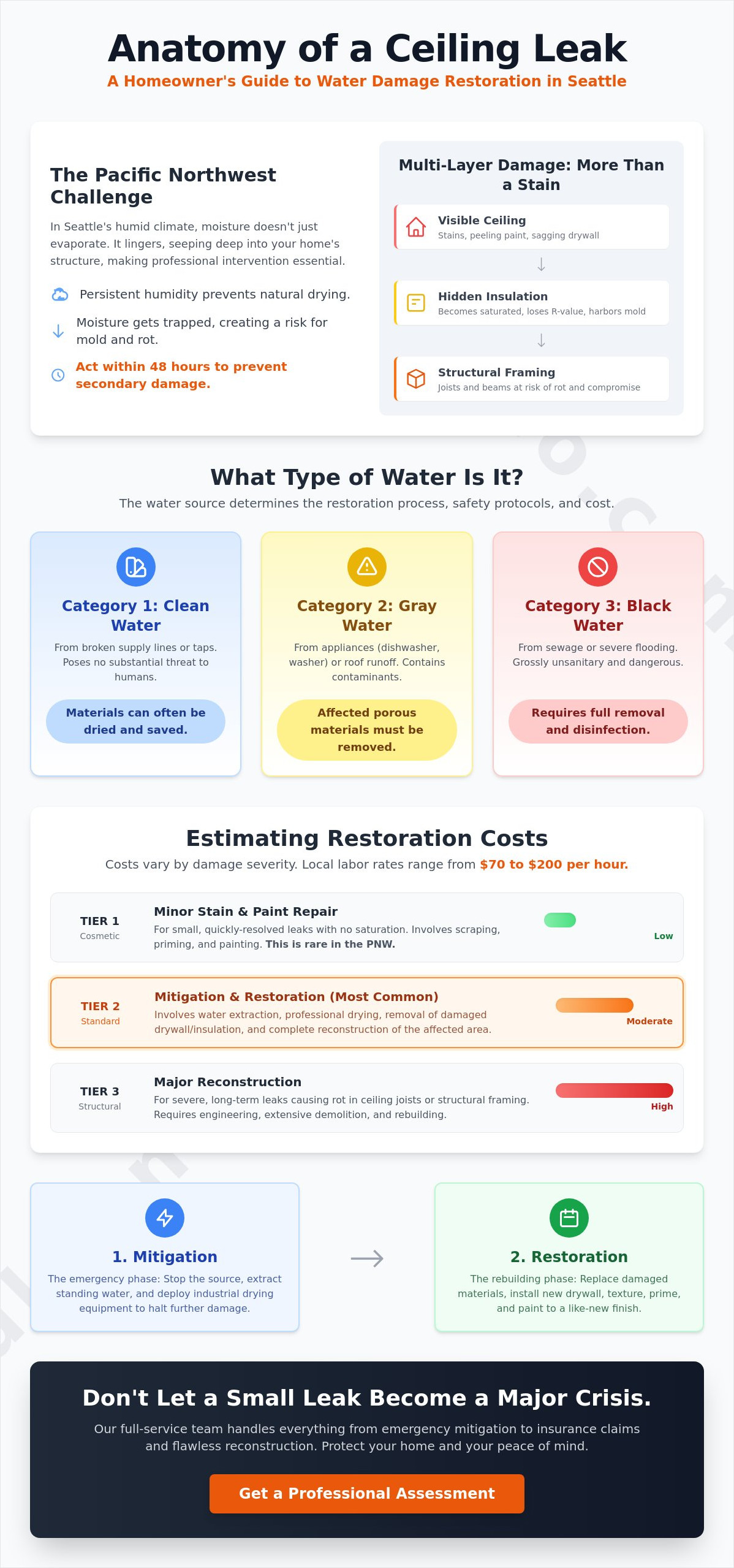
When a ceiling begins to sag or discolor, the visible stain is rarely the whole story. True ceiling water damage is a complex, multi-layer issue that impacts your drywall, the saturated insulation behind it, and the structural framing that supports your home. Understanding water damage at this level is essential because moisture trapped in these hidden cavities creates a breeding ground for complications. If the water reaches your ceiling joists, it can compromise the very skeleton of your property. Secondary damage is the structural rot or mold that occurs when a ceiling is not professionally dried and remediated within the first 48 hours.
Most incidents in our region stem from three primary sources: wind-driven roof leaks, sudden plumbing failures, or overflowing appliances on an upper floor. Since overhanging branches often contribute to roof damage during local storms, residents can learn more about CDA TREE AND UTILITY to protect their homes. While a single drip might seem manageable, the cost to fix ceiling water damage Seattle residents encounter often escalates when these sources are left unaddressed. A slow leak from a bathroom above can saturate the floorboards and the ceiling below simultaneously, creating a dual-layered restoration challenge that requires a methodical, professional touch to resolve.
The Seattle Factor: Why Moisture Lingers
In the Pacific Northwest, we face over 150 rainy days a year, which creates a unique challenge for property recovery. Seattle's persistent humidity makes "natural drying" nearly impossible for trapped moisture. In older housing stock found from Shoreline to Everett, the lack of modern vapor barriers often allows dampness to migrate through attic spaces unchecked. This environment acts as a sponge. Because our ambient air is so frequently saturated, professional dehumidification is a non-negotiable requirement in King and Snohomish Counties to pull moisture from deep within the wood joists. Without high-grade industrial equipment, the wood remains at a high moisture content, which almost guarantees the return of mold.
Identifying Water Categories (Clean vs. Gray vs. Black)
The industry classifies water into three categories, each dictating a different level of intervention. Category 1 involves "clean" water from broken supply lines. Category 2, or "gray" water, often comes from dishwashers or washing machines and contains some contaminants. Category 3 is "black" water, involving sewage or highly unsanitary sources. It's a common misconception that rain is clean. By the time roof runoff enters your home, it has collected organic debris, roof granules, and bird waste, meaning it is often treated as Category 2.
These classifications directly impact your project because they determine whether materials can be cleaned or must be entirely removed and replaced. This distinction is a major factor in the final cost to fix ceiling water damage Seattle projects require, as higher categories necessitate more rigorous safety protocols and specialized disposal fees to protect your family's health. We assume the burden of these technical assessments on your behalf, ensuring the recovery process is both safe and thorough.
Estimating the Cost: From Minor Stains to Structural Reconstruction
Calculating the cost to fix ceiling water damage Seattle homeowners face requires a clear understanding of the local labor market and the specific scope of the damage. In the Puget Sound region, professional restoration labor rates currently range from $70 to $200 per hour, reflecting the specialized skills needed to manage property recovery in our unique, high-humidity climate. Beyond labor, material costs for high-quality, moisture-resistant drywall and specialized stain-blocking primers have remained elevated. While it is tempting to seek the lowest possible estimate, "cheap" repairs that merely cover up a stain often fail to address the underlying moisture, eventually leading to the significant health risks of mold and thousands of dollars in future remediation expenses.
Tier 1: Minor Drywall and Paint Repair
This tier applies to cosmetic issues where the source of the leak was resolved immediately and the moisture never penetrated the insulation. The scope involves scraping away flaking material, applying a high-grade primer, and color-matching the paint. However, this scenario is quite rare in the Pacific Northwest. Because our ambient humidity is so high, even a small leak usually necessitates more than just a surface-level patch to ensure the home remains safe and dry.
Tier 2: Standard Water Mitigation and Restoration
The majority of projects fall into this category, where an active leak requires professional intervention to prevent long-term rot. This phase includes the removal of saturated insulation and the deployment of industrial air movers and dehumidifiers for three to five days. We believe that a frictionless recovery depends on the precision of IICRC-certified technicians who monitor moisture levels daily. Ensuring the cavity is completely dry before hanging new drywall is the only way to guarantee a high-quality, lasting finish. If you find yourself in the middle of a sudden leak, our team can help you navigate the transition from water mitigation to a fully restored state with ease.
Tier 3: Full Reconstruction and Structural Repair
When water damage causes a ceiling to sag or compromises the wood joists, the project moves into structural reconstruction. This is a complex undertaking that often requires matching custom textures or safely removing aged "popcorn" finishes. In cities like Seattle or Kirkland, these significant repairs may trigger the need for building permits to ensure the work meets current safety codes. We assume the burden of these administrative requirements, acting as your advocate to ensure every structural member is reinforced and your home's integrity is perfectly restored. This comprehensive approach is essential for maintaining the long-term value and safety of your property.
Mitigation vs. Restoration: Why the Process Dictates the Price
When you discover water dripping through a light fixture or pooling on your hardwood, it's natural to view the repair as a single, overwhelming task. However, professional recovery is actually a two-phase journey: mitigation and restoration. Understanding this distinction is vital because the cost to fix ceiling water damage Seattle homeowners incur is often determined by the precision of the initial response. Mitigation is essentially "stopping the bleed." It involves the immediate extraction of water, stabilization of the environment, and aggressive drying to prevent further loss. Restoration, or reconstruction, is the subsequent phase that returns your home to its pre-loss state, or even an upgraded condition, with high-quality finishes that make the original damage a distant memory.
Investing in professional mitigation upfront is a protective measure for your finances. While the equipment and labor for emergency drying carry an initial cost, they prevent the far more expensive $10,000 plus price tag associated with black mold remediation and structural rot. We act as a stabilizing force during this transition, assuming the burden of coordination between these two phases. By choosing a single-source contractor to manage the full duration of the project, you remove the friction of hiring multiple companies and ensure a seamless handoff from the drying crew to the master craftsmen who handle the final build-back.
The Emergency Mitigation Phase
This phase is high-intensity and focused on safety. We begin with water extraction and "flood cut" procedures, which involve removing precisely the amount of saturated drywall needed to vent the ceiling cavity. In Seattle's older homes, we utilize thermal imaging technology to detect hidden moisture pockets trapped behind traditional plaster and lath. This data-driven approach ensures we don't leave a single drop behind. Once the area is accessible, we apply antimicrobial treatments to the structural members. This step is non-negotiable in our humid climate, as it provides a protective shield against fungal growth while the industrial dehumidifiers work to stabilize the air.
The Reconstruction Phase
Once our sensors confirm the structure is dry, the focus shifts to renewal. This is where the cost to fix ceiling water damage Seattle projects require translates into visible quality. Our team handles the hanging, taping, and mudding of new drywall to create a seamless, invisible finish. We also take this opportunity to re-insulate the ceiling cavity, ensuring your home meets or exceeds current Washington State energy codes for better thermal efficiency. The process concludes with meticulous painting and trim work. Navigating insurance claims for these detailed repairs can be complex, but our administrative support team works alongside you to ensure every line item of the reconstruction is documented and accounted for, leading to a home that feels brand new again.
Navigating Insurance Claims for Seattle Water Damage
The complexity of a property loss often feels heaviest when it's time to talk to your insurance provider. Understanding the "Sudden and Accidental" rule is the first step in managing the cost to fix ceiling water damage Seattle policies typically cover. Standard homeowners insurance is designed to protect you against sudden catastrophes, like a burst pipe or a water heater failure. However, a slow, 10-year-old roof leak is often classified as a maintenance issue and may be denied. To protect your claim, you should document the damage immediately with high-resolution photos and videos before any cleanup begins. This visual evidence acts as a baseline for your loss and ensures nothing is overlooked during the recovery process.
We believe that you shouldn't have to face an insurance adjuster alone. DK Production acts as a protective specialist, assuming the burden of administrative negotiations on your behalf. Choosing the right insurance restoration companies means having an advocate who understands the technical language adjusters use. We provide the detailed documentation required to make the claims process frictionless, allowing you to focus on returning your home to its high-quality finished state.
Working with Your Claims Adjuster
When an adjuster visits your Seattle or Bothell home, they are looking for specific indicators of the loss. Having a professional, line-item estimate in hand before they arrive is a significant strategic advantage. It sets a standard for the conversation and ensures that often-missed items are addressed. Adjusters frequently overlook subfloor moisture beneath upper-floor leaks or the saturation levels of attic insulation. By pointing out these hidden issues during the walkthrough, we ensure the scope of work is accurate from day one.
Recoverable Depreciation and Deductibles
The financial side of a claim involves understanding the difference between Actual Cash Value (ACV) and Replacement Cost Value (RCV). ACV is the depreciated value of your ceiling today, while RCV is the actual amount it costs to rebuild it to a brand-new state. Most modern policies allow you to claim "Recoverable Depreciation," which is the difference between these two numbers, once the work is finished. Your deductible is the portion of the loss you are responsible for, and it is typically subtracted from the first payout. We provide the detailed invoicing and completion certificates your carrier needs to release these final funds quickly. If you need assistance with your current claim, our team can help you manage the recovery process from start to finish.
Choosing a Full-Service Partner for Ceiling Restoration in Seattle
Finding a partner who understands the full trajectory of property recovery is the most effective way to manage the cost to fix ceiling water damage Seattle homeowners encounter. Many contractors specialize in either the messy demolition of mitigation or the fine details of finishing, but choosing a firm that masters both disciplines creates a stabilizing force for your project. This comprehensive approach removes the friction of managing multiple crews and ensures that the technical requirements of drying are perfectly aligned with the aesthetic goals of reconstruction. By assuming the burden of coordination, a full-service specialist transforms a stressful event into a controlled, methodical path toward a dry and beautiful home.
We believe that every restoration project should be handled with a sense of quiet confidence and disciplined performance. When you work with a local professional who is licensed, bonded, and deeply familiar with Puget Sound building codes, you gain more than just a repair. You gain a protective specialist who advocates for your property's long-term health. Whether the damage was a sudden burst pipe or a rain-driven intrusion, a full-service partner ensures the transition from initial planning to final completion is smooth and results-oriented, ultimately protecting the value of your most significant investment.
Beyond Repair: Upgrading Your Space
The demolition required to reach wet insulation often provides a rare opportunity to improve your living environment. This "silver lining" allows you to integrate modern upgrades that would otherwise be cost-prohibitive as standalone projects. You might consider transitioning a simple ceiling repair into a more comprehensive kitchen remodel in Bellevue or a luxurious bathroom remodel in Kirkland. During the reconstruction phase, our team can easily install recessed LED lighting, improve acoustic dampening between floors, or apply custom textures that elevate your home beyond its original state. This results-oriented mindset ensures that the final product isn't just a repair, but a total renewal of your space.
The DK Production Difference
DK Production is deeply committed to providing a calm, disciplined response to property crises throughout the region. Our expertise spans the entire duration of a project, from the initial water extraction in Arlington and Everett to the final, high-end reconstruction in Seattle and Shoreline. We strike a balance between authoritative expertise and a supportive partnership, ensuring that the cost to fix ceiling water damage Seattle residents face translates into a frictionless experience and a high-quality finished state. If you are ready to move from chaos to order, contact DK Production for a professional assessment and a seamless restoration journey today.
Securing Your Path to a Fully Restored Home
A water-damaged ceiling is a structural challenge that requires a disciplined and methodical response. By prioritizing immediate mitigation and understanding the cost to fix ceiling water damage Seattle residents face, you protect your property from the long-term risks of secondary moisture and mold. We've explored how navigating insurance complexities and choosing a full-service partner can transform a stressful crisis into a frictionless journey toward renewal.
Founded in 2014, DK Production brings over a decade of Puget Sound expertise to every project. We act as your advocate, assuming the burden of both technical mitigation and premium reconstruction to ensure your home returns to a high-quality finished state. Whether you are repairing a sudden leak or leveraging the restoration as a starting point for a high-value kitchen or bathroom remodel, our team provides the stabilizing force and safety-conscious standards you deserve.
Restore your home with Seattle’s restoration experts. Contact DK Production today.
You don't have to manage this burden alone. With the right specialist by your side, your home will soon be dry, safe, and even more beautiful than before.
Frequently Asked Questions
Does homeowners insurance cover ceiling water damage in Seattle?
Most homeowners insurance policies cover ceiling water damage if the cause is sudden and accidental. This typically includes events like a sudden pipe burst or a water heater failure. However, gradual damage from a slow roof leak or poor maintenance is often excluded. We recommend reviewing your specific policy or working with a restoration partner who can help navigate the administrative requirements of your claim to help maximize your coverage.
How long does it take to fix a water-damaged ceiling?
A standard restoration project usually spans about two weeks. The initial mitigation phase requires three to five days of industrial drying to ensure the structural members are stabilized. Once the moisture levels are confirmed safe, the reconstruction phase involving drywall hanging, mudding, and painting takes another week. This methodical timeline ensures your home is perfectly dry before any finishes are applied, preventing future issues like mold or structural rot.
Can I just paint over a water stain on my ceiling?
You shouldn't simply paint over a water stain because it fails to address the moisture trapped in the drywall and insulation. Painting acts as a temporary mask that hides a deeper problem, often leading to hidden mold growth and structural decay. In the humid Seattle climate, trapped moisture will eventually cause the paint to bubble and the drywall to sag. A professional assessment is necessary to confirm the area is dry before any cosmetic renewal.
How do I know if the water damage has caused mold?
Mold can begin to grow within 24 to 48 hours of a water intrusion. While visible black or green spots are obvious signs, a persistent musty odor often indicates growth hidden behind the drywall or within the attic insulation. We use thermal imaging and moisture meters to detect these hidden pockets. If your ceiling has been wet for more than two days, professional antimicrobial treatment is a vital step in your recovery process.
What is the average hourly rate for restoration contractors in Seattle?
Professional restoration labor rates in the Puget Sound currently range from $70 to $200 per hour. This rate reflects the specialized expertise and high-grade equipment required to manage property recovery in our damp environment. When evaluating the cost to fix ceiling water damage Seattle projects require, remember that these rates cover IICRC-certified technicians who provide the administrative support and technical precision needed for a frictionless, high-quality restoration.
Do I need a permit to repair a water-damaged ceiling in King County?
You typically need a building permit in King County if the repair involves structural modifications, electrical work, or large-scale reconstruction. Minor cosmetic patches usually don't require one, but replacing multiple ceiling joists or re-wiring light fixtures will trigger a permit requirement. We assume the burden of these administrative details, working with local building departments in Seattle and Kirkland to ensure your restoration meets all current safety and energy codes.
Should I call a roofer or a restoration company first for a ceiling leak?
You should call a restoration company first to stabilize the interior and stop the moisture from spreading through your ceiling. While a roofer is needed to fix the source of the leak, a restoration specialist provides the immediate mitigation and drying equipment required to prevent mold and structural rot. We often act as project managers, coordinating with other trades to ensure the full duration of your recovery is handled with discipline and care.
What is the difference between water mitigation and reconstruction?
Mitigation is the emergency phase focused on "stopping the bleed" through water extraction, drying, and stabilization. It's the immediate response that prevents secondary damage. Reconstruction is the subsequent build-back phase where we hang new drywall, apply finishes, and return the space to its pre-loss state. A full-service partner manages both phases seamlessly, ensuring the cost to fix ceiling water damage Seattle homeowners incur leads to a brand-new, high-quality result.


Comments