
15 Critical Questions to Ask a Water Damage Restoration Company Before You Hire

Imagine walking into your laundry room only to find two inches of standing water and the unmistakable sound of a steady drip behind the drywall. In that moment of chaos, the urge to hire the first person who picks up the phone is overwhelming. However, making a rushed decision can lead to secondary issues like hidden mold growth or a rejected insurance claim. Knowing the right questions to ask water damage restoration company professionals ensures you aren't just hiring a technician with a fan; you're choosing a dedicated advocate for your home's long-term safety.
We understand that your property is your most significant investment, and seeing it damaged is deeply unsettling. You're likely feeling the weight of the mess and the anxiety of navigating complex administrative negotiations with your insurance carrier. This guide is designed to replace that stress with a clear, methodical path toward renewal. We've compiled 15 essential questions that will help you identify a partner capable of managing the entire journey from the initial "wet mess" to a high-quality finished state. You'll learn how to verify IICRC S500 compliance, address the rising friction in 2026 insurance claims, and ensure your home is restored to its pre-loss condition with total confidence.
Table of Contents
Verifying Professional Credentials and Response Capabilities
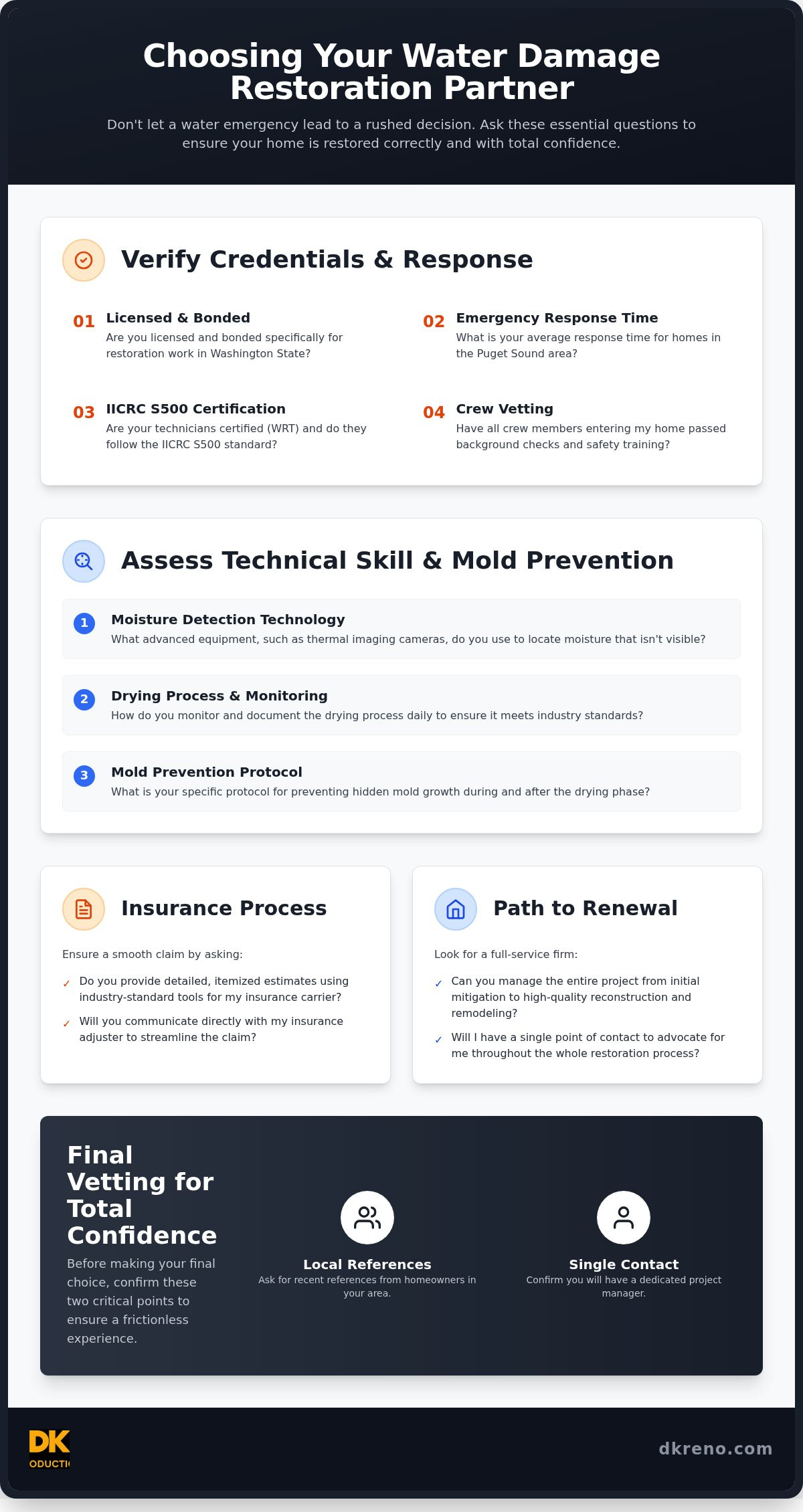
When water migrates through your flooring or saturates your drywall, you need a stabilizing force like DK Production to manage the chaos. Finding a partner who assumes the burden of the crisis starts with vetting their professional foundation. One of the first questions to ask water damage restoration company teams is whether they are licensed and bonded specifically for restoration work in Washington State. This distinction is vital; restoration requires specialized knowledge that exceeds typical general contracting and impacts how your insurance claim is handled.
When you're compiling your list of questions to ask water damage restoration company candidates, prioritize their average emergency response time for homes in the Puget Sound area. In a region where moisture levels are naturally high, every hour counts to prevent secondary damage. You should also confirm that every crew member entering your home has passed a background check and completed rigorous safety training. Your peace of mind depends on knowing the people in your private space are disciplined, safety-conscious professionals who respect your property.
The Importance of IICRC Certification
The ANSI/IICRC S500 Standard is the recognized gold standard for professional water damage restoration. While a general contractor might understand how to swing a hammer, a certified specialist understands the science of psychrometry and structural drying. Technicians holding current WRT (Water Damage Restoration Technician) certifications are trained to follow these rigorous performance standards. Insurance carriers often rely on these standards to validate the scope of work and justify the costs of the project. If a firm can't name their specific certifications or explain the S500 methodology, it's a significant red flag. They might leave your home looking dry while moisture remains trapped in the subfloor, leading to hidden mold growth.
Local Licensing and Insurance Requirements
Washington State has specific bonding requirements that protect homeowners during high-stakes restoration projects. Using unlicensed labor for insurance-funded repairs can lead to claim denials or significant legal liabilities if an injury occurs on-site. Local proximity matters just as much as legal standing. A firm with deep roots in Arlington, Everett, or Seattle can reach your property within the 24-hour window that is critical for effective drying. As noted in Wikipedia's guide to water damage, the restoration process involves complex categories of contamination that require immediate, expert intervention to prevent permanent structural loss. Choosing a local partner ensures a frictionless experience from the initial emergency call through the final transition to a fully restored home.
Technical Methodology: Questions About Drying and Mold Prevention
Effective water mitigation is a precise science, not just a matter of setting up fans and hoping for the best. When interviewing potential partners, one of the most technical questions to ask water damage restoration company representatives involves their specific protocol for detecting moisture that isn't visible to the naked eye. Water naturally seeks the path of least resistance, often pooling behind baseboards or inside wall cavities where it can cause structural rot long before you smell the first hint of mildew. A professional firm acts as a protective specialist, using data to drive every decision during the mitigation phase.
Your restoration partner should assumes the burden of the crisis by providing a clear, evidence-based drying plan. This plan isn't a static document; it's a living strategy that requires daily monitoring to ensure moisture levels are dropping according to industry standards. Asking about their process for preventing mold growth during this phase is essential. You need to know how they determine which materials can be saved versus what must be removed to protect your home's air quality and structural integrity. For a team that prioritizes this level of technical precision, DK Production offers the expertise needed to stabilize your property effectively.
Advanced Moisture Detection Technology
Relying on a visual inspection is never sufficient for a high-stakes restoration project. You should ask if the team utilizes thermal imaging cameras and non-penetrating moisture meters to find trapped pockets of water behind finished surfaces. These tools create a clear picture of the damage, allowing for the creation of documented 'moisture maps' that are essential for your insurance file. Because 'dry to the touch' is a misleading metric, professional monitoring ensures that materials like subflooring and structural studs have reached their specific dry standard before any reconstruction begins. This level of detail is another one of the vital questions to ask water damage restoration company technicians to ensure no hidden threats remain.
The Science of Structural Drying
The drying process requires a strategic balance of airflow, dehumidification, and temperature control to be successful. High-velocity air movers are used to pull moisture from surfaces, while industrial-grade LGR (Low Grain Refrigerant) dehumidifiers remove that moisture from the air to prevent it from re-saturating other materials. Structural drying is the scientific removal of moisture from building materials to pre-loss conditions. By utilizing 'closed-loop' drying systems, technicians can stabilize the environment and prevent cross-contamination or the spread of airborne spores. This methodical approach provides the relief and peace of mind that comes from knowing your home is being returned to a safe, high-quality state.
Navigating the Administrative and Insurance Claim Process
The administrative side of a water loss is often more stressful than the actual standing water. You're dealing with adjusters, policy limits, and complex terminology while trying to keep your family safe. When finalizing your list of questions to ask water damage restoration company candidates, you must address their ability to handle the paperwork. A truly professional firm doesn't just dry out your home; they act as a project manager and advocate for your property owner rights. They should provide a detailed, itemized estimate using industry-standard software like Xactimate. This ensures that the language used in the estimate matches what your insurance adjuster expects to see, which reduces friction and speeds up the approval process.
One of the most important questions to ask water damage restoration company teams is how they assist in documenting the loss. You need a partner who understands that professional documentation is the only way to ensure a fair settlement. This includes high-resolution photos of the damage, daily moisture readings, and equipment logs that justify the scope of work. Without this level of detail, you face a higher risk of claim denials or underpayment. Your partner should also help you understand the difference between mitigation, which is the emergency drying to stabilize the home, and reconstruction, which involves the actual repairs to restore your space.
Acting as Your Administrative Advocate
DK Production functions as a stabilizing force by bridging the gap between your immediate needs and the insurance company's requirements. We recommend looking for an insurance restoration specialist who understands how to document the loss thoroughly. This administrative support is a verbal signature of their commitment to being a collaborative ally. By assuming the burden of coordination, they allow you to focus on your family's well-being while they handle the technical negotiations with the adjuster. This methodical approach transforms a chaotic situation into an organized path toward total renewal.
Managing the Financial Transition
Understanding the financial mechanics of a claim is essential for a frictionless experience. You should ask how the company handles deductibles and whether they utilize an Assignment of Benefits (AOB) agreement. These administrative details dictate how payments flow and who is responsible for negotiating if the adjuster's estimate is lower than the actual cost of repairs. A dependable partner assumes the burden of these third-party negotiations on your behalf. They act as a protective specialist, ensuring the final settlement reflects the true cost of returning your home to its pre-loss condition or better. This quiet confidence in managing the full duration of the project provides the relief and peace of mind you need during a crisis.
The Path to Renewal: Reconstruction and Property Restoration
Many homeowners are shocked to find that the team that dried out their living room isn't the same team that puts the walls back together. This creates a dangerous gap where your home sits gutted for weeks while you search for a separate contractor. When building your list of questions to ask water damage restoration company professionals, you should confirm if they are a full-service firm capable of handling the entire duration of the project. A provider that manages both the technical mitigation and the high-end reconstruction acts as a stabilizing force; they ensure that the transition from a wet mess to a fully restored home is handled with quiet confidence and accountability.
One of the essential questions to ask water damage restoration company teams involves their ability to handle custom finishes. If your loss occurred in a high-value space like a designer kitchen or a master bathroom, a simple patch job won't suffice. You need a partner who understands how to match existing cabinetry, high-end countertops, and intricate tile work to preserve your home’s value. Asking about the specific timeline for moving from the drying phase to the reconstruction phase will help you visualize the path back to normalcy and avoid unnecessary project delays.
Closing the Gap Between Mitigation and Rebuild
The primary advantage of hiring a single team is the elimination of miscommunication between different contractors. When you choose a partner for water damage in Arlington, WA, you benefit from a seamless handoff between the technicians who stabilized the structure and the craftsmen who will rebuild it. DK Production’s remodeling expertise serves as a secret weapon during this phase. Because the same company knows exactly what was removed and why, they can ensure the new materials match the existing style and quality of your home without the friction of starting over with a new crew.
Upgrading During the Restoration Process
A property loss is undeniably stressful, but it also presents a rare opportunity for total renewal. You can often turn this disaster into a chance for home remodeling in Seattle, WA, while the structure is already open. While your insurance carrier pays for the base restoration to return the home to its pre-loss condition, you can choose to handle out-of-pocket upgrades for modern fixtures or improved layouts. This methodical approach ensures the final result feels like a fresh start rather than a compromised repair. If you are ready to transition from chaos to a high-quality finished state, contact DK Production to discuss your full-service restoration and reconstruction needs.
Final Vetting: Local References and Choosing Your Puget Sound Partner
Choosing a restoration partner in the Puget Sound requires more than just checking a box on a list of services. You need a team that understands the unique moisture challenges of our region and has a proven history of success in our local communities. When you reach the final stage of your search, the most revealing questions to ask water damage restoration company candidates focus on their local track record and their commitment to long-term accountability. Request at least three references for restoration projects completed within the last six months in areas like Arlington, Everett, or Seattle. These conversations provide a window into how the company handles the stress of a real-world emergency and whether they deliver on their promise of a high-quality finished state.
When speaking with references, consider asking these specific questions to gauge the company's performance:
Did the team maintain a clean and safe job site throughout the project?
Were there any unexpected delays in the transition from drying to rebuilding?
How effectively did the company communicate with your insurance adjuster?
You should also confirm who your primary point of contact will be throughout the entire duration of the project. A single, dedicated project manager ensures that communication remains clear during multi-week reconstruction jobs, preventing the frustration of having to explain your situation to a different person every time you call. Confirming these details helps you finalize the list of questions to ask water damage restoration company representatives before signing any contracts. Finally, ensure they offer a written warranty that covers both the technical drying process and the quality of the reconstruction work to provide lasting relief.
Evaluating Local Reputation
It's highly beneficial to search for a home remodel contractor near me who possesses deep roots in the Puget Sound community. Local knowledge is invaluable for navigating specific building codes and permitting requirements in Washington State. A contractor who's already familiar with local inspectors and municipal regulations can significantly reduce the timeline of your project. Beyond the technicalities, a local partner is more likely to prioritize their reputation and provide the compassionate, high-quality service that comes from being a true neighbor.
The Stabilizing Force: Why Your Choice Matters
In the wake of property damage, your contractor assumes the role of a reliable mentor or a protective specialist. They act as a stabilizing force that assumes the burden of the crisis, allowing you to focus on returning your life to normalcy. The peace of mind that comes from a safety-conscious, disciplined team cannot be overstated. By choosing a partner who manages the full duration of the project with quiet confidence, you ensure a frictionless experience from the initial chaos to the final renewed state. If you're facing a property crisis now, Contact DK Production for a professional assessment and restoration plan to begin your path to renewal.
Secure Your Home’s Future with a Trusted Restoration Partner
Navigating the aftermath of a water loss is a journey that requires more than just industrial fans; it demands a dedicated advocate who assumes the burden of the crisis on your behalf. By utilizing the questions to ask water damage restoration company professionals outlined in this guide, you can confidently distinguish between a basic cleanup crew and a full-service partner. You now understand the importance of IICRC standards, the necessity of professional moisture mapping, and the immense value of having one team manage everything from the initial dry-out to high-end reconstruction.
DK Production acts as a stabilizing force for Puget Sound homeowners, offering a 24/7 emergency mitigation response and expert insurance claim advocacy to ensure a frictionless experience. We specialize in transforming a chaotic situation into a total renewal through our comprehensive reconstruction and remodeling services. Don't let the stress of property damage overwhelm your peace of mind. Schedule a Professional Water Damage Assessment with DK Production today to begin your path toward a dry, safe, and beautifully restored home. You've got this, and we're here to help you every step of the way.
Frequently Asked Questions
How soon should I call a water damage restoration company after a leak?
Call a professional immediately, ideally within the first 24 hours of discovering the leak. Category 1 water can degrade to Category 2 or gray water within 48 to 72 hours according to IICRC standards. Rapid response prevents mold growth and structural rot. In the humid Puget Sound climate, moisture is a persistent threat that requires a stabilizing force to intervene before the cost and complexity of the damage doubles.
Will my insurance company pay the restoration contractor directly?
Most insurance carriers can pay the contractor directly if you sign an Assignment of Benefits or a Direction to Pay form. This administrative support removes the financial burden from the homeowner during a crisis. We act as your project advocate, negotiating with the adjuster to ensure the settlement covers the high-quality materials needed for total renewal. This creates a frictionless experience while we handle the technical and administrative details for you.
Can I choose my own restoration company, or do I have to use the one the insurance suggests?
You have the legal right to choose any licensed restoration contractor you trust for your home repairs. While insurance carriers often provide a preferred vendor list, these companies may have pre-negotiated rates that prioritize the insurer's costs over your home's quality. Selecting your own specialist allows you to find a partner who assumes the burden of the crisis and prioritizes your long-term satisfaction rather than just following a carrier's standardized checklist.
What is the difference between water mitigation and water restoration?
Water mitigation is the emergency stabilization phase, while water restoration or reconstruction is the process of rebuilding the home. Mitigation involves extracting water and drying the structure to prevent mold. Restoration involves the final remodeling work, such as replacing drywall, flooring, and cabinetry. Understanding this distinction is one of the key questions to ask water damage restoration company professionals to ensure they handle the full duration of the project with accountability.
How long does the typical water damage restoration process take in Seattle?
The drying phase usually takes 3 to 5 days, but the full reconstruction can take several weeks depending on the scope of the damage. Seattle's naturally high humidity can extend drying times if industrial LGR dehumidifiers aren't used. Once the structure is certified dry, the transition to remodeling begins. A full-service firm manages this timeline methodically, moving from chaos to order without the delays caused by hiring separate contractors or starting over with new crews.
Is it safe to stay in my home during the water damage drying process?
It's generally safe to stay in the home if the damage is localized and the water is Category 1 or clean. If the loss involves Category 3 black water or if the noise from high-velocity air movers is too disruptive, you might need to relocate temporarily. We prioritize your safety and air quality, using HEPA filtration and closed-loop systems to maintain a disciplined, safety-conscious environment while we work toward total property recovery and renewal.
What are the red flags I should look for when interviewing a restoration contractor?
Beware of contractors who offer an estimate without using moisture detection technology or those who can't provide IICRC certification numbers. Other red flags include a lack of Washington State bonding or a refusal to provide recent local references. Identifying these issues early is part of the essential questions to ask water damage restoration company teams. A protective specialist should be transparent about their methodology and administrative support to ensure your home is returned to a safe state.
Do I need a separate contractor for the reconstruction after the drying is done?
No, you don't need a separate contractor if you hire a full-service firm like DK Production. Many restoration companies only handle the dirty work of tear-out and drying. Choosing a partner who specializes in both water mitigation and high-end remodeling provides a frictionless experience. This ensures the new materials match your home's existing quality, moving you smoothly from a wet mess to a fully restored state with a single point of project management.


Comments