
Wet Drywall Repair in Kirkland: A Professional Guide to Water Damage Restoration

Updated: Jun 20
Will that damp spot on your ceiling dry out on its own, or is it already quietly feeding a colony of mold behind the paint? When you discover moisture in your walls, the need for professional wet drywall repair in Kirkland becomes a high-stakes race against time and our local humidity. It's completely normal to feel overwhelmed as you weigh the fear of hidden structural damage against the stress of navigating insurance claims. You're likely wondering whether a simple fan is enough or if you're looking at a full-scale reconstruction project.
We understand that your home is your sanctuary, and seeing it compromised by water is a heavy burden to carry. This guide will help you move from initial panic to a state of total renewal by detailing the professional standards required to protect your property. We'll explore how to identify deep-seated moisture, explain the necessity of following Kirkland Municipal Code for permits, and show you how a methodical restoration process leads to a mold-free, perfectly textured finish. By the end, you'll have a clear roadmap for coordinating with adjusters and specialists to ensure your home returns to its high-quality, pre-loss condition without the typical friction of home repairs.
Key Takeaways
Identify the early warning signs of a compromised gypsum core, including soft spots and yellow staining, to prevent long-term structural decay.
Master the professional 4-step restoration process that prioritizes source control and strategic flood cuts for optimal airflow.
Learn why professional wet drywall repair in Kirkland is essential to avoid trapping moisture behind new paint, which often triggers rapid mold growth.
Clarify the vital differences between "water damage" and "flood" coverage in Washington insurance policies to protect your financial interests.
Explore how expert reconstruction moves beyond simple patching to provide a seamless, high-end finish that restores your peace of mind.
Table of Contents
Identifying the Severity of Wet Drywall in Your Kirkland Home
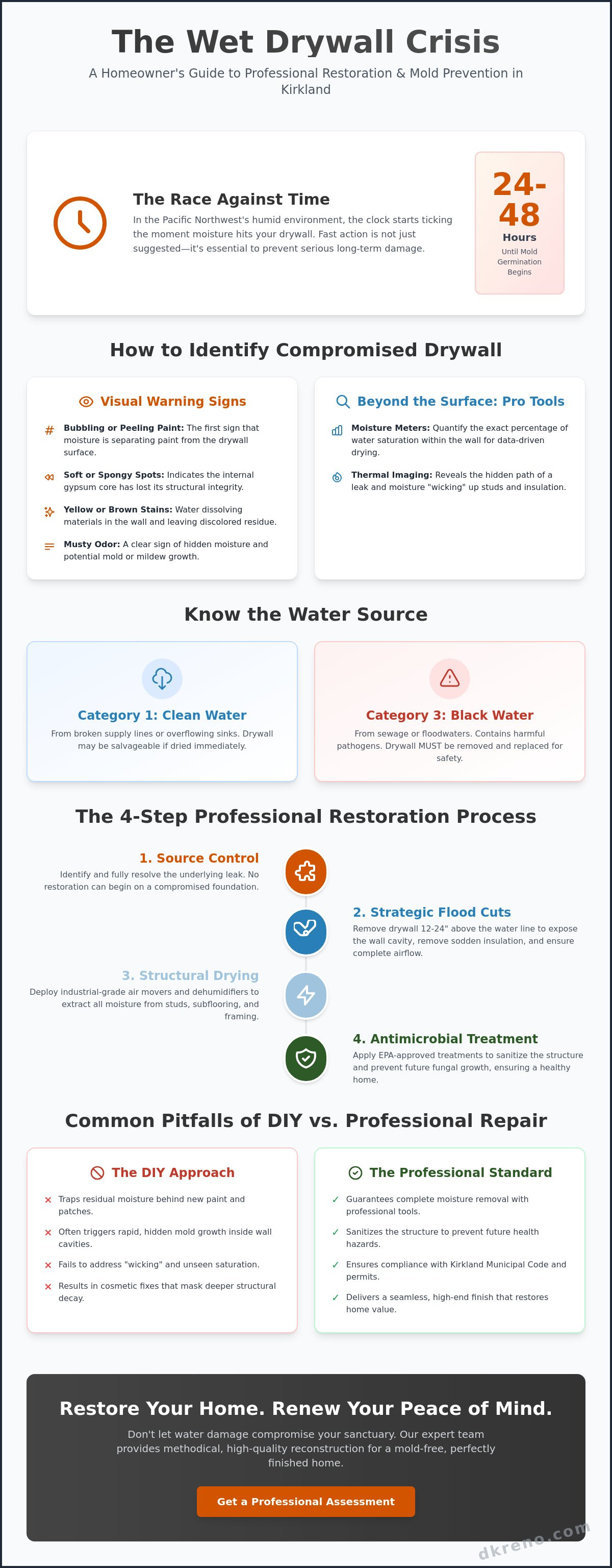
Wet drywall isn't just a cosmetic issue; it represents a fundamental failure of the properties of drywall, specifically the gypsum core that provides structural stability to your walls. When water penetrates this core, the material loses its integrity and becomes a breeding ground for microorganisms. In the humid environment of the Pacific Northwest, mold germination often begins within 24 to 48 hours of exposure. This narrow window makes rapid wet drywall repair in Kirkland a necessity rather than a suggestion. You might notice bubbling paint, soft spots that give way under light pressure, or a lingering musty odor that signals moisture is trapped where you can't see it. Yellow or brown staining often follows as the water dissolves the paper backing and reacts with the gypsum. Because many homes in our area were constructed around 1983, older drywall systems may already be more susceptible to structural wear, making prompt identification even more critical for your peace of mind.
The Role of Professional Moisture Detection
Visual inspection is rarely enough for modern Kirkland homes, especially those built during the construction boom of the 1980s. Professional moisture meters are used to quantify the exact percentage of water saturation within the wall, providing a data-driven baseline for your wet drywall repair in Kirkland. Thermal imaging cameras allow us to trace the path of a leak without tearing into your finishes prematurely. These tools reveal "wicking," a process where water travels upward through the wall studs and insulation. This hidden movement can cause damage several feet away from the original leak site, making professional detection a vital step in ensuring a complete recovery. By identifying the full scope of saturation, we remove the guesswork and prevent the shock of finding hidden mold months after a repair was supposedly finished.
Categorizing the Water Source
The path toward renewal depends heavily on the type of water involved. Category 1 water, often called "clean water," comes from broken supply lines or overflowing sinks and may allow for the drywall to be salvaged if dried quickly. Conversely, Category 3 water, or "black water," involves sewage or rising outdoor floodwaters that contain harmful pathogens. If your home experiences a Category 3 intrusion, the drywall must be removed and replaced to ensure a safe, sanitary environment. Understanding these distinctions helps us act as your advocate, ensuring your insurance claim accurately reflects the necessary safety protocols for your specific situation. We prioritize your family's health by following rigorous standards, transforming a chaotic water intrusion into a controlled and successful restoration project.
The 4-Step Professional Wet Drywall Restoration Process
Successful wet drywall repair in Kirkland follows a disciplined, four-step trajectory designed to transition your home from a state of crisis to one of total renewal. We begin with Source Control, which ensures the underlying leak is fully resolved before any reconstruction begins. It's impossible to build a lasting finish on a foundation that's still compromised by moisture. Once the area is stable, we move to Flood Cuts. This involves removing the unsalvageable material to allow for essential airflow within the wall cavity. The third stage is Structural Drying, where we deploy industrial equipment to extract moisture from the studs and subflooring. Finally, we apply an Antimicrobial Treatment. This safety-conscious step aligns with EPA mold cleanup guidelines to protect your family from future fungal growth and ensure a healthy living environment.
Why Controlled Demolition is Necessary
Precision is the hallmark of a professional restoration. We perform flood cuts by removing drywall 12 to 24 inches above the visible water line, which allows us to address the "wicking" effect mentioned earlier. This process is vital because insulation often acts like a sponge, holding onto contaminants and moisture long after the surface feels dry to the touch. By removing the damp gypsum while carefully preserving the structural studs, we create a clean slate for the reconstruction phase. This methodical approach prevents the friction of repeated repairs and ensures that your wall's internal components are fully sanitized and ready for new materials.
The Science of Structural Drying
True recovery requires more than just surface-level evaporation. We use high-capacity air movers and industrial dehumidifiers to achieve a specific "dry standard" for your home's unique environment. Standard household fans lack the power to pull moisture from the deep core of wooden studs or headers. We monitor this progress with daily moisture readings, providing you with documented proof that the environment is stable. This data-driven process removes the stress of uncertainty and guarantees that your new drywall won't fail due to trapped humidity. If you're currently facing a moisture emergency, choosing a partner for professional water damage restoration can help you navigate this complex process with confidence and ease.
Our goal is to act as your advocate throughout this transition, moving from the initial chaos of a leak to an organized, results-oriented restoration. By focusing on these rigorous standards of performance, we assume the burden of the crisis so you can focus on returning to your normal routine. Professional wet drywall repair in Kirkland isn't just about patching a hole; it's about restoring the safety and value of your property through disciplined, expert intervention.
Common Pitfalls of DIY Wet Drywall Repair
Attempting a DIY fix for water damage is often a natural response to the stress of a sudden leak, yet many homeowners inadvertently mistake a cosmetic patch for a complete recovery. There is a vital distinction between a simple "repair" and the comprehensive process of restoration. While a quick patch hides the damage, true wet drywall repair in Kirkland must adhere to professional water damage restoration standards to ensure the environment is truly stable. Failing to follow these rigorous protocols often results in trapped moisture, which creates a perfect greenhouse for mold growth behind your new paint. Our professional approach acts as a stabilizing force, removing the friction of recurring issues and providing you with the peace of mind that your home is genuinely restored.
Another frequent pitfall involves the lack of proper documentation during the mitigation phase. If you bypass the professional drying process, you lose the data-driven evidence, such as moisture maps and drying logs, that insurance adjusters require. This oversight can complicate your current claim or even lead to the denial of future claims if mold is discovered later. Additionally, DIYers often struggle with the physical weight of gypsum. Inadequate structural support for heavy ceiling patches can lead to sagging or even a dangerous collapse, especially in older Kirkland homes where the original framing might have shifted over time. Choosing a specialist ensures that every structural element is reinforced to modern safety standards.
The Hidden Danger of Mold Growth
Stachybotrys, often called black mold, thrives in the dark, damp cavities behind your walls. This poses a significant risk to families, particularly those with existing allergies or respiratory sensitivities. A common misconception is that "bleaching" the surface of the drywall will solve the problem. In reality, bleach is primarily water; while it may remove the surface stain, it fails to reach the mold roots embedded deep within the porous gypsum core. Professional intervention involves removing the compromised material entirely and treating the remaining structure with specialized antimicrobials to ensure a healthy, mold-free home.
Aesthetic Failures in Patching
Kirkland residences frequently feature specialized wall textures that are notoriously difficult to replicate without professional equipment. The challenge of "feathering" seams for a seamless finish often results in visible ridges or mismatched patterns that catch the light. These aesthetic failures aren't just frustrating; they can actively decrease your home's resale value by signaling to potential buyers that repairs were not handled with care. We utilize high-quality joint compounds and precision techniques to deliver a flawless texture match, transforming the damaged area into a state of total renewal that blends perfectly with the rest of your living space.
Navigating Insurance and Local Regulations in Kirkland
Understanding the nuances of your policy is a vital first step toward a successful recovery. In Washington, standard homeowner's insurance typically covers sudden and accidental water damage, such as a burst pipe, but it excludes damage from rising surface water or flooding. This distinction is critical for your financial protection. Working with an insurance restoration specialist ensures you have an advocate who understands these administrative complexities and can translate technical damage into clear, compensable language for your adjuster. We act as a stabilizing force during this transition, assuming the burden of negotiations so you can focus on returning to your normal routine.
Documentation acts as the backbone of your claim. We provide comprehensive moisture logs, detailed photos, and professional estimates that justify the necessity of wet drywall repair in Kirkland. This paper trail is especially important because the City of Kirkland, per Municipal Code Section 21.06.205, requires a permit for any sheetrock removal or installation. Failing to secure these permits can complicate future property sales or lead to administrative fines, which is why we manage these regulatory details on your behalf. Our methodical approach ensures that every step of your project is compliant with local laws and insurance requirements.
Maximizing Your Claim Recovery
Most insurance policies include a "duty to mitigate," meaning you're required to take immediate action to prevent secondary damage like mold. Professional contractors bridge the communication gap with claims adjusters, ensuring that every estimate covers "like-kind and quality" materials. This commitment to quality means your home's unique finishes are replaced with equivalent materials rather than basic alternatives, preserving the inherent value and aesthetic of your living space. By following these rigorous standards of performance, we help you secure the full recovery you're entitled to under your policy.
Kirkland Environmental Factors
The Puget Sound climate presents unique challenges during our rainy winters, where high outdoor humidity can significantly slow down the natural drying process. We use industrial-grade equipment to manage indoor humidity and prevent moisture from lingering in wall cavities. Additionally, we strictly adhere to Washington State regulations regarding lead and asbestos testing, which is a vital safety protocol for the significant portion of Kirkland homes constructed before 1980. Proper disposal of water-damaged materials is not just a legal requirement; it's a part of our disciplined commitment to local environmental standards. If you're navigating the complexities of a recent leak, you can schedule a professional water damage assessment to ensure your home is handled with expert care.
DK Production: Expert Drywall Reconstruction and Renewal
Finding a reliable partner for wet drywall repair in Kirkland is about more than just hiring a contractor; it's about finding a protective specialist who assumes the full burden of the crisis on your behalf. At DK Production, we act as a stabilizing force for homeowners navigating the high-stress environment of property damage. Our team bridges the gap between emergency mitigation and high-end reconstruction, ensuring that your home doesn't just return to normal, but achieves a state of total renewal. We bring this same disciplined approach to our work with water damage in Arlington and throughout the Puget Sound, providing a consistent standard of excellence for every property owner we serve.
From Chaos to Order: Our Restoration Methodology
Our methodology is designed to move your home from a state of chaos to one of perfect order through a logical, results-oriented trajectory. We begin by stabilizing the property to prevent any secondary loss, such as the rapid mold growth that can occur in our humid climate. Once the environment is secure, we execute a meticulous reconstruction plan that returns your living space to its pre-loss condition with seamless texture matching. This transition is supported by our administrative expertise, as we provide the detailed documentation and moisture logs necessary for frictionless insurance negotiations. By acting as your advocate, we remove the complexity typically associated with large-scale repairs and third-party adjusters.
Why Choose a Full-Service Contractor?
One of the primary benefits of our partnership is the ease of having a single point of contact for the entire duration of your project. We eliminate the friction of coordinating between a mitigation company and a separate repair crew. Because we also specialize in high-value residential remodeling, we apply the same rigorous standards of performance to a drywall patch that we would to a whole-house renovation. This ensures that every repair is handled with a focus on quality and safety. We don't just patch holes; we restore the integrity and beauty of your home through a safety-conscious, professional partnership.
You deserve a restoration experience that prioritizes your peace of mind and delivers a high-quality finished state without the typical stress of home repairs. Our commitment to satisfaction means we assume the responsibility of project management, allowing you to focus on your family while we handle the technical and administrative details. When you need expert wet drywall repair in Kirkland, trust a team that views every project as an opportunity for total renewal and a return to normalcy.
Restore the Safety and Beauty of Your Kirkland Home
Addressing moisture damage requires a disciplined, methodical approach that goes beyond simple aesthetic patches. By prioritizing professional moisture detection and adhering to rigorous drying standards, you protect your family from the health risks of hidden mold and preserve your property's structural integrity. We've explored how a full-service restoration strategy ensures a seamless transition from initial mitigation to high-end reconstruction, allowing you to avoid the common pitfalls of mismatched textures and administrative friction with insurance adjusters.
At DK Production, we act as your advocate throughout the entire duration of your project. Founded in 2014, our team brings over a decade of local expertise to every wet drywall repair in Kirkland. We specialize in insurance restoration and high-end reconstruction across Seattle and the greater Puget Sound, assuming the burden of the crisis so you can return to normalcy with confidence. Don't let moisture compromise your sanctuary; take the first step toward total renewal today.
Request a Professional Water Damage Assessment from DK Production and let us transform your property back into the high-quality home you love.
Frequently Asked Questions
How long does it take for wet drywall to dry in the Kirkland climate?
Professional drying typically takes between 3 and 5 days when using industrial grade dehumidifiers and air movers. Kirkland's specific climate, particularly during the humid winter months, often prevents moisture from evaporating naturally. Without expert intervention, dampness can linger for weeks, which significantly increases the risk of structural decay and fungal growth in your wall cavities.
Can I just paint over a water stain on my ceiling?
You shouldn't paint over a water stain without first confirming the area is completely dry and the leak is resolved. Painting acts as a vapor barrier that traps residual moisture inside the gypsum core, which often triggers rapid mold colonies. Professional wet drywall repair in Kirkland involves removing the stain's source and ensuring the material's integrity before any aesthetic finishes are applied.
Will my homeowners insurance cover wet drywall repair from a pipe leak?
Most standard homeowner policies in Washington cover damage that's sudden and accidental, such as a burst pipe or a failing appliance hose. However, insurance companies often exclude gradual damage caused by long term maintenance issues or slow, hidden leaks. We recommend reviewing your specific policy and working with a restoration specialist who can provide the detailed documentation your adjuster needs for a successful claim.
Is it safe to stay in my home while drywall is being repaired?
It's typically safe to remain in your home during most repair projects, provided the water source was clean and the affected area is properly contained. We use specialized plastic barriers and HEPA air scrubbers to prevent dust and debris from migrating into your living spaces. If the damage involves sewage or extensive mold growth, we'll provide a clear assessment of whether temporary relocation is necessary for your family's safety.
What is the difference between water mitigation and water restoration?
Water mitigation focuses on the immediate emergency actions required to prevent further loss, such as stopping the leak and drying out the structure. Water restoration, or reconstruction, is the subsequent phase that involves rebuilding and finishing the damaged areas to return your home to its pre-loss state. Our full service approach manages both phases to provide a seamless transition from initial chaos to total renewal.
How do I know if the mold behind my drywall is dangerous?
You should treat all mold growth as a potential health risk, regardless of its color or appearance. While black mold is often the most feared, many different species can cause respiratory irritation or allergic reactions in sensitive individuals. Professional testing is the only definitive way to identify the specific type of mold present and determine the appropriate remediation protocols for your home.
Can wet drywall be saved if it was soaked by a roof leak?
Drywall can sometimes be saved if it was exposed to clean rainwater from a roof leak and the drying process began within 24 to 48 hours. If the material has begun to sag, crumble, or show signs of delamination, it's lost its structural integrity and must be replaced. We use precision moisture meters to determine if the gypsum core can be fully restored or if a replacement is safer.
What should I do in the first hour after discovering a wet wall?
Your first priority is to stop the flow of water and turn off any electricity to the impacted walls or ceilings. For homeowners in other coastal areas facing a sudden pipe burst, a professional emergency plumber Miami provides an example of the 24/7 response needed to halt the damage before restoration can begin. Once the area is safe, move any furniture or valuables away from the moisture and document the damage with photos for your insurance claim. Contacting a specialist for wet drywall repair in Kirkland immediately after these steps ensures that professional mitigation begins within the critical 24 hour window for mold prevention.


Comments