
Water Damage Insurance Claim Process in Arlington, WA: A 2026 Homeowner’s Guide

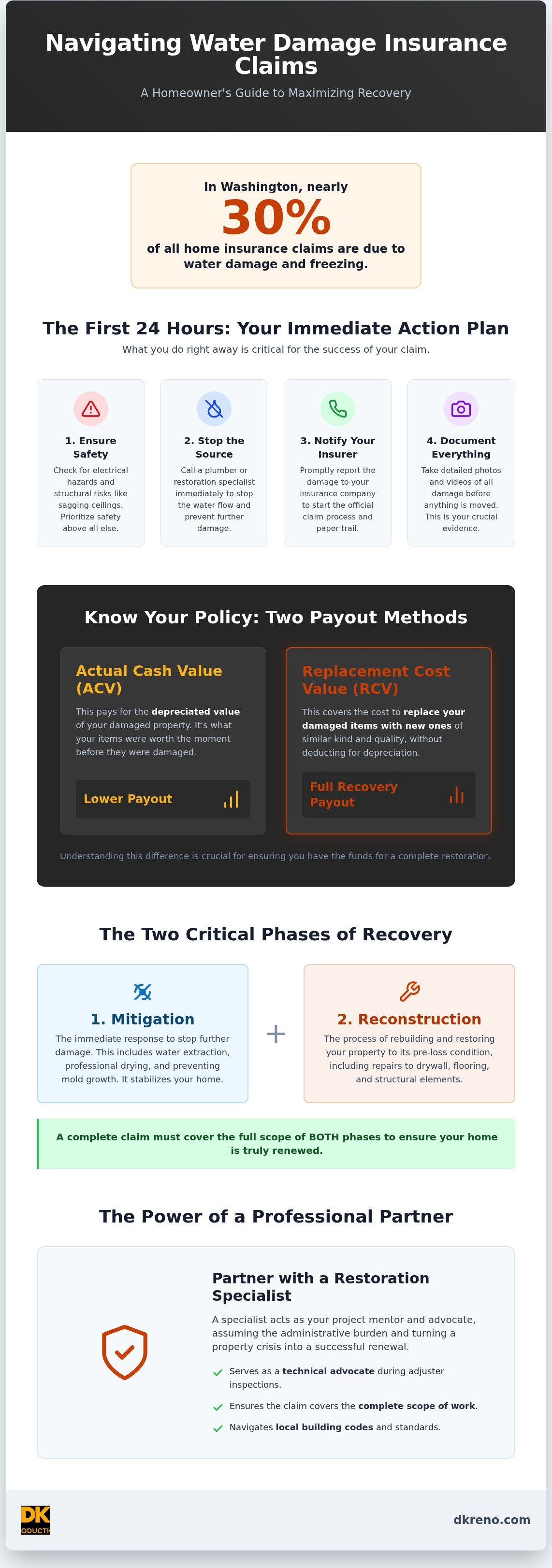
Did you know that water damage and freezing account for nearly 30% of all home insurance claims in Washington? When you wake up to a saturated kitchen or a flooded basement, the immediate chaos is overwhelming. You aren't just dealing with standing water; you're entering the complex water damage insurance claim process Arlington homeowners often find daunting. It’s natural to feel anxiety about potential claim denials or whether your insurance will cover the full cost of restoration to pre-loss condition, especially as national averages for restoration costs continue to rise in 2026.
We understand the heavy stress of living in a damaged home while trying to decipher insurance jargon and find a contractor you can actually trust in Snohomish County. This guide provides a clear, step-by-step roadmap to help you maximize your recovery and ensure your property is fully restored without the typical administrative friction. We will walk you through the essential documentation steps, explain your rights under Washington’s bad faith laws, and show you how to secure professional advocacy that turns a property crisis into a successful renewal. By assuming the burden of the claim on your behalf, we help you move from the initial shock of a leak to the peace of a high-quality finished state.
Table of Contents
Immediate Steps: The First 24 Hours of an Arlington Water Damage Claim
The first 24 hours after discovering a leak are often the most chaotic, yet they are the most influential for your eventual recovery. This window is where you establish the foundation for the water damage insurance claim process Arlington residents must navigate to secure a full restoration. Your first priority is physical safety. Water conducts electricity, so you should avoid any rooms where standing water reaches electrical outlets or where ceilings appear to be sagging under the weight of trapped moisture. If the structural integrity of a room feels compromised, keep everyone out until a professional can assess the risk.
Once safety is confirmed, follow the "Stop the Source" rule. If a burst pipe is actively spraying, your first call should be to a licensed plumber to stem the flow. However, if the water is entering from an external source or if the leak has already stopped, a restoration specialist should be your primary contact to begin the recovery. Promptly notifying your insurance carrier starts the essential paper trail. Understanding Property Insurance fundamentals is helpful here; your policy is a legal agreement that requires you to act quickly to protect your home from additional harm.
Securing the Property and Preventing Secondary Damage
You must identify the type of water involved before taking any action. Category 3 water, often called "black water," includes sewage or groundwater and contains harmful pathogens that require professional biohazard protocols. You shouldn't attempt to clean this yourself or even walk through it without protective gear. Taking these precautions fulfills your "duty to mitigate," a standard clause in most policies that requires homeowners to take reasonable steps to prevent further damage. Mitigation is the essential first step to prevent mold growth and stabilize the environment for a successful rebuild.
The Documentation Phase: Evidence for Your Adjuster
Your smartphone is your most powerful tool during this phase. Capture high-resolution photos and videos of the "loss state" before any water is removed. Focus on the source of the leak, the path the water traveled, and areas where moisture is wicking up drywall or under floorboards. It's vital that you don't throw away damaged materials like saturated carpet or warped baseboards until an adjuster has inspected them. Adjusters need physical proof to verify the scope of the loss. Organize these files into a digital claim folder so you can provide your restoration partner with a comprehensive record from day one. This level of detail prevents the common trap of undervalued claims and ensures every hidden risk is documented before it's covered up by repairs.
Understanding the Water Damage Insurance Claim Process
The lifecycle of a claim moves from the initial filing through a detailed inspection and ends with the final "Certificate of Completion." It's a methodical progression designed to document every loss and move you toward a high-quality finished state. Understanding the water damage insurance claim process Arlington homeowners face is easier when you view it as a collaborative project between you, your adjuster, and your restoration partner. This structured approach helps ensure that no detail is overlooked during the chaotic early days of a property crisis.
A critical factor in your recovery is whether your policy uses Actual Cash Value (ACV) or Replacement Cost Value (RCV). ACV only pays for the depreciated value of your belongings and materials; conversely, RCV covers the cost to replace them with new items of similar quality. Accuracy in your "Proof of Loss" form is non-negotiable. This document is your formal statement of the damage, and any omissions here can lead to a lower payout that fails to cover the full scope of reconstruction. Taking the time to be precise now prevents delays later in the project.
Working with the Insurance Adjuster
When the adjuster visits your home, they are looking for specific evidence to justify the payout. Having your restoration contractor present during the water damage insurance claim process Arlington homeowners undergo ensures that the technical scope is fully captured. Your contractor acts as a technical advocate to identify hidden moisture or structural risks that might be missed during a standard walkthrough. Disagreements over the "Scope of Work" are common; however, a professional partner can provide the moisture maps and thermal imaging data needed to bridge these gaps. You aren't required to use the insurance company’s "preferred vendors." Choosing an independent specialist often ensures your home's long-term value remains the top priority while providing a frictionless experience.
Navigating Policy Limits and Exclusions
Most standard policies cover internal pipe bursts but exclude external surface water or rising rivers. For those specific risks, you would need separate coverage through the National Flood Insurance Program. Standard policies generally cover sudden and accidental damage, such as a supply line failure, but often exclude gradual damage caused by long-term seepage or deferred maintenance. Your deductible is typically subtracted from the first payment you receive, so it's important to plan your budget accordingly. If you feel overwhelmed by these administrative hurdles, professional claim advocacy can assume the burden and help you navigate the fine print with confidence.
Mitigation vs. Reconstruction: Ensuring Your Claim Covers Both
A common pitfall in the water damage insurance claim process Arlington homeowners experience is stopping the momentum once the floors are dry. While mitigation is vital to prevent mold, it only addresses the immediate crisis of standing water. A claim that focuses solely on the drying phase leaves your home in a "demo state" rather than its true pre-loss condition. The transition point occurs the moment moisture meters confirm dry standards are met, shifting the focus from stabilization to renewal. You deserve a home that looks exactly as it did before the event, which often requires matching specific flooring or cabinetry that spans multiple rooms to maintain aesthetic continuity.
Choosing a single-source partner for both mitigation and property reconstruction creates a frictionless transition that often saves weeks of waiting. When the team that dried the walls is the same team that rebuilds them, the administrative burden on you is significantly reduced. This continuity ensures that the water damage insurance claim process Arlington residents rely on remains organized and fully funded, preventing the common gap where insurance carriers might claim certain repairs aren't related to the initial leak.
The Reconstruction Scope of Work
Professional insurance restoration companies use industry-standard software to calculate rebuild costs, ensuring every square foot of drywall and every linear foot of trim is accurately accounted for. Beyond the visible surfaces, reconstruction must address structural integrity and compromised insulation that could lead to future energy loss. If hidden damage is discovered during the demolition phase, your contractor must "supplement" the claim. This involves submitting additional evidence to the adjuster to ensure the final payout reflects the actual work required for a safe and complete recovery of your property.
Restoring High-Value Areas: Kitchens and Bathrooms
Water damage in kitchens and bathrooms presents unique challenges due to custom cabinetry and stone countertops that don't tolerate moisture well. If a leak compromises your master bath, you might leverage the claim to perform a waterproof shower remodel to ensure the new installation exceeds modern standards and provides long-term peace of mind. DK Production’s deep roots in high-value residential remodeling mean your reconstruction isn't just a basic repair. We apply the same discipline and aesthetic standards to restoration projects that we do to our custom additions, turning a moment of crisis into a form of total renewal that feels like a high-quality upgrade.
Local Factors Influencing Arlington, WA Claims in 2026
Arlington isn't just any town; its proximity to the Stillaguamish River and the overall Puget Sound climate creates specific hurdles for property recovery. The water damage insurance claim process Arlington homeowners follow must account for the persistent high humidity that defines our region. This environmental factor directly impacts drying times, as moisture levels in the air often work against standard dehumidification equipment. During the peak rainy season, which typically runs from October through April, the demand for local expertise spikes as saturated ground and heavy storms increase the risk of basement and crawlspace intrusions. A local "Arlington Response" is critical because every hour of delay during a Snohomish County winter allows moisture to migrate deeper into your home's structural framing.
Navigating Local Permits and Inspections
A frequent point of confusion is whether a reconstruction project requires a formal building permit from the City of Arlington. While simple "like-for-like" cosmetic repairs might not, any work involving structural changes, electrical rerouting, or significant plumbing modifications necessitates a permit. The advantage of a professional partner is ensuring these local code compliance costs are built directly into your insurance claim payout from the start. While city inspection timelines in the Puget Sound area can fluctuate based on seasonal demand, having a contractor who is familiar with Arlington’s municipal requirements ensures your project stays on track and meets all safety standards for 2026.
Environmental Concerns: Mold and Humidity
The damp climate of the Pacific Northwest makes professional-grade dehumidification a non-negotiable part of the water damage insurance claim process Arlington residents undergo. Without high-capacity equipment, mold can begin to colonize in as little as 24 to 48 hours. Washington State maintains rigorous standards for mold testing and clearance, often requiring a third-party industrial hygienist to verify the home is safe before reconstruction begins. In our local context, the "dry standard" for Arlington homes is defined as reaching a moisture content level in structural materials that is consistent with the home's unaffected dry areas, typically between 8% and 12% for wood framing. If you are currently facing a saturated kitchen or a flooded crawlspace, don't wait for the humidity to compromise your home's air quality. You can contact our local Arlington team for an immediate assessment that prioritizes your home's long-term safety and structural integrity.
Choosing an Arlington Restoration Partner for a Frictionless Claim
Choosing the right partner is the final, most critical step in the water damage insurance claim process Arlington homeowners must complete. You don't just need a laborer; you need a protective specialist who acts as a mentor throughout the entire project duration. This professional assumes the administrative burden of the claim while managing the transition from initial planning to final completion. By acting as your advocate when dealing with the adjuster, a reliable partner ensures that the focus remains on quality and your eventual return to normalcy. This partnership removes the friction typically associated with large-scale repairs and third-party negotiations.
Before signing any contracts, verify that your chosen partner holds IICRC certification and valid Washington State licensing. These credentials aren't just paperwork; they represent a commitment to rigorous performance standards and safety-conscious methodologies. A disciplined contractor follows a methodical communication flow that moves your home from a state of chaos to one of order. This trajectory concludes with a detailed final walkthrough, where every corner of the restored space is inspected to ensure it matches the high-quality, pre-loss state you expect. It's this level of accountability that separates a simple repair from a total renewal of your property.
The DK Production Difference
Since our founding in 2014, DK Production has served as a stabilizing force for Arlington families facing property crises. Our deep local roots mean we understand the specific nuances of Snohomish County building codes and the environmental challenges of the Puget Sound. What truly sets us apart is our dual expertise in both emergency restoration and high-end residential remodeling. Because we specialize in kitchen and bathroom remodeling, our reconstruction work doesn't just repair the damage; it elevates the space through a form of total renewal that basic restoration firms simply cannot match. We assume the burden of the crisis so you can focus on your family.
Your Next Steps to Recovery
The path back to a beautiful home begins with a single, decisive action. When you schedule an emergency assessment with our team, we arrive ready to assume the burden of the crisis on your behalf. During our first 60 minutes on-site, we identify the water source, map the moisture migration, and begin the documentation required for a frictionless claim experience. We provide the quiet confidence you need to move forward, knowing that every detail of the rebuild is being managed by experienced project managers committed to your satisfaction. Don't let the stress of a flooded home linger when professional advocacy is just a call away.
Moving From Property Crisis to Total Renewal
Recovering from a flooded home is a journey that moves from initial shock to the relief of a high-quality finished state. By prioritizing immediate documentation and understanding the technical nuances of your policy, you've already taken the first steps toward a successful recovery. The water damage insurance claim process Arlington residents navigate is most effective when it bridges the gap between drying out the structure and performing high-end reconstruction. You shouldn't have to settle for a home that is merely dry when you can have one that is fully restored to its pre-loss condition or better.
Our team stands ready to act as your protective specialist, assuming the burden of the crisis so you don't have to. With IICRC certified technicians and a commitment to 24/7 emergency mitigation, we provide the stabilizing force needed during high-stress moments. We specialize in full-service reconstruction and remodeling, ensuring that every detail of your renewal meets our rigorous standards of performance.
Restore Your Home with Arlington's Trusted Restoration Specialists
You have the power to turn this property crisis into a frictionless experience. We are here to guide you every step of the way.
Frequently Asked Questions
Does my homeowner's insurance cover all types of water damage in Arlington?
Standard policies generally cover sudden and accidental events like a burst pipe or a failed water heater supply line. However, they typically exclude damage resulting from rising external water, such as river flooding, or gradual issues caused by deferred maintenance. You would need a separate policy for rising groundwater. It is vital to review your specific declarations with a professional to understand your coverage boundaries before a property crisis occurs.
How long does the water damage insurance claim process typically take in Washington?
The initial mitigation phase usually concludes within three to seven days, but the full water damage insurance claim process Arlington homeowners experience can take several weeks or even months. Timelines depend heavily on the complexity of the reconstruction and the speed of the insurance adjuster's approval. Managing expectations through a clear project roadmap helps maintain your peace of mind and ensures a smooth transition toward total renewal.
Can I choose my own contractor, or do I have to use the one my insurance recommends?
You have the legal right to choose any licensed contractor you trust to restore your home to its original condition. While insurance companies often suggest "preferred vendors" to handle the work, these firms may prioritize the insurer's bottom line over your home's long-term value. Selecting an independent, protective specialist ensures you have a dedicated advocate who focuses exclusively on returning your property to its high-quality, pre-loss state.
What happens if my insurance adjuster's estimate is lower than the contractor's bid?
Discrepancies between estimates are common and are usually resolved through the supplemental claim process. Your contractor provides technical evidence, such as moisture maps and thermal imaging data, to justify the necessary scope of work to the adjuster. This professional advocacy ensures the insurance company accounts for every required repair, preventing unexpected out-of-pocket expenses for you during the reconstruction phase of your project.
Is mold damage covered under a standard water damage claim in Snohomish County?
Mold coverage is often limited to a specific dollar amount within standard policies, provided the growth resulted directly from a covered, sudden water event. If the mold is caused by long-term humidity or a slow, ignored leak, the claim might be denied by your carrier. Acting within the first 24 hours for emergency mitigation is the best way to prevent mold from becoming a costly exclusion.
What is the difference between water mitigation and water reconstruction?
Mitigation focuses on immediate stabilization, including water extraction, professional drying, and the demolition of unsalvageable materials to prevent further structural harm. Reconstruction is the subsequent phase where your home is actually rebuilt, involving drywall installation, flooring, and cabinetry. A full-service partner manages both phases to ensure a frictionless transition from a damaged state back to a finished, high-quality home that looks like new.
How much will my deductible be for a water damage claim?
Your deductible is a fixed amount specified in your policy declarations, often ranging from $500 to $2,500 for standard residential coverage. This amount is typically subtracted from the initial payout check issued by your insurance carrier rather than being paid directly to the contractor. Understanding this cost upfront helps you plan your recovery budget without unexpected financial surprises during the property restoration process.
What should I do if I find hidden water damage weeks after the initial leak?
You should contact your insurance company and your restoration contractor immediately to report the new discovery. Claims can often be reopened or supplemented if the hidden damage is directly related to the original covered event. Providing detailed photo evidence of the newly found moisture ensures that the additional repairs are integrated into your ongoing water damage insurance claim process Arlington for a complete recovery.


Comments