
The Water Damage Cleanup Process Explained: From Crisis to Home Renewal

Updated: Jul 17
Did you know that mold can begin to colonize damp materials within just 24 to 48 hours of a leak? It's a sobering reality that adds immense pressure to an already chaotic situation, leaving many homeowners feeling overwhelmed by the sudden disruption to their daily lives. Having the water damage cleanup process explained by a professional acts as a stabilizing force, turning a high-stress emergency into a methodical journey toward property renewal.
We believe that recovering from a disaster shouldn't be a secondary crisis of paperwork and confusion. This expert breakdown navigates you through the essential stages of water mitigation and reconstruction, ensuring you achieve a dry, safe, and mold-free home. You'll learn how a disciplined approach simplifies the insurance claim process and how high-quality reconstruction can actually improve your living space. We're here to assume the burden of the restoration so you can focus on the relief of returning to a high-quality finished state.
Table of Contents
What is the Water Damage Restoration Process?
Many homeowners mistake a quick session with a shop-vac for a complete solution, but the reality of property recovery is much more complex. To have the water damage cleanup process explained accurately, one must view it as a sophisticated recovery system rather than a simple chore. It involves stabilizing the structure, extracting moisture from deep within building materials, and returning the environment to a safe, pre-loss condition. Professional intervention is essential because water is highly invasive. It travels through wall cavities and under floorboards, leading to long-term rot or structural failure if it isn't addressed by experts who understand the science of drying.
There is a critical distinction between simple cleanup and structural drying. While cleanup might address visible puddles, structural drying focuses on the moisture trapped inside your home's bones. Understanding what is water damage and how it affects different porous materials is the first step in a successful recovery. A professional partner acts as a stabilizing force during the initial chaos, providing the authoritative expertise needed to stop the damage from spreading while offering the empathetic support you need to feel secure again.
The Importance of Immediate Emergency Response
Timing is the most significant factor in property salvageability. The first 24 hours are often referred to as the "Golden Hours" because this is the window where most materials can still be dried without requiring total replacement. Rapid stabilization prevents water from wicking into unaffected areas, which limits the scope of the disaster. When you first contact an emergency restoration specialist, they'll provide clear, decisive instructions to protect your safety while their team mobilizes. This immediate action is the most effective way to prevent the secondary crisis of mold growth, which can begin in as little as one to two days.
Initial Inspection and Moisture Mapping
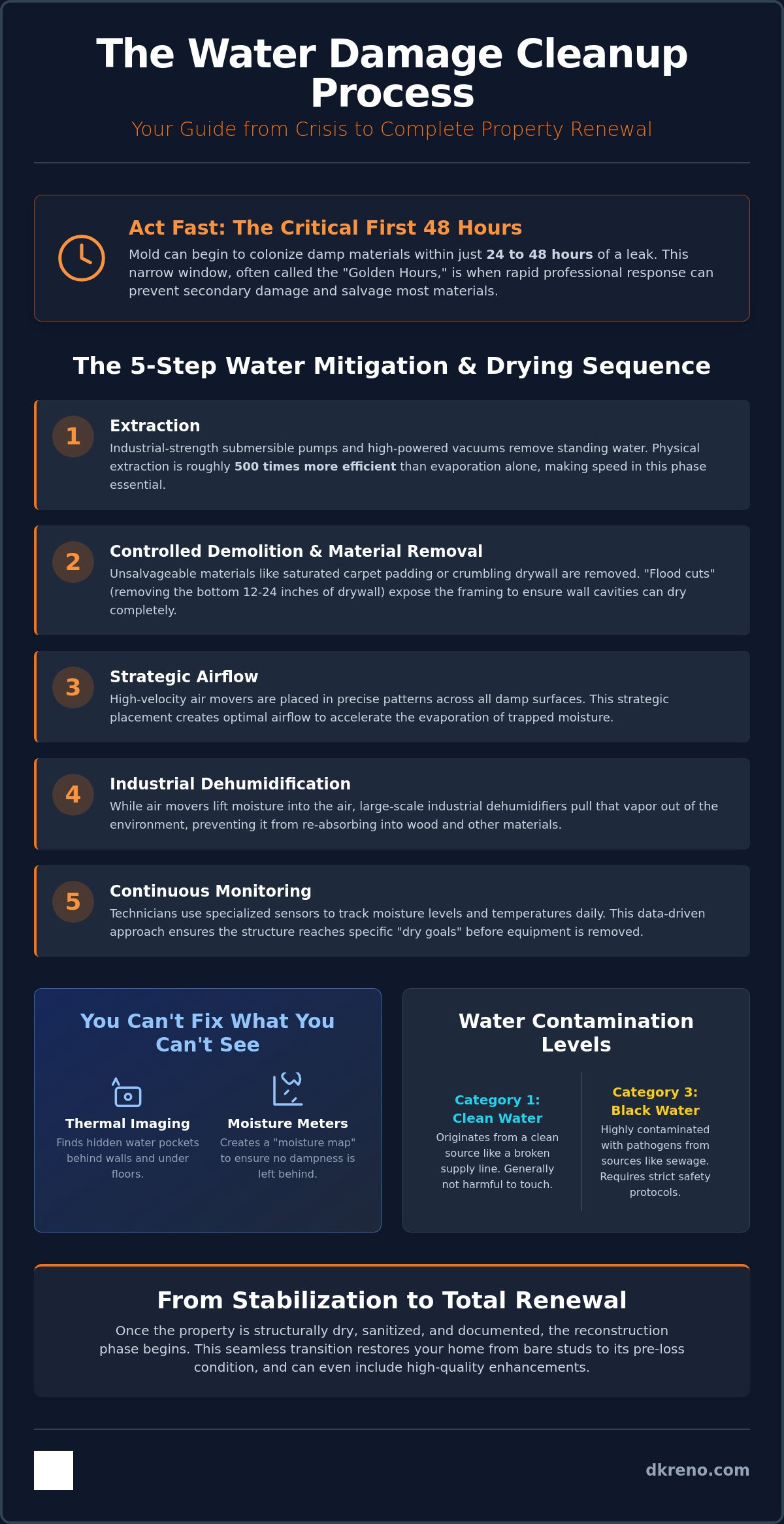
You can't fix what you can't see. Professionals use advanced tools like thermal imaging cameras and moisture meters to find hidden water pockets trapped behind finishings. This data allows them to create a "moisture map" of your home, ensuring no dampness is left behind to cause future issues. As part of the water damage cleanup process explained to every client, we categorize the water source to determine safety protocols. Category 1 involves clean water from a broken pipe, while Category 3, or "black water," involves highly contaminated sources like sewage. In these complex scenarios, professional drainage specialists like T.M. Drainage provide essential CCTV surveys to identify the root cause of blockages and ensure the system is properly unblocked. Each situation requires a tailored restoration plan that balances speed with the rigorous standards of performance required for a safe, dry home.
The 5-Step Water Mitigation and Drying Sequence
Once the initial assessment is complete, the focus shifts to stabilization. This phase is known as mitigation, where the goal is to stop the damage from progressing. When you have the water damage cleanup process explained by a specialist, you'll see it's a calculated sequence of five distinct steps designed to protect your home's structural integrity. We adhere to the industry standard for water damage restoration to ensure every action meets rigorous safety and performance benchmarks.
Step 1: Extraction. We use industrial-strength submersible pumps and high-powered vacuums to remove bulk water. This is the most critical phase for speed.
Step 2: Controlled Demolition. Our team removes unsalvageable materials, such as saturated carpet padding or crumbling drywall, to expose the framing for drying.
Step 3: Strategic Airflow. We place high-velocity air movers in precise patterns to create optimal evaporation across all damp surfaces.
Step 4: Industrial Dehumidification. While air movers lift moisture into the air, large-scale dehumidifiers pull that moisture out, preventing it from settling back into the wood.
Step 5: Continuous Monitoring. We use specialized sensors to track moisture levels daily, ensuring we hit specific "dry goals" before concluding the phase.
Advanced Extraction and Material Removal
Physical extraction is roughly 500 times more efficient than relying on evaporation alone. This is why we prioritize removing as much standing water as possible before even turning on a fan. During this stage, we identify "non-restorable" items like porous insulation or saturated particle board that must be discarded. To save the home's skeleton, we often perform "flood cuts." This involves removing the bottom 12 to 24 inches of drywall. It allows air to circulate inside the wall cavities, which is the only way to dry the hidden studs and prevent long-term rot. Partnering with a specialist for your restoration ensures these technical decisions are made with your home's future safety in mind.
Structural Drying in the Puget Sound Climate
The high humidity in areas like Seattle and Everett presents a unique challenge for property recovery. In Western Washington, the air is often already saturated, meaning "just opening the windows" can actually introduce more moisture and stall the drying process. We utilize the science of psychrometry to manage the indoor environment. By manipulating temperature and vapor pressure, we "force" moisture out of dense structural members. This methodical approach is the only way to ensure a home is truly dry in our damp climate, providing you with the peace of mind that no hidden moisture remains to fuel mold growth.
Sanitization and Odor Control: Ensuring a Healthy Environment
A common misconception in property recovery is that once a surface feels dry to the touch, the danger has passed. However, having the water damage cleanup process explained by a certified specialist reveals that "dry" does not always mean "safe." Water, especially from gray or black sources, carries microscopic pathogens and bacteria that can linger long after the visible moisture is gone. To ensure your home is truly healthy, we implement a rigorous sanitization protocol that addresses these invisible threats at the molecular level, providing the peace of mind that your living environment is restored to a hospital-grade standard of cleanliness.
Our team applies professional-strength antimicrobials to all affected structural members. These specialized solutions are designed to penetrate deep into materials, neutralizing bacterial colonies that household cleaners simply cannot reach. This step is a critical bridge between the chaos of mitigation and the precision of reconstruction. By eliminating the biological footprint of the water, we create a stable foundation for the renewal of your home. We also utilize advanced deodorization techniques, such as hydroxyl generators or thermal foggers, to permanently remove the "musty" odor rather than just masking it with perfumes.
Preventing Post-Water Mold Growth
Speed is your greatest ally when it comes to biological growth. According to the EPA guide to mold cleanup, mold can begin to colonize damp materials in as little as 24 to 48 hours. This makes deep structural sanitization far more important than simple surface wiping. Many homeowners attempt to use bleach, but this is often ineffective on porous materials like wood or drywall. Bleach's chemical structure prevents it from soaking into the fibers where mold roots hide. Our professional-grade treatments are specifically formulated to reach these depths, ensuring that once the home is dry, it stays safe and mold-free for the long term.
Air Quality and HEPA Filtration
During the water damage cleanup process explained to our clients, we emphasize that the air you breathe is just as important as the floors you walk on. The drying process naturally disturbs dust, spores, and volatile organic compounds (VOCs). To protect your family, we deploy industrial HEPA air scrubbers that cycle the air in the affected area multiple times per hour. These machines capture 99.97 percent of particles as small as 0.3 microns, effectively scrubbing the environment of airborne contaminants. This ensures the home is clinically clean before we transition into the reconstruction phase, allowing your family to remain in a safe, breathable environment throughout the duration of the project.
The Reconstruction Phase: From Bare Studs to Total Renewal
Once the dehumidifiers are turned off and the structural members are certified dry, the journey moves into its most rewarding phase. While many guides leave the water damage cleanup process explained only up to the point of stabilization, true recovery requires a shift from a mitigation mindset to one of reconstruction. This is where your home stops being a "loss site" and starts becoming your sanctuary again. Using a full-service partner like DK Production eliminates the friction of a handoff between two different companies. When the team that dried the studs is the same team that hangs the drywall, accountability is absolute and the transition is seamless.
We prioritize structural integrity above all else. Every rebuilt area must meet current local building codes, which often means the new version of your home is safer and more robust than the original. We don't just patch holes. We ensure that load-bearing joists, subflooring, and insulation are installed to rigorous standards of performance. This methodical approach transforms a moment of chaos into an organized path toward a high-quality finished state.
Seamless Structural Repairs
The ultimate goal of high-quality reconstruction is the "invisible repair." You shouldn't be able to tell where the water damage occurred once the project is complete. We carefully match existing textures, trim profiles, and paint colors to integrate new materials with the original structure. Whether it's replacing saturated subflooring or installing fresh drywall, the focus remains on precision. This attention to detail ensures that the value of your property is not just preserved, but protected against future issues. It's about more than just fixing what's broken; it's about restoring the soul of the home.
Seizing the Remodeling Opportunity
A water loss is undoubtedly a crisis, but it also presents a rare opening to improve your home. Since the walls are already open and the flooring is removed, it's the most cost-effective time to upgrade your living space. Many homeowners leverage this situation to finally get that waterproof shower remodel in Arlington, WA, replacing outdated fixtures with leak-free luxury.
Instead of settling for builder-grade finishes, you can choose custom kitchen cabinetry or high-end bathroom features that reflect your personal style. It's helpful to consult with home remodeling contractors near me early in the process to explore design ideas that maximize your insurance coverage while adding long-term value. If you're ready to turn this challenge into a beautiful new beginning, reach out to our team to discuss your reconstruction and remodeling goals today.
Navigating Insurance and Choosing Your Restoration Partner
The administrative side of property recovery is often just as daunting as the physical repairs. When you have the water damage cleanup process explained by experts, you'll find that success depends heavily on the quality of documentation provided to your carrier. Professional insurance restoration companies act as your primary record-keepers, capturing the evidence required to justify every dollar of your claim. Detailed moisture logs, infrared photos, and daily drying reports are the "currency" of a successful settlement. These records prove the necessity of the work performed, ensuring your insurance company has the data they need to approve your recovery budget.
We utilize the Xactimate estimating system, which is the same software used by the vast majority of insurance adjusters. By speaking their language, we remove the friction often found in price negotiations. This alignment allows us to act as a protective specialist for the property owner, ensuring that the scope of work is comprehensive and that no corners are cut during the restoration. Our goal is to assume the burden of these negotiations so you can focus on the relief of seeing your home return to its original state.
Working with Your Claims Adjuster
When meeting with your adjuster, it's vital to provide a clear timeline and a list of all affected items. Understanding the difference between "Replacement Cost Value," which is the cost to replace items today, and "Actual Cash Value," which is the depreciated value, is essential for managing your expectations. Remember that as a homeowner, you have the legal right to choose your own contractor. You aren't obligated to use an insurance company’s "preferred vendor" list; instead, you should select a partner who prioritizes your home’s safety and your long-term satisfaction over the carrier’s bottom line.
Why DK Production is Your Puget Sound Advocate
We're deeply committed to providing a frictionless experience for every client we serve. Our team doesn't just perform repairs; we act as project managers who guide you from the initial emergency call through to the final walkthrough. By specializing in water damage in Arlington, WA, we bring local expertise and a high level of accountability to every project. This disciplined, safety-conscious approach ensures that the water damage cleanup process explained at the start of your journey is exactly what you experience until the day you step back into your fully renewed home.
Restore Your Peace of Mind and Your Property
Recovering from a flood is about more than just drying floors; it's about restoring your sense of security. We've had the water damage cleanup process explained through the lens of both scientific mitigation and high-quality reconstruction, showing that a methodical approach is the only way to ensure a truly safe home. By acting quickly within the first 24 hours and maintaining rigorous documentation for your insurance carrier, you turn a property crisis into a controlled, predictable path toward renewal. This journey is an opportunity to not just fix what was broken, but to elevate your living space through expert craftsmanship.
Founded in 2014, our team brings over a decade of local expertise to every project in the Puget Sound. We act as your protective specialist, managing everything from industrial-strength drying to complex insurance advocacy and high-end reconstruction. You don't have to navigate this stressful transition alone. Request Your Emergency Water Mitigation & Restoration Assessment today to secure your home's future. We're committed to assuming the burden of this crisis on your behalf, helping you move from chaos to a high-quality finished state you'll love. We're ready to help you turn this challenge into a beautiful new beginning.
Frequently Asked Questions
How long does the water damage restoration process usually take?
The mitigation and drying phase typically takes between three to five days, though the exact duration depends on the volume of water and the types of materials affected. Once the structure is certified dry, the reconstruction phase can take anywhere from a few days to several weeks. We focus on maintaining a methodical pace to ensure every structural member is stabilized before we begin the final finishes.
Is it safe to stay in my home during the water cleanup process?
Safety depends on the category of water contamination and the location of the damage within your home. If the loss involves Category 3 "black water" or if the constant noise from industrial air movers disrupts your sleep, staying elsewhere is often the better choice. We prioritize your family's health by using HEPA air scrubbers to maintain air quality, but we'll provide a clear recommendation after our initial inspection.
Will my insurance cover the full cost of water damage cleanup and reconstruction?
Most standard homeowner policies cover sudden and accidental water discharge, such as a burst pipe, but coverage depends on your specific policy language. We act as your advocate by providing the detailed moisture logs and Xactimate estimates that adjusters require for claim approval. It's essential to review your deductibles and coverage limits with your agent as soon as the crisis begins.
What is the difference between water mitigation and water restoration?
Water mitigation is the immediate emergency response focused on stopping further damage through extraction and drying. Restoration, often referred to as reconstruction, is the subsequent phase where we rebuild and finish the affected areas to their pre-loss state. Having the water damage cleanup process explained in these two distinct stages helps you understand the transition from stabilization to total home renewal.
Can I handle water damage cleanup myself if it's just a small leak?
While you can dry minor spills on non-porous surfaces, any water that reaches wall cavities or subflooring requires a professional assessment. Hidden moisture often leads to mold growth within 24 to 48 hours, which is impossible to detect without specialized moisture meters. We recommend an expert inspection to ensure a small leak doesn't evolve into a long-term structural or health crisis.
How do I know if the drying process is actually finished?
We determine the end of the drying phase using scientific measurements from moisture sensors and thermal imaging rather than just a physical touch. The process is only complete when affected materials reach "dry goals" that match the moisture levels of unaffected areas in your home. This disciplined monitoring ensures that no trapped dampness remains to compromise your new flooring or drywall.
What should I do with my furniture and belongings during the cleanup?
You should move salvageable items to a dry, unaffected room or an off-site storage facility to prevent secondary damage from high humidity. Our team often uses foam blocks or plastic tabs to lift heavy furniture off damp carpets, which prevents permanent staining from wood finishes. For items that are damaged beyond repair, coordinating with a professional hauling service like Rapid Junk Pros ensures that heavy debris and ruined furniture are removed promptly. We'll help you document the condition of your contents to ensure your insurance claim is handled with precision.
Why does my house smell musty even after the water is gone?
A musty odor indicates that moisture is still trapped in porous materials or that bacterial colonies have begun to colonize the area. As part of the water damage cleanup process explained by our specialists, we use hospital-grade antimicrobials and industrial air scrubbers to neutralize these organic compounds. Professional deodorization is the only way to ensure your home is clinically clean and free of lingering smells.


Comments