
Lien waivers for homeowners: When to sign and collect them

A lien waiver and a lien release aren’t interchangeable: a waiver gives up lien rights before a lien is filed, while a release removes a lien that already exists. A mechanic’s lien is a claim against property for unpaid work or materials. For homeowners, lien waivers document payments and clarify which work and amount the signer is giving up lien rights for.
It’s easy to treat a waiver as routine paperwork, but timing matters. An unconditional waiver can give up lien rights even if payment hasn’t reached the signer, while a conditional waiver takes effect only when its payment condition is met.
This article explains when conditional and unconditional waivers apply, why payment timing matters, and which contractors, subcontractors, and suppliers to collect them from. It also distinguishes waivers from releases, so you can understand what each document does during a home repair or remodeling project.
Table of Contents
Conditional lien waivers
A conditional lien waiver gives up specified lien rights only after its stated condition, usually receipt and processing of payment, is met. Clear lien waivers for homeowners tie each document to a particular payment rather than treating a signature alone as proof that funds cleared.
Progress and Final Payment Waivers
A conditional progress-payment waiver covers a defined portion of work through a specific date, while a conditional final-payment waiver covers the claimant’s remaining rights after final payment. This distinction helps homeowners match the waiver to the payment stage and work being paid for.
For example, a contractor billing for completed construction work can sign a progress waiver that applies only after payment is received and processed. A final waiver applies to final payment, subject to the document’s terms. Before signing or accepting either form, confirm the amount, covered work, project, and relevant date.
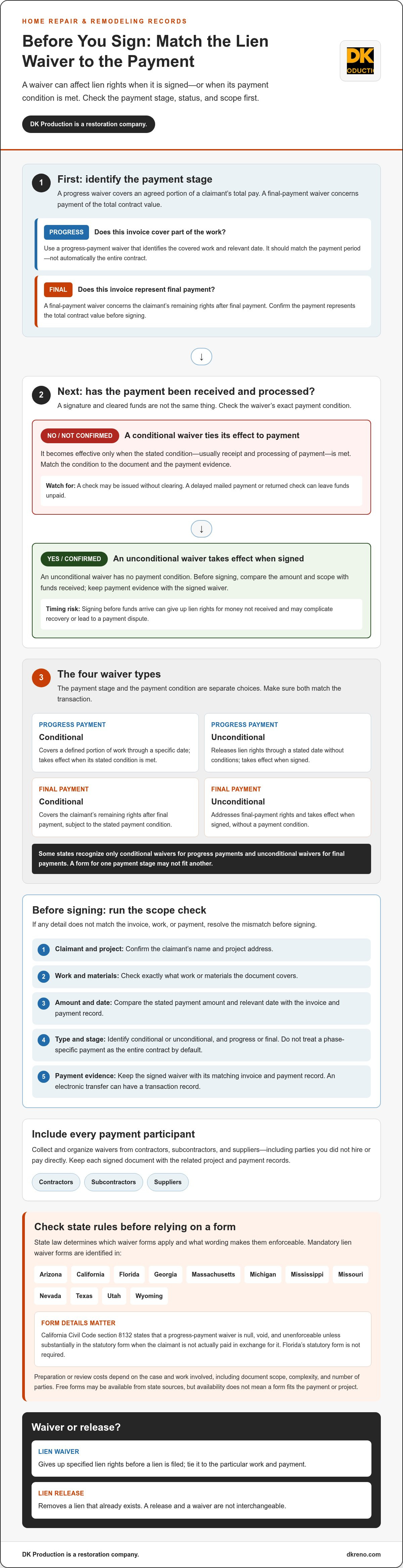
There are four basic waiver types: conditional and unconditional waivers for progress payments, and conditional and unconditional waivers for final payments. A conditional waiver is provided before payment and becomes effective when its stated condition is met. An unconditional waiver takes effect when signed, so timing matters if funds haven’t cleared.
A progress waiver covers an agreed portion of a claimant’s total pay; a final-payment waiver concerns payment of the total contract value. Some states recognize only conditional waivers for progress payments and unconditional waivers for final payments. A form for one payment stage may not fit another.
State Rules and Enforceable Forms
State law determines which waiver forms apply and what wording makes them enforceable, so the property’s state matters. Arizona, California, Florida, Georgia, Massachusetts, Michigan, Mississippi, Missouri, Nevada, Texas, Utah, and Wyoming have mandatory lien waiver forms; Florida’s statutory form isn’t required. When working with established regional specialists like Miller's Home Improvement for roofing projects in Michigan, utilizing these required forms ensures each payment milestone is documented in full compliance with state rules.
California illustrates why form details matter. Under California Civil Code section 8132, a progress-payment waiver is null, void, and unenforceable unless it is substantially in the statutory form when the claimant isn’t actually paid in exchange for it, according to California Legislative Information. Lien waiver requirements can vary, so review the applicable form before relying on it.
Preparation or review costs depend on the case and work involved, including the document’s scope, complexity, and number of parties. Free forms may be available from state sources, but availability doesn’t mean a form fits the payment or project. Compare its details with the transaction before relying on it.
When organizing lien waivers for homeowners, match each form to the claimant, work, payment amount, and effective condition. Confirm that payment has processed before treating a conditional waiver as effective, then keep the signed document with the related payment record.
For phased construction, lien waivers for homeowners can distinguish one payment from another when each form clearly identifies the work and amount it covers. Review the details as invoices arrive to keep the paperwork aligned with the project’s progress.
Risks of signing an unconditional waiver before payment clears
An unconditional waiver can take effect when signed, before expected funds arrive. Understanding how lien waivers for homeowners relate to payment timing helps keep each signed document aligned with money actually received.
Progress and Final Waiver Timing
An unconditional progress-payment waiver releases lien rights through a stated date without conditions, while an unconditional final waiver addresses final-payment rights. Each applies to a different payment stage, so the document’s scope should match the invoice.
For a progress invoice, compare the covered-through date with the work and payment period. For a final invoice, confirm that payment represents the total contract value before signing. A conditional waiver ties its effect to the stated payment condition; an unconditional waiver doesn’t.
Signing too early can cause problems if a mailed payment is delayed or a check is returned unpaid. The signer may give up lien rights for funds they haven’t received, complicating recovery and potentially leading to a payment dispute.
Keep payment evidence with the signed waiver. For an unconditional waiver, save a transaction record and compare it with the amount stated in the document. That record can help show whether the payment corresponds to the waiver.
Checking Waiver Information
Before signing or paying, review the claimant’s name, project address, covered work or materials, payment amount, and date. Confirm that the parties and scope match the invoice so the document doesn’t cover more work or money than intended.
Next, identify whether the form is conditional or unconditional and whether it covers progress or final payment. If an invoice covers one completed phase, a waiver for the entire contract may not fit. Resolve any mismatch before signing.
Review how the waiver defines payment and when its condition is met. A check can be issued without clearing, while an electronic transfer can have a transaction record. Compare available payment evidence with the document’s exact wording rather than treating a signature as proof that funds arrived.
For lien waivers for homeowners, keeping each form with its matching invoice and payment record creates a useful project trail. If the wording doesn’t match the work, amount, or parties involved, request a corrected document before signing. This helps homeowners track which payment is documented and which remains unsettled.
Use lien waivers for homeowners as payment-specific records, not blanket confirmation for every participant or project phase. Careful review before signing can help prevent a waiver from taking effect for the wrong scope or amount.
Obtaining waivers from contractors, subcontractors, and suppliers
Construction projects involve more than the contractor hired by the homeowner. Contractors, subcontractors, and suppliers may have lien rights for their work or materials, so payment records should account for every participating party.
Collecting Waivers Across the Project
Collect a waiver from each party whose work or materials are covered by a payment, including parties you didn’t hire directly. A general contractor can collect preliminary notices from project participants to help identify who is working on the property.
Request waivers as payments are made, and match each document to its signer, project, work, and payment amount. On longer jobs, progress waivers commonly arrive at the end of a billing period; final waivers accompany the final billing. Keep signed documents with invoices and payment records.
General Contractor Waiver Management
The general contractor can coordinate waivers from subcontractors and suppliers, not just provide one for its own work. This matters because if a contractor fails to pay a vendor, the property owner may face a lien claim.
For a payment draw, the contractor may provide its waiver for the latest payment and collect subcontractor waivers for earlier work already paid. Homeowners can request this paperwork with each invoice. Monthly billing is typical in the United States, though contract terms can set a different schedule.
Waivers cover only the signer and work described, not every party or activity on the project. For example, a supplier’s form should identify the materials and project it concerns. Check the named parties, work, and payment amount, then retain the signed form for future reference.
State requirements vary, and some states prescribe waiver forms. In Florida, a waiver that isn’t substantially similar to statutory forms is enforceable according to its terms, according to the Florida Legislature. The form and its wording can therefore affect what the signer gives up.
Residential Projects and Direct Payments
Residential work and direct homeowner payments don’t eliminate the need to account for contractors, subcontractors, and suppliers. Whether coordinating with specialized trade professionals like Progressive Contracting NY Corp for exterior restoration or hiring a general remodeling crew, waiver requirements vary by state, while payment arrangements determine which parties receive funds and which waivers relate to each payment.
If a contractor refuses to provide a waiver, record the request and response, and preserve the contract, invoices, payment records, and project notices. If a lien is filed, keep the filed document and promptly seek legal advice about the steps and deadlines that apply in that state.
Before paying, identify the parties tied to the invoice and ask the general contractor for waivers covering subcontractors and suppliers. This connects the payment trail to everyone who contributed work or materials, even when you paid only the general contractor directly.
Lien waivers compared with lien releases
A lien waiver and a lien release address different points in a construction project. A waiver gives up lien rights before a lien is filed; a release removes a lien that has already been filed. For property owners, the key distinction is whether a mechanic’s lien exists.
Consider a kitchen project with a contractor’s progress invoice. A signed waiver can cover lien rights for the payment and work it identifies, before any lien is filed. It doesn’t, by itself, remove a lien already recorded against the property. If a lien has been filed, the homeowner needs a release addressing that existing lien.
The documents also typically identify different information. A waiver should describe the specific work, materials, project, and payment it covers. A lien release usually includes the property address and the date the lien was filed. These details help owners connect the paperwork to the right project and lien status.
Use the document that matches the situation:
Before a lien is filed: Review a waiver for the signer, covered work, payment amount, and payment stage, such as progress or final payment.
After a lien is filed: Look for a release that identifies the existing lien, including the property address and filing date.
For project records: Keep the signed waiver or release with the related invoice, payment record, and construction documents.
A waiver’s scope matters. If a supplier’s waiver covers only materials delivered for one phase, don’t treat it as proof that every party has given up lien rights for the entire project. Likewise, a release for a particular filed lien shouldn’t be confused with a waiver for later progress work or another payment.
Check the status before relying on either document: determine whether a lien has been filed, then match the document to that status. Compare the property details and named parties against your contract and project records. A mismatch in address, signer, payment, or covered work can leave uncertainty about what the paperwork addresses.
The practical takeaway is simple: waivers address potential lien rights before filing; releases address liens already in place. Keep both terms distinct as invoices arrive, especially when different contractors and suppliers work on the same property. For a whole-house remodeling project, organize payment documents and project paperwork from the start. Plan your whole-house remodeling project with clear records that are easier to track through each phase.
DK Production Restoration: Restoration
DK Production provides Water Damage, Fire & Smoke, Mold Remediation, Damage Assessment, and Restoration & Rebuild services for residential properties. If damage leads to repair work, keep invoices and signed waivers organized by project phase and payment so the paperwork stays clear as restoration progresses.
Water mitigation addresses water damage, while reconstruction supports the work needed to return affected areas to use. Keeping project documents together helps you track the work and payments alongside the repair process.
For restoration or reconstruction after water damage, contact DK Production Restoration to discuss your project.
Keep your project moving with clear records
A reliable process for lien waivers for homeowners starts with organizing project paperwork by phase. Store contracts, invoices, signed documents, and payment confirmations together so you can quickly connect each record to the work it concerns.
As your project progresses, update your records when a new invoice or document arrives. This makes lien waivers for homeowners easier to review alongside repair or restoration work, without losing track of project details.
DK Production provides Water Damage, Fire & Smoke, Mold Remediation, Damage Assessment, and Restoration & Rebuild services. If property damage calls for repairs, organized project records can help keep paperwork connected to the work underway.
Contact DK Production Restoration today to discuss your restoration needs and take the next step with confidence.
Frequently Asked Questions
What is a Mechanic’s Lien?
A mechanic’s lien is a claim against property for unpaid construction work or materials. For example, if a supplier provides flooring for a renovation but isn’t paid, the supplier may be able to claim a lien against the home. The claim concerns payment for work or materials, not the quality of the finished project. State rules determine how liens are filed and addressed.
What is a lien waiver and how does it protect homeowners?
A lien waiver records that a signer gives up lien rights for the payment and work described in the document. It helps homeowners connect payments to the contractor, supplier, or project work covered. For example, a waiver from a flooring installer doesn’t document payment to a separate cabinet supplier. Keep each waiver with its matching invoice and payment record, rather than treating one document as covering every project participant.
What are the main types of lien waivers: conditional and unconditional, partial and final?
Conditional waivers depend on a stated condition, usually payment; unconditional waivers take effect when signed. Partial, or progress-payment, waivers cover a portion of the work or payment, while final waivers relate to final payment. For instance, a waiver for an installment on completed bathroom work differs from one covering the final contract payment. Check both the payment stage and condition before relying on a form.
When should a homeowner request a lien waiver from a contractor or subcontractor?
Request a waiver alongside each progress payment and with the final billing so the paperwork corresponds to the payment being made. If a project has separate invoices for electrical work and materials, request documents identifying each relevant claimant and covered work. This makes it easier to see which payments are documented and which parties still need paperwork. Store signed waivers with their invoices and payment confirmations.
Can a homeowner safely sign a lien waiver before a payment clears?
An unconditional waiver can take effect upon signing, even if the expected payment hasn’t cleared, so signing before funds arrive carries risk. A check could be delayed or returned unpaid, leaving a dispute over the money and waived rights. A conditional waiver ties its effect to the stated payment condition. Read the wording, confirm the amount and covered work, and match the waiver to the payment status.
How should homeowners collect lien waivers from subcontractors and material suppliers?
Ask the general contractor to identify project participants and gather waivers from subcontractors and suppliers, including those you didn’t hire directly. Match each signed form to the participant, materials or work, invoice, and payment it concerns. For example, retain a lumber supplier’s waiver separately from a carpenter’s waiver. DK Production provides restoration services, and organized project records help keep restoration paperwork distinct from payment documents.



Comments