
How Long Does Water Damage Restoration Take? A 2026 Timeline Guide

Water damage restoration is a two-act play where mitigation stops the bleeding, but reconstruction finally heals the home. If you're currently walking on damp carpets or listening to the constant hum of industrial fans, your first question is likely: how long does water damage restoration take? It's completely natural to feel overwhelmed by the uncertainty of insurance coverage or the fear that hidden mold is already taking hold. You want your life back, and you deserve the peace of mind that comes from a home that's dry, safe, and restored to its original beauty.
This guide provides the clarity you need to navigate the recovery process without the usual administrative friction. We'll explain why the 24 to 48 hour window is critical for mold prevention and how current 2026 standards, like the IICRC S500, impact your project schedule. By understanding the specific phases of professional mitigation and the subsequent remodeling steps, you can move from the chaos of a crisis to the orderly return of your high-quality finished space. We've outlined the factors that influence every stage so you can manage your expectations and your home with confidence.
Table of Contents
Understanding the Two Phases of Water Damage Recovery
The journey back to a normal life after a leak or flood isn't a single, uninterrupted event. It's actually a two-part process that requires different mindsets and specialized skill sets. Many homeowners feel a sense of relief when the standing water is gone, yet they soon realize that reaching a dry state is only the beginning of the story. To accurately estimate how long does water damage restoration take, you must distinguish between the emergency stabilization of the property and the subsequent reconstruction of your living space.
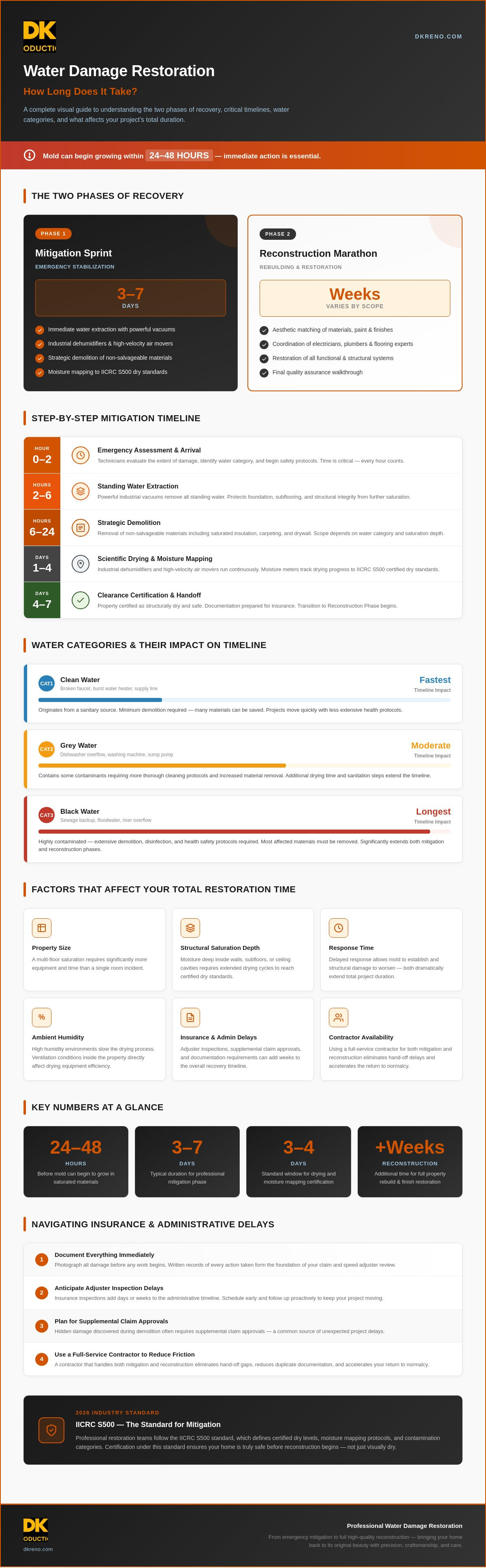
The first phase is a fast-paced effort to protect your home's structural integrity, while the second phase is a meticulous rebuilding process. Mitigation typically lasts between 3 to 7 days, but the reconstruction phase can extend for several weeks. Recognizing this distinction helps you manage the transition from a state of crisis to a state of renewal without unnecessary stress. By viewing the project as two distinct acts, you can better prepare for the eventual return to your high-quality finished home.
Phase 1: The Mitigation Sprint
This initial stage is a race against the clock. The primary goal is to stabilize the environment and stop the progression of damage. Professional teams prioritize the removal of moisture to prevent the growth of mold, which can start in as little as 24 to 48 hours. During this sprint, technicians focus on technical precision to ensure the property meets rigorous dry standards. This phase is characterized by intense activity and the constant hum of specialized machinery.
Immediate Extraction: Powerful vacuums remove standing water to protect the foundation and subflooring from long-term saturation.
Scientific Drying: Industrial dehumidifiers and high-velocity air movers are strategically placed to pull moisture from deep within the walls and floors.
Strategic Demolition: This involves removing non-salvageable materials, such as saturated insulation or carpets affected by specific Water damage categories, to ensure a clean slate for repairs.
Phase 2: The Reconstruction Marathon
Once the property is certified as dry and safe, the reconstruction marathon begins. When homeowners ask how long does water damage restoration take, they are often surprised by the duration of this second chapter. This phase is less about emergency response and more about high-quality craftsmanship. It involves restoring the aesthetic and functional elements of your home so that the final result is indistinguishable from the original state. Because this stage requires coordinating different specialists, it naturally takes more time to complete.
Aesthetic Matching: Experts work to find materials, paint colors, and finishes that perfectly match your home's existing style for a seamless look.
Trade Coordination: We manage the scheduling of specialized professionals, including electricians, plumbers, and flooring experts, to ensure every system is restored correctly.
Final Quality Assurance: A comprehensive walkthrough ensures every detail meets professional standards, providing you with the peace of mind that your home is truly whole again.
Critical Factors That Dictate Your Restoration Speed
Estimating how long does water damage restoration take requires a careful analysis of the unique variables present in your home. No two incidents are identical; a minor supply line leak in a well-ventilated laundry room presents a different timeline than a significant pipe burst that saturates multiple floors. We look at the specific environment to determine the most efficient path forward, ensuring that every action taken serves the ultimate goal of a safe and high-quality result. By identifying these variables early, we can provide you with a clearer project schedule and reduce the uncertainty that often accompanies property damage.
Water Categories and Safety Protocols
The source of the water dictates the level of cleaning and demolition required for a safe environment. Professional restoration teams follow strict safety protocols based on three primary categories of contamination. These categories directly influence the speed of the project because they determine how much material can be saved versus what must be removed for health reasons.
Category 1 (Clean Water): This originates from a sanitary source, such as a broken faucet or a burst water heater. These projects often move quickly because minimal teardown is required and the focus remains on rapid drying.
Category 2 (Gray Water): This water contains significant contamination, often from a washing machine or dishwasher overflow. It requires thorough sanitization of all affected surfaces, which typically adds 24 to 48 hours to the initial mitigation phase.
Category 3 (Black Water): This is grossly contaminated water from sewage backups or external flooding. Safety is the priority here, requiring extensive demolition of porous materials and rigorous decontamination before any reconstruction can begin.
Structural Complexity and Material Impact
The materials within your home react to moisture in different ways, and their porousness determines the specialized equipment needed for recovery. Drywall and insulation act like sponges, often requiring removal if they remain saturated for too long. In contrast, materials like hardwood floors require a more patient approach. We often utilize specialized mat drying systems that use suction to pull moisture from deep within the wood grains; this process is delicate and extends the timeline, but it is the best way to save expensive flooring and avoid a full replacement.
Structural complexity also plays a role, especially in multi-level homes where water travels through the 'sandwich' between the ceiling and the floor above. This requires drying both sides of the structure simultaneously to prevent trapped moisture from causing secondary damage. Our professional mitigation teams work toward a specific 'dry standard,' which is a predetermined moisture level based on the readings of unaffected materials in your home. If you are currently dealing with a complex leak, our team offers expert water damage services that manage these technical details on your behalf, allowing you to focus on returning to your normal routine.
Environmental conditions in the Pacific Northwest also impact the process. High ambient humidity can slow down natural evaporation, making the use of high-grade industrial dehumidifiers essential to maintain a controlled drying environment. By managing the air quality and temperature with precision, we can overcome external weather factors and keep the project moving toward completion.
The Step-by-Step Timeline of Professional Mitigation
When you're standing in a flooded room, the clock is your biggest adversary. Understanding the daily progression of a professional crew helps replace panic with a clear plan of action. While every property is unique, a standard response follows a methodical rhythm designed to move your home from chaos to a controlled, dry state. This section breaks down the specific milestones that answer the question: how long does water damage restoration take during the critical mitigation phase?
The transition from a state of emergency to a state of recovery happens in stages. We start with heavy extraction and move toward precise environmental control. By following a structured timeline, we ensure that no moisture is left behind to cause future problems. This disciplined approach is what allows us to act as a stabilizing force for you during a high-stress event.
The First 24 Hours: Emergency Stabilization
The first day is dedicated to emergency stabilization and safety. Our priority is your well-being, so we immediately inspect electrical systems and structural integrity to prevent secondary hazards. We don't just look at the surface; technicians use thermal imaging cameras to locate hidden pockets of water trapped behind drywall or under cabinetry. High-capacity extraction units then remove the bulk of the water. Removing liquid water is roughly 1,200 times more efficient than evaporating it, making this the most effective way to prevent mold growth before it starts.
Days 2 through 5: The Science of Drying
Once the standing water is gone, the science of drying begins. This isn't just about placing fans; it's about managing psychrometric readings, which are technical measurements of temperature, humidity, and airflow. Technicians return to your home daily to monitor these levels and adjust air movers or dehumidifiers as needed. We're looking to create the perfect vapor pressure to pull moisture out of dense materials like subflooring or wall studs. It's vital that all equipment stays running 24/7 during this window to maintain the drying momentum and prevent the air from becoming oversaturated.
By day five, most standard projects reach their predetermined dry goals. We conduct final moisture mapping to verify that every corner of the affected area meets professional standards. Once the house is certified dry, we perform a final sanitization to eliminate any lingering bacteria or odors. The removal of the industrial equipment marks the successful end of the mitigation phase. At this point, your property is no longer a "loss site" but is ready to transition into a reconstruction project, where the focus shifts to rebuilding your home's beauty and comfort.
Navigating Insurance and Administrative Delays
Even when the industrial fans are humming, a second, invisible clock is ticking in the background. Many homeowners ask how long does water damage restoration take without realizing that administrative hurdles often dictate the pace. Insurance negotiations, adjuster schedules, and approval cycles for supplemental claims can add days or even weeks to the project timeline. We act as your advocate during this phase, using our expertise to bridge the gap between technical necessity and policy requirements. This coordination ensures that the paperwork moves as quickly as the physical repairs.
The Adjuster's Role in the Schedule
The speed of your recovery often depends on how quickly an adjuster can perform an on-site inspection. In high-demand areas like Seattle and Everett, local weather events can lead to a surge in claims, stretching adjuster availability thin. This initial visit is vital because it establishes the baseline for your claim. We compare the insurance company's estimate against our professional "Scope of Work" to ensure no critical repairs are overlooked. Be aware that if you have a mortgage, your lender may also need to sign off on claim checks, which can introduce additional waiting periods before funds are released for reconstruction.
Documentation: The Key to Speed
Clear, indisputable evidence is the best way to prevent administrative stalls. We capture comprehensive "before" photos and maintain detailed moisture logs to prove exactly why specific actions, like removing saturated drywall, were necessary. By using industry-standard software like Xactimate, we provide transparent pricing that aligns with what adjusters expect to see. This level of detail reduces the back-and-forth negotiations that often delay the start of repairs. When every moisture reading is documented, there's less room for debate, which keeps the project moving forward.
Working with specialized insurance restoration companies ensures that your project doesn't get stuck in a cycle of supplemental claim approvals. When we discover hidden damage during the demolition phase, we document it immediately and submit the findings to your carrier in their preferred language. This proactive approach assumes the administrative burden on your behalf, allowing the project to move from drying to rebuilding with minimal friction. If you're feeling overwhelmed by the paperwork, our team provides the professional restoration support needed to keep your claim on track and your home moving toward completion.
Accelerating Recovery with a Full-Service Contractor
The biggest variable in how long does water damage restoration take is often the gap between the drying phase and the start of repairs. Many homeowners hire a specialist for mitigation and then begin the search for a reconstruction contractor once the equipment is removed. This "hand-off" problem can add two to three weeks of unnecessary downtime as a new team must visit the site, provide an estimate, and wait for insurance approval. A unified team understands the hidden moisture history of the building; this prevents the re-discovery of problems that often happens when a new contractor takes over mid-stream.
We believe that recovery should be a continuous, logical flow from chaos to order. While our industrial dehumidifiers are still running, our project managers are already mapping out the reconstruction phase. This overlapping schedule allows us to secure materials and schedule trades early, ensuring that your home doesn't sit empty and exposed for a single day longer than necessary. For those dealing with water damage in Arlington, WA, our local expertise allows us to navigate specific regional challenges and community standards with ease. By managing the full duration of the project, we eliminate the friction that typically slows down large-scale repairs.
The Full-Service Advantage
Unified accountability is the cornerstone of a stress-free restoration. When a single company handles both the structural drying and the final paint stroke, there is no room for finger-pointing or miscommunication between different crews. We ensure that the disciplined standards expected for home remodeling in Seattle, WA are applied to your reconstruction project. This methodology links professional actions directly to your long-term satisfaction. Our comprehensive approach means your home isn't just fixed; it is renewed to a high-quality finished state that often exceeds its original condition.
Your Path to Normalcy
Your project manager acts as a reliable mentor, providing a realistic "Move-in Ready" date so you can plan your return with confidence. We assume the burden of the crisis on your behalf, managing every technical detail and administrative negotiation to provide a truly frictionless experience. The relief of knowing your home is in the hands of protective specialists allows you to focus on your family instead of the construction zone. This commitment to total renewal is what transforms a house back into a home. Contact DK Production today to find a stabilizing force for your home restoration journey.
Returning Your Home to Total Renewal
Understanding how long does water damage restoration take is about recognizing the transition from emergency stabilization to high-quality reconstruction. By focusing on professional mitigation and unified accountability, you can eliminate the administrative friction that often stalls progress. A seamless recovery requires both technical precision and expert insurance negotiation support to ensure your home returns to its pre-loss condition without unnecessary delays. This clear roadmap helps you move from the stress of a construction zone to the comfort of a finished space.
Since 2014, DK Production has acted as a protective specialist for homeowners in Arlington, Seattle, and across the Puget Sound. We assume the full burden of your restoration project, providing a frictionless experience that prioritizes your peace of mind and safety. Our team is committed to delivering a dry, safe, and beautifully restored home that meets rigorous performance standards. We act as your advocate, managing the path to renewal so you can focus on your life.
Restore your peace of mind—contact DK Production for expert water restoration today. Your journey back to normalcy starts with a partner who advocates for your property every step of the way. We look forward to helping you turn the page on property damage and returning your home to a state of total renewal.
Frequently Asked Questions
Is 3 days enough time to dry out water damage?
Three days is often the minimum time required for professional drying, but the actual duration depends on the material's saturation. While surface moisture might evaporate quickly, dense materials like subflooring or wall studs often require four to five days of continuous industrial dehumidification to reach a certified dry standard. We monitor moisture levels daily to ensure no hidden dampness remains to cause structural issues later.
Can I stay in my house during the water restoration process?
You can typically stay in your home if the damage is localized, but large-scale projects or Category 3 black water contamination often require temporary relocation for your safety. The constant noise of high-velocity air movers and the removal of essential facilities like bathrooms or kitchens can make daily life difficult. We work with you to determine the most comfortable and safe arrangement while we manage the restoration.
How long before mold starts growing after a water leak?
Mold spores can begin to colonize damp surfaces within 24 to 48 hours of initial exposure. This rapid growth is why immediate water extraction and humidity control are the highest priorities during the first day of service. By stabilizing the environment quickly, we prevent secondary damage that would significantly extend how long does water damage restoration take for your property.
Why does my insurance claim take so long to get approved?
Delays often stem from the time it takes for an insurance adjuster to perform a site visit and review the professional scope of work. During peak seasons or after major storms, local demand can slow down the response time significantly. Providing detailed moisture logs and high-resolution "before" photos helps our team accelerate this administrative process by leaving no room for debate regarding the necessity of the repairs.
What happens if the contractor finds more damage during demolition?
If hidden issues like structural rot or previous leaks are discovered during demolition, we immediately document the findings and submit a supplemental claim to your insurance carrier. This ensures that all necessary repairs are included in the project scope so the home is returned to a truly safe condition. While this can add a few days for approval, it prevents long-term structural problems from being ignored during the rebuild.
Does the type of flooring I have affect the restoration timeline?
The type of flooring is a major factor in determining how long does water damage restoration take because different materials have varying porosity. For example, hardwood floors often require specialized mat drying systems that pull moisture from the wood over several days to avoid warping. In contrast, saturated laminate or carpet over a pad usually requires immediate removal, which shifts the project focus directly to the reconstruction phase.
How much of the restoration process is covered by standard homeowners insurance?
Most standard policies cover restoration for sudden and accidental events, such as a burst pipe or water heater failure, but they typically exclude gradual leaks or external flooding. It is important to review your specific policy for limits on mold remediation or sub-limits for sewage backups. We provide detailed documentation to help you navigate your eligible coverage and minimize out of pocket expenses for necessary repairs.
What is the difference between water mitigation and water reconstruction?
Water mitigation is the emergency phase focused on extraction, drying, and sanitization to prevent further structural harm. Water reconstruction is the rebuilding phase where we repair drywall, replace flooring, and handle remodeling tasks to restore the home's original aesthetic. While mitigation is a fast-paced sprint to stabilize the property, reconstruction is a more methodical process that returns your home to its high-quality finished state.


Comments