
Avoiding Scams from Restoration Companies: A Homeowner’s Guide to Safe Recovery

Updated: Jul 17
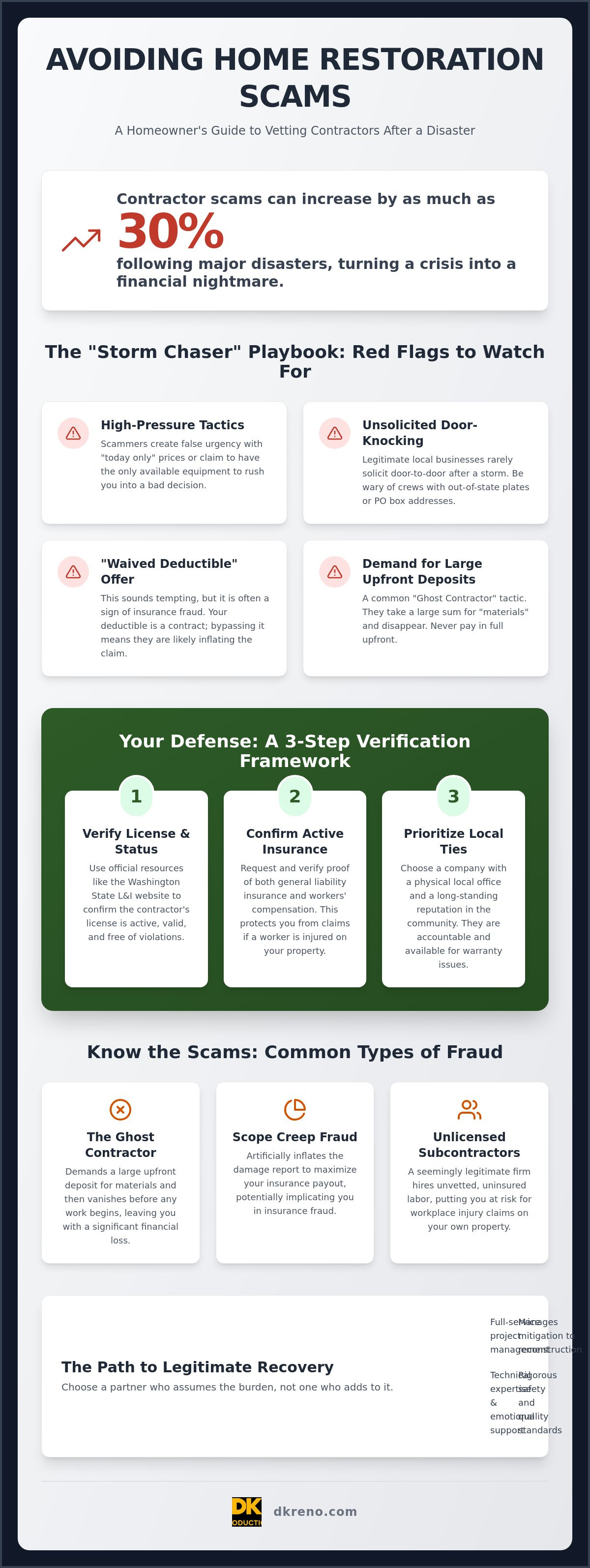
Reports of contractor scams can increase by as much as 30% following major disasters, often turning a property crisis into a long-term financial nightmare. When you are standing in a damaged home, the pressure to sign a contract and begin repairs can feel overwhelming. However, avoiding scams from restoration companies requires a steady hand and a commitment to verification over urgency. You deserve a partner who assumes the burden of the crisis rather than someone who adds to it with predatory tactics or unlicensed work.
We understand that the transition from chaos to a fully restored state is a journey that requires both technical expertise and emotional support. This guide provides the tools you need to identify red flags, verify professional credentials, and protect your home from predatory "storm chasers." We will preview the essential steps of vetting a local partner, understanding new 2026 contract transparency laws, and ensuring your reconstruction is handled with the rigorous standards of performance you expect.
Table of Contents
The Restoration Scam Landscape: Why Homeowners Are Targets
Homeowners facing property damage are often in a state of high stress, which makes them prime targets for predatory contractors. After a disaster, the priority is usually returning to normalcy as quickly as possible. Scammers understand the psychology of a scam and use this sense of urgency to bypass the careful vetting process you would normally use for a kitchen remodel or a bathroom addition. Avoiding scams from restoration companies starts with recognizing that these predators aren't just looking for work; they're looking for the path of least resistance to your insurance payout.
The "Storm Chaser" phenomenon involves out-of-state crews that monitor weather patterns and mobilize to disaster zones within hours. These firms lack local ties and often disappear once the initial insurance check is cashed, leaving you with no recourse for warranty issues. They focus on "Insurance Bait," where the goal is to secure a high-value claim rather than provide quality repair. By focusing on the administrative payout instead of the physical reconstruction, they sacrifice the safety and integrity of your home for a quick profit. The long-term cost of these scams is devastating, often resulting in subpar materials, code violations, and even potential insurance fraud charges against the homeowner.
Common Types of Restoration Fraud in 2026
Fraudulent tactics have become more sophisticated in 2026, but they generally fall into three categories. The "Ghost Contractor" is the most direct threat; they demand a large deposit for materials and simply vanish before work begins. Others use "Scope Creep," where they artificially inflate the damage report to max out your insurance limits, which can lead to legal liability for you if the insurer discovers the discrepancy. Finally, the "Unlicensed Subcontractor" trap involves a firm that appears legitimate but hires unvetted, uninsured labor to perform the actual work, putting you at risk for workplace injury claims on your property.
Why 'Free' Restoration Services Are Never Free
A common red flag is the promise to "waive your deductible." In Washington, this is a legal red flag and can be considered insurance fraud. Legitimate firms won't ask you to participate in a scheme that compromises your policy or your legal standing. Additionally, some "mitigation-only" firms specialize in gutting homes but have no intention of rebuilding. They take the quick mitigation payment and leave you with a skeleton of a house and no plan for reconstruction. For a true recovery, you need a comprehensive residential property restoration plan that addresses both the immediate stabilization and the eventual high-quality finished state of your space.
Red Flags: Identifying the 'Storm Chaser' Playbook
Identifying a predatory contractor requires looking past the immediate chaos of a flooded kitchen or a damaged roof. For those in the Pacific Northwest, seeking out companies with decades of local history, such as Advanced Roofing, provides a benchmark for the type of established reputation you should look for. Legitimate local professionals prioritize stabilization and safety, whereas scammers prioritize a signed contract. A primary indicator of a "storm chaser" is unsolicited door-knocking. While a neighbor might offer help, a business that solicits work door-to-door after a weather event is rarely a local fixture. These out-of-state crews often operate with out-of-state plates or PO box addresses, lacking a physical local office where you can find them if issues arise months later.
The "Waived Deductible" offer is perhaps the most dangerous red flag. It sounds like financial relief, but it's frequently a gateway to insurance fraud. For those focused on avoiding scams from restoration companies, it's vital to recognize that your deductible is a contract between you and your insurer; any contractor offering to bypass it is likely cutting corners elsewhere or inflating the claim artificially. A detailed line-itemed estimate provides transparency, ensuring that every dollar of your insurance claim is directed toward high-quality materials and skilled labor.
Tactics Used to Bypass Your Better Judgment
The FTC's guide to avoiding home improvement scams highlights many common red flags, yet predators constantly evolve their tactics. They might claim to have "special today only" pricing or suggest they have the only available dehumidifiers in the county. In 2026, some scammers even use AI-generated emails to mimic official insurance correspondence. Never sign a "Direction to Pay" form before your adjuster has approved a detailed scope of work. This form can give the contractor total control over your claim funds before a single piece of drywall is replaced.
How to Say 'No' to High-Pressure Sales
Protecting your home means maintaining control of the process. Implement a strict 24-hour rule: never sign a contract the same hour you receive it, no matter how much the contractor emphasizes the risk of mold. Under 2026 regulations, legitimate home improvement contracts must include the contractor's email address and allow for cancellation via email. If a contractor refuses to provide these details, they are likely operating outside the law. Request a written scope of work and tell the contractor you need to review it with your insurance adjuster first. If you feel pressured, consulting a trusted home remodel contractor near me for a second opinion can provide the clarity you need to move forward safely. By staying vigilant, you take the first step in avoiding scams from restoration companies and ensuring your home is returned to a state of total renewal. If you're currently facing a property crisis, reaching out to a local specialist can help you distinguish between a quick fix and a quality restoration.
The Verification Framework: Licensing, Insurance, and Local Ties
Moving beyond the initial instinct to trust a friendly face, you need a disciplined approach to vetting any contractor who enters your home. Avoiding scams from restoration companies requires more than just skepticism; it demands a methodical verification of a firm's legal and professional standing. A legitimate partner won't just tell you they are qualified. They will provide the documentation to prove it, assuming the burden of proof so you don't have to. This verification framework acts as a stabilizing force, ensuring that the team managing your property recovery is held to the highest standards of performance and safety.
The National Insurance Crime Bureau on contractor fraud emphasizes that predatory individuals often rely on a homeowner's lack of technical knowledge. You can counter this by confirming active General Liability and Workers' Compensation insurance. Workers' Comp is particularly vital; if a technician is injured on your property and the company isn't covered, you could be held financially liable. Furthermore, look for deep local roots in the Puget Sound community. A company that has completed numerous home remodeling Seattle WA projects is far more likely to value its reputation than a transient crew following a storm path.
Using the WA L&I 'Verify a Contractor' Tool
In Washington, the primary defense against fraud is the Department of Labor & Industries (L&I) website. You should search for a company using their name or their Unified Business Identifier (UBI) number to see their current status. This tool allows you to check for active infractions or lawsuits against their bond, which provides a clear picture of their history with previous clients. If a license is listed as "suspended" or "expired," it's an immediate deal-breaker. A suspended license often means the company has failed to maintain its bond or insurance, leaving you completely unprotected if the project goes wrong.
The Importance of IICRC Certification
Technical expertise in restoration is governed by the Institute of Inspection Cleaning and Restoration Certification (IICRC). When avoiding scams from restoration companies, verify that the firm adheres to IICRC S500 standards for professional water damage restoration and S520 standards for mold remediation. These aren't just suggestions; they are rigorous protocols that ensure your home is dried and cleaned to a level that prevents long-term structural damage or health risks. Insurance adjusters often require these certifications to approve a claim, as they provide an objective benchmark for quality. Always ask if the specific technicians on-site are trained and certified, ensuring that the expertise extends to the people actually performing the work.
Financial Safety: Contracts, Deductibles, and Payment Schedules
Financial recovery should be as methodical as the physical reconstruction of your home. Avoiding scams from restoration companies requires a firm grasp on how money flows throughout the duration of a project. A legitimate partner operates with transparency, providing a stabilizing force during a period of high stress. One of the most critical safeguards is the "No Large Upfront Deposit" rule. You should never be asked to pay more than 10-15% of the total estimate before work begins. Large deposits are a common tool for "ghost contractors" who take the funds and disappear, leaving you with a damaged property and a depleted insurance payout.
A professional restoration firm utilizes industry-standard software like Xactimate to generate a detailed, line-itemed scope of work. This level of specificity ensures that your insurance adjuster can verify every cost, from the grade of the flooring to the number of air scrubbers used during mitigation. Vague or verbal-only estimates are a significant red flag; they lack the accountability required to protect your finances. By tying payments to specific milestones such as the completion of water mitigation, the finalization of framing, or the installation of finishes, you maintain control over the project's progress and quality.
Navigating the Insurance Claim Process Safely
Your insurance adjuster is often your best ally in identifying padded or fraudulent estimates. They understand the typical costs for property recovery and can spot discrepancies that indicate a scam. Be particularly wary of "Assignment of Benefits" (AOB) forms. While a "Direction to Pay" simply allows the insurer to pay the contractor directly for work performed, an AOB strips you of your rights to the claim, giving the contractor total control over the legal and financial aspects of your recovery. Always insist on a "Three-Way Check" process involving you, the contractor, and your mortgage company to ensure total oversight of the funds.
What a Legitimate Restoration Contract Includes
A disciplined contract acts as a roadmap from chaos to order. It must include firm start and end dates, though reasonable windows for discovering unforeseen damage are standard. Every material should be listed with specific brands, grades, and finishes to prevent the use of subpar alternatives. In Washington, you also have a legal right to cancel most contracts signed in your home within three days. For a comprehensive look at what to look for in a professional agreement, refer to our insurance restoration companies guide. If you are ready to partner with a specialist who assumes the burden of the crisis on your behalf, talk to our restoration specialists today to begin your journey toward total renewal.
The Path to Legitimate Recovery with DK Production
The journey from property damage to a restored home requires more than just a contractor; it demands a partner who assumes the burden of the crisis on your behalf. While many firms focus solely on the initial extraction of water or debris, our approach is built on full-service accountability. We manage the entire duration of your project, from the first hour of emergency water mitigation to the final walkthrough of your high-end reconstruction. This comprehensive model is a primary defense in avoiding scams from restoration companies, as it eliminates the risk of being left with a gutted, uninhabitable property and no plan for the rebuild.
Our commitment to the Puget Sound community is deeply rooted in our work across Arlington, Shoreline, and the greater Seattle area. We provide administrative advocacy that acts as a stabilizing force between you and your insurance provider. By coordinating directly with adjusters and utilizing transparent, industry-standard reporting, we ensure a frictionless claim process. This protective specialist role allows you to focus on your family's return to normalcy while we handle the technical and administrative complexities of your recovery.
From Chaos to Total Renewal
One of the greatest stressors in property recovery is managing multiple vendors who may not communicate with each other. We provide a single point of contact for the entire duration of your project, moving methodically from chaos to order. Because our background includes extensive remodeling expertise, we don't simply aim to return your home to its pre-loss condition. We look for opportunities to elevate your space, ensuring your reconstruction meets rigorous standards for both safety and aesthetic performance. Whether we are handling a kitchen remodel after a pipe burst or a whole-house restoration, our quiet confidence comes from decades of experience in turning property disasters into total renewals.
Start Your Stress-Free Recovery Today
The transition back to a high-quality finished state should never be rushed by high-pressure sales tactics. Choosing a partner who prioritizes your satisfaction and long-term safety is the final step in avoiding scams from restoration companies. We offer a professional, no-pressure assessment of your property to help you understand the full scope of your recovery needs without the typical friction of third-party negotiations. Let us assume the burden of this crisis so you can experience the relief of a project managed with discipline and compassion. Contact DK Production for a professional restoration assessment and take the first step toward a safe, reliable, and beautiful recovery.
Taking Control of Your Property Recovery
Restoring your home after a disaster is a significant undertaking that requires a disciplined, safety-conscious approach. By implementing a strict verification framework and maintaining control over your financial schedule, you transform a potentially chaotic situation into a methodical journey toward renewal. Avoiding scams from restoration companies is ultimately about reclaiming your peace of mind by prioritizing transparency and local accountability over the high-pressure tactics of transient contractors.
As an IICRC Certified Firm that is fully WA L&I Licensed and Bonded, we are dedicated to acting as your protective specialist throughout the entire duration of your project. Our team provides the expert intervention and insurance administrative support needed to ensure a frictionless experience from initial stabilization to the final walkthrough. You don't have to carry the burden of a property crisis alone when a reliable mentor is ready to advocate for your home's safety and value. Secure your home's future with a trusted local restoration specialist and begin the transition back to the comfort and quality you deserve. Your path to a complete, high-quality recovery starts with a single, confident step forward.
Frequently Asked Questions
Can a restoration company really waive my insurance deductible?
No, a restoration company cannot legally waive your insurance deductible. In Washington, this practice is considered a form of insurance fraud because the deductible is a binding agreement between you and your insurer. Any contractor offering this incentive is likely inflating the claim elsewhere or using subpar materials. Avoiding scams from restoration companies requires a partner who respects the legal and financial boundaries of your policy.
Should I sign a contract before my insurance adjuster sees the damage?
Wait until your insurance adjuster has inspected the damage and approved a detailed scope of work before signing a full reconstruction contract. You may need to sign an authorization for emergency mitigation to prevent further loss, but the final rebuild agreement should align with your insurance coverage. This prevents you from being financially responsible for costs that your insurance provider might later deny.
What is an 'Assignment of Benefits' and should I sign one?
An Assignment of Benefits (AOB) is a legal document that transfers your insurance claim rights to the contractor. This allows the firm to file claims and collect payments without your direct involvement or approval. It is generally safer to avoid AOBs and instead sign a "Direction to Pay," which keeps you in control of the claim while allowing the contractor to be paid for work you've approved.
How much should I pay a restoration contractor upfront?
A legitimate contractor typically requires an initial deposit of no more than 10% to 15% of the total estimate. This payment covers the initial mobilization and administrative costs of starting your recovery. You should avoid any firm that demands a large upfront payment before any equipment is on-site. Milestone-based payments ensure that funds are only released as specific phases of the project are completed to your satisfaction.
What if a contractor finds 'hidden damage' after work begins?
When hidden damage is discovered, a professional contractor will document the findings with photos and submit a "supplement" to your insurance adjuster. This process ensures that the additional repairs are approved and funded by your policy before the work begins. A reliable partner manages this administrative negotiation for you, maintaining a stabilizing force throughout the project and preventing unexpected out-of-pocket expenses.
How do I verify if a contractor is actually licensed in Washington state?
Visit the Washington State Department of Labor & Industries (L&I) website and use the "Verify a Contractor" tool. By entering the company's name or UBI number, you can confirm they have an active license, bond, and insurance. This search also identifies any past infractions or lawsuits against their bond, which is essential for ensuring you are working with a disciplined and safety-conscious local specialist.
Is it a scam if a contractor knocks on my door after a storm?
Unsolicited door-knocking after a storm is a significant red flag in the restoration industry. While some honest contractors do solicit, many are "storm chasers" who travel from out of state to exploit homeowners in crisis. Legitimate local firms rarely need to go door-to-door. Always insist on a full verification process and never sign a contract under pressure from someone who arrived uninvited at your home.
What is the difference between a mitigation company and a reconstruction company?
Mitigation involves the immediate steps taken to stop further damage, such as water extraction and structural drying. Reconstruction is the subsequent phase where your home is actually rebuilt and returned to its original or improved state. A full-service firm handles both, assuming the burden of the entire project and providing a frictionless experience as you move from the initial disaster to a state of total renewal.


Comments